Showing posts with label Dzogchen. Show all posts

Friday, March 4, 2016

The Nine Ways of Bon & Iranian Central Asia

**************************

Click Here to View the Main Index

**************************

"The teachings of Yungdrung Bon did not solely originate in Zhang-zhung, but were said to have been brought from Tazik, that is, Iranian speaking Central Asia, to Zhang-zhung in Western and Northern Tibet by a number of mysterious white-robbed sages long before the political events of the seventh and eighth centuries.........".....http://vajranatha.com/articles/traditions/bonpo.html?showall=1

"..... it now appears likely that before Indian Buddhism came to Central Tibet in the seventh and eighth centuries, Zhang-zhung had extensive contacts with the Buddhist cultures that flourished around it in Central Asia and in the Indo-Tibetan borderlands. Just to the west of Zhang-zhung there once existed the vast Kushana empire which was Buddhist in its religious culture. It was an area in which Indian Buddhism interacted with various strands of Iranian religion-- Zoroastrian, Zurvanist, Mithraist, Manichean, as well as Indian Shaivism and Nestorian Christianity. This was also true of the oasis cities of the Silk Route to the northeast of Zhang-zhung .... the Kalachakra Tantra is said to have been brought from Shambhala in Central Asia to Nalanda in India ....certain trends within Yungdrung Bon, rather than being later plagiarisms and imitations of Indian Buddhism concocted in the tenth century, actually do go back to a kind of syncretistic Indo-Iranian Buddhism "......http://vajranatha.com/articles/traditions/dzogchen.html?showall=1

"Nine different ways, or vehicles..... even though one is a practitioner of a higher ‘Way’, this does not exclude the practice of one or more of the lower ‘Ways’ should the need arise. Although the methods differ, all of the Nine Ways have compassion as their base..... three different classifications of the Nine Ways of Bön according to the region in which the texts were found after being hidden. These three are referred to as The Southern Treasures (terma texts revealed in Bhutan and the southern area of Tibet)...... The Northern Treasures (terma texts revealed in Zhangzhung and northern Tibet)...... and The Central Treasures ( terma texts revealed in central Tibet close to Samye)......The Nine Ways of Bön"...http://texts.drupal-test.shanti.virginia.edu/node/11463#

"It is held that Tonpa Shenrab first studied the Bon doctrine in Tagzig Olmo Lung Ring, at the end of which he pledged to Shenlha Okar, the God of Compassion, that he would guide the peoples of this world to liberation....The ultimate souce of their teachings is sTag-gzigs , a country situated rather vaguely still further to the west... "....https://collab.itc.virginia.edu....Nine Ways of Bon

The Nine Ways of Bon according to The Southern Treasures: (David Snellgrove’s 1961 translation remains the only extended translation of the Nine Ways that is available!)

IX. THE SUPREME WAY (bla-med theg-pa)..... The Unsurpassed Way: This Way is primarily focused upon the practice of Dzogchen, or The Great Perfection. This Way does not rely upon antidotes of any kind, ritual or practice with a meditational deity. It is concerned with the realization of the true nature of one’s own mind.....The categories and ideas elaborated in this IXth Vehicle are usually referred to as the teachings of the 'Great Perfection' ( rdzog-chen ).....the Way of Dzogchen (khyad par chen po'i theg pa or rdzogs pa chen po, abbreviated rdzogs chen) .....In general, the Dzogchen teachings are found only in the old unreformed Tibetan schools of the Buddhist Nyingmapas and the non-Buddhist Bonpos...

VIII. THE WAY OF THE PRIMEVAL SHEN (ye-shen theg-pa)......The Way of the Primordial Shen: This Way is primarily focused upon higher tantric practice......This deals with the need for a suitable master, as suitable partner, and a suitable site. The preparation of the mandala is then described in detail together with important admonitions not to forget the local divinites ( sa-bdag ). The process of mediation (known as the 'Process of Emanation'-in Sanskrit utpattikrama) is recounted. The last Part of this section describes the 'Proces of Realisation' (Sanskrit nispannakrama), which is the 'super-rational' state of the perfected sage. His behaviour might often be mistaken for that of a madman....(ye gshen theg pa) renders the guidelines for seeking a true tantric master and the commitments (dam tshigs, parallel to the Sanskrit samaya) that bind a disciple to his tantric master

VII. THE WAY OF PURE SOUND (a-dkar theg-pa)......The Way of the White AH: This Way is primarily focused upon tantric practice using visualization..... It gives a very good account of the tantric theory of 'transformation' through the mandala......It then goes on to refer briefly to the union of Method and Wisdom as realized by the practiser and his feminine partner.....Way of Primordial Sound (a dkar theg pa) charts the integration of an exalted practitioner into the mandala of highest enlightenment;

VI. THE WAY OF THE GREAT ASCETICS (drang-srong theg-pa).....specifies the proper conduct for those who are fully ordained practitioners.....drang-rong translates rsi which in India refers to the great seers of the past.......Drang-rong is used by bonpos to refer to fully qualified monks, corresponding to the buddhist term dge-slong (= bhiksu ). This is the way of strict ascetic discipline....... The Way of the Fully Ordained: This Way specifies the proper conduct for those who are fully ordained practitioners.....Way of a Monk (drang srong theg pa) codifies monastic rules and regulations;

V. THE WAY OF THE VIRTUOUS ADHERERS (dge-bsnyen theg-pa).......specifies the proper conduct of lay person taking vows.....dGe-bsnyen is the normal Tibetan term for upasaka which in India referred to the Buddhist layman. Similarly, here it refers to those who follow the practice of the ten virtues and the ten perfections, and who build and worship stupas....... The Way of the Virtuous Lay Practitioners: This Way specifies the proper conduct of lay person taking vows....Way of a Lay Follower (dge bsnyen theg pa) contains the ten principles for wholesome activity...

***********************************************

The 1st, 2nd, 3rd and 4th Ways are classified as The Causal Ways, or the Bön of Causes. ....Tibetan Shamanism is found in the first four causal ways. Shamans in Tibet take a very earthy and dualistic approach to life, healing the disturbances and illnesses in this life without being concerned about the next life.....These first four causal ways of the native Tibetan shamans’ paths, are called: Chashen (The way of the Shen of Prediction), Nangshen (The Way of the Shen of the Visible World), Trulshen (The Way of the Shen of ‘Magical’ Illusion), and Sichen (The way of the Shen of Existence).....shamanism, healing, magical rites of exorcism, astrology, and divination (these practices belong to the four lower or Causal Ways among the Nine Ways of Bon

***********************************************

IV. THE WAY OF THE SHEN OF EXISTENCE (srid-gshen theg-pa)...... This Way is primarily focused upon rituals for the dead and methods to promote longevity for the living......This deals with beings in the 'Intermediate state' ( bar-do ) between death and rebirth, and ways of leading them towards salvation......Way of Existence (srid gshen theg pa) details funeral and death rituals....Working with the soul of the living and the dead is the most important feature of the fourth way, Sichen, which contains a detailed explanation of the principle of the la (soul), yid (mind), and sem (thinking mind). “The la is the karmic trace, which is stored in the kunzhi namshe, (or base consciousness). The sem follows the karmic trace and produces blissful, painful and neutral experiences which are experienced by the yid....When a living person’s soul is lost, shattered, or disordered, there are practices to recall and reinforce its energy, such as soul retrieval. In relation to the dead, there are explanations of 81 different types of death, such as accidental death, suicide, murder, and sinister death....following these kinds of death, it is very important to perform appropriate rites....one of the most important practices performed by Tibetan shamans of the sichen path is soul retrieval – Lalu (literally redeeming, or buying back the soul), and Chilu, (redeeming the life-energy)..”

III. THE WAY OF THE SHEN OF ILLUSION (hprul-gshen theg-pa).....This Way includes venerating a deity or master and then applying mantra and mudras in order to accomplish a goal such as requesting assistance from natural energies.....This is concerned with rites for disposing of enemies of all kinds. The rites described here are to be found in the bon tantras, e.g. those of dBal-gsas and the khro-bahi rgyud drug .....Similar practices are referred to in Buddhist tantras, e.g. Hevajra -Tantra...... The Way of the Shen of Manifestation...Way of Illusion ('phrul gshen theg pa) explains the rites for the dispersal of adverse tulpas, entities and energies.....Shamans of the third way, Trulshen, go where there is strong, wild energy, where they perform practices to conquer the spirits and demons that inhabit those places, subjugating them into their service. One achieves this through practising mantra (words of magic power), mudra (meaningful hand gestures to communicate with gods and spirits), and samadhi (meditation), while performing sadhanas (devotional practices) to engage various wrathful goddesses such as Walmo and Chenmo."

II. THE WAY OF THE SHEN OF VISUAL WORLD (snang-gshen theg-pa).....The Way of the Shen of the Phenomenal World: This Way includes rituals dealing with communication with external forces such as rituals of protection, invocation, ransom of the soul and life-force, and of repelling negative or harmful energies.....It is concerned with overpowering or placating the gods and demons of this world...Way of the Visual World (snang shen theg pa) details the psychophysical Universe....Nangshen, comprises various rituals for purification to summon energy and enhance prosperity, to suppress and liberate negative forces, and to invoke and make offerings to powerful deities and pay ransoms to demonic spirits.... In ransom rites, an effigy is prepared which represents the beneficiary of the rite, or the shamanic practitioner who is performing it....people often make life-size effigies dressed it in her clothes, so that it was very lifelike and resembled her closely.....

I. THE WAY OF THE SHEN OF THE PREDICTION (phyva-gshen theg-pa)......This Way includes divination, astrology, various rituals, and medical diagnosis.....four methods of prediction: (a) divination, sortilege (mo)......(b) astrological calculation (rtsis).....(c) ritual (gto).....(d) medical diagnosis (dpyad)....Way of Prediction (phyva gshen theg pa) codifies ritual, prognostication, sortilege and astrology....Chashen, the first way, comprises medical diagnosis and healing, as well as various ancient divination and astrological rites performed by the shaman to determine whether the person who needs to be healed has an energetic imbalance, or is being provoked by a demonic spirit, or negative energy.....

"... if the causal means of shamanism were practiced widely in the world, it would be of great benefit for the environment and the world community......It would be of even greater benefit if all nine vehicles were practiced.".......Shamanism in the Native Bon Tradition of Tibet-By Tenzin Wangyal Rinpoche.....http://entheology.com/peoples/shamanism-in-the-native-bon-tradition-of-tibet/

http://ravencypresswood.com/2013/02/24/what-are-the-nine-ways-of-bon/

"In 1961, Yongdzin Tenzin Namdak Rinpoche, Geshe Lungtok Tenpa’i Nyima Rinpoche, the future abbot of Menri Monastery, and Geshe Samten Karmey were invited to England by David Snellgrove. During this time, Yongdzin Rinpoche suggested the translation of excerpts of the Nine Ways based upon the Southern Treasures. Yongdzin Rinpoche personally selected the passages that David Snellgrove translated. In 1967, these excerpts were published as The Nine Ways of Bön. At that time, very little was known about the Yungdrung Bön tradition among Western scholars. There was a great deal of theorizing and conjecture. So, although Snellgrove’s translation of the text is quite accurate, his own personal conclusions as to the origins and influences of the Yungdrung Bön should be taken within the context of the time in which he was writing. However, to-date, his translation remains the only extended translation of the Nine Ways that is available."

"The ultimate souce of their teachings is sTag-gzigs , a country situated rather vaguely still further to the west... " ......The Nine Ways of Bon: Excerpts from Gzi-brjid". Edited and Translated by D.L. Snellgrove, pp.1-23 London Oriental Series , Vol 18, Oxford University Press 1968......http://paganscholarscorner.homestead.com/The-Nine-Ways-of-Bon.html

"In the Tibetan Bon traditon.....the first 4 of the Nine Ways are Shamanic Levels of Ordinary Elemental Magic.......the the next 3 are Tantric Transformation Levels.....and the highest 2 are Dzogchen Direct Experience Levels...in all nine levels of Bon the connecting deity is Shenlha Okar."

"Tibetan Bonpo in ancient times appeared to cover a number of different types of practitioner, whether shaman, magician, or priest. Here there seems to be a strong parallel of the role of the Bonpo in ancient Tibet with that of the Druid in ancient pre-Christian Europe. Just as the Druidic order was divided into the three functions of the Bards, the Vates, and the Druids, who were singers, soothsayers, and magicians respectively, so the ancient pre- Buddhist kingdom of Tibet was said to be protected by the Drung (sgrung) who were bards and singers of epics, the Deu (lde'u) who were soothsayers and diviners, and the Bonpo (bon-po) who were priests and magicians."(John M.Reynolds)

"The Nyingma classifies the teachings into 9 yanas or vehicles for realisation. These are all equally precious and each is complete within itself with a ground, a path and a fruit." ...http://www.nyingma.com/The%20Nine%20Yanas.htm

"According to the Nyingmapa school, the various systems of teachings are subdivided into the following nine paths or “vehicles” culminating in purified Maha Ati awareness. The first three generally teach the way of renunciation (spong lam), the second three teach purification (sbyong lam), and the last three the way of transformation (sgyur lam):
1. The worldly vehicle of divinities and men (‘jig rten Iha mi’I theg pa), including all non-Buddhist religions.
2. The vehicle of the shravakas (listeners) and of the pratyekabuddhas –those who seek enlightenment solely for their own sake, i.e.; Hinayana Buddhism.
3. The vehicle of the bodhisattvas, consisting of the teachings of Mahayana Buddhism.
Next appear the three vehicles known as the External Tantras. These teachings and practices are concerned with purification and preparation to receive the wisdom teachings of realized beings that follow. These vehicles are known as: 4. Kriya Tantra; 5. Ubhava Tantra; and 6. Yoga Tantra. Concerning the next three vehicles, strictly speaking only 7. Maha-yoga, and, 8. Anu-yoga, are known as Internal Tantras. Classed as tantras, they are teachings and practices involved primarily with the transformation of the individual into the pure dimension of realization.
9. Ati-yoga, the self-liberated state, is based on the direct experiential knowledge of the primordial state, the joining (or realization of the inseparability) of what is known as the Path (or: Child) and Mother Luminosity.".....http://www.buddhistgeeks.com/2010/05/maha-ati-natural-liberation-through-primordial-awareness/

http://vajranatha.com/articles/traditions/dzogchen.html?showall=1

**************************

Email....okarresearch@gmail.com

March 2016

**************************

Monday, May 18, 2015

Yājñavalkya of Videha ( c. 7th c BC) the Hridaya & the Kati Crystal Heart Channel

**************************

Click Here to View the Main Index

**************************

....Yājñavalkya (Devanagari: याज्ञवल्क्य) of Videha ( c. 7th century BC) , ..... the Brhadaranyaka Upanishad, As a mirror stained with impurities cannot reflect an image, so the impure heart cannot reflect Self-Knowledge”.

"Yājñavalkya was a sage and philosopher of Vedic India. He was one of the first philosophers in recorded history, alongside Uddalaka Aruni.In the court of King Janaka of Mithila, he was renowned for his expertise in Vedic ritual and his unrivaled talent in theological debate. He expounded a doctrine of neti neti to describe the universal Self or Ātman. He later became a wandering ascetic. His teachings are recorded in the Shatapatha Brahmana and the Brihadaranyaka Upanishad......He is traditionally credited with the authorship of the Shatapatha Brahmana (including the Brihadaranyaka Upanishad), besides the Yoga Yajnavalkya and the Yājñavalkya Smṛti. He is also a major figure in the Upanishads."

Click on the map to enlarge

"Videha (Sanskrit: विदेह) was an ancient South Asian kingdom, located in what is now eastern Terai-Madhesh region of Nepal and the northern Indian state of Bihar. During the late Vedic period (c.850-500 BC), it became a dominant political and cultural centre of South Asia. Late Vedic literature such as the Shatapatha Brahmana and the Brihadaranyaka Upanishad both mention Janaka (c. 7th century BC) as a great philosopher-king of Videha, renowned for his patronage of Vedic culture and philosophy, and whose court was an intellectual centre for Brahmin sages such as Yajnavalkya......Towards the end of the Vedic period (c. 500 BC), Videha was absorbed into the Vajji confederation and subsequently into the Magadha empire. The Videha kingdom is also mentioned in the Sanskrit epics, the Mahabharata and the Ramayana. The latter mentions a marriage alliance between the kingdoms of Kosala and Videha. The capital of Videha was Mithila, identified with the modern town of Janakpur in Southern Nepal."

"The Bṛhadāraṇyaka Upanishad (Sanskrit: बृहदारण्यक उपनिषद्) is one of the oldest, mukhya (primary) Upanishads. It is contained within the Shatapatha Brahmana, which is itself a part of Shukla Yajur Veda......Brihadaranyaka Upanishad is estimated to have been composed about 700 BC."

"Then Yājñavalkya said....The thirty-three Gods are the principal manifestations, and others are only their glories, radiances, manifestations, magnificences or forces, energies, powers... The term 'god' means a power that causally works inside a form. That which regulates from inside any particular individual, groups of individuals, etc. is the god of that individual or the god of that group of individuals. In a broad sense we may say, the cause of anything is the deity of that thing. Now again we have to bring to our mind the meaning of the word 'cause'. The deity does not operate as an external cause. The sun as the cause of the eye is not the sun that is ninety-three million miles away, disconnected from the eye in space. The god of any particular phenomenon is the invisible presence."......The Brihadaranyaka Upanishad

"Then Yājñavalkya said......Darkness is the abode of something. Is there something whose abode is darkness? And for whom the heart is the perceiving medium, hṛdayaṁ lokaḥ, and the mind is the guide...."....The Brihadaranyaka Upanishad

"Heart....hṛdayaṁ lokaḥ......The Heart Sūtra (Sanskrit: प्रज्ञापारमिताहृदय Prajñāpāramitāhṛdaya) is a famous sūtra in Mahāyāna Buddhism. Its Sanskrit title, Prajñāpāramitāhṛdaya, literally means "The Heart of the Perfection of Understanding....The word Hridaya is a composite of hrid and ayam - "center, this". It is the center on the right, which we reach as a result of meditation (Samadhi). From the Hridaya, consciousness arises to the sahasrara through the sushumna and from there spreads out to all the parts of the body through the several 'nadis'. Then alone we become conscious of the objects around us....due to the illusion that these have real existence, experiences suffering, man strays far away from his Self. The seat from where all these arise and manifest is the Hridaya."

Yājñavalkya Hridaya.....“Yajnavalkya said: ‘Indha is the Self identified with the physical self. Viraj, the physical world is his wife, the object of his enjoyment. The space within the heart is their place of union in dream, when the Self is identified with the subtle body, or mind. The Self in dreamless sleep is identified with the vital force. Beyond this is the Supreme Self–he that has been described as Not This, Not That. He is incomprehensible, for he cannot be comprehended; he is undecaying, for he never decays; he is unattached, for he does not attach himself; he is unfettered, for nothing can fetter him. He is never hurt. You have attained him who is free from fear, O Janaka, and free from birth and death.’..(Brihadaranyaka Upanishad 4:3:1-7).

"When the sun has set, and the moon has set, and the fire has gone out, and no sound is heard, what serves then as his light?’ Yajnavalkya said: ‘The Self indeed is his light; for by the light of the Self man sits, moves about, does his work, and when his work is done, rests.’
King Janaka said: ‘Who is that Self?’ .......Yajnavalkya said: ‘The self-luminous being who dwells within the lotus of the heart, surrounded by the senses and sense organs, and who is the light of the intellect, is that Self. Becoming identified with the intellect, he moves to and fro, through birth and death, between this world and the next. Becoming identified with the intellect, the Self appears to be thinking, appears to be moving. While the mind is dreaming, the Self also appears to be dreaming, and to be beyond the next world as well as this.’” (Brihadaranyaka Upanishad 4:3:1-7).

"...I keep the Awareness on the Heart Center, and on “Breathing-in the Light into my Eyes, then flowing it into the Heart”, to fill the Heart......the Kati Channel becomes better defined, warmer, more perceivable, more and more active and energised....".. http://hridaya-yoga.com/category/blog/

"Position your body with the seven attributes like before. Steadily fix your gaze in the space in front of you, into the vacuity at the level of the tip of your nose, without any disorderliness or duplicity. This is the benefit of this gaze: in the center of the hearts of all beings there is the hollow crystal kati channel, which is a channel of primordial wisdom. If it points down and is closed off, primordial wisdom is obscured, and delusion grows. Thus, in animals that channel faces downwards and is closed off, so they are foolish and deluded. In humans that channel points horizontally and is slightly open, so human intelligence is bright and our consciousness is clear. In people who have attained siddhis and in bodhisattvas that channel is open and faces upwards, so there arise unimaginable samādhis, primordial wisdom of knowledge, and vast extrasensory perceptions. These occur due to the open quality of that channel of primordial wisdom. Thus, when the eyes are closed, that channel is closed off and points down, so consciousness is dimmed by the delusion of darkness. By steadily fixing the gaze, that channel faces up and opens, which isolates pure awareness from impure awareness. Then clear, thought-free samādhi arises, and numerous pure visions appear. Thus, the gaze is important. ..".....http://thedaobums.com/topic/36286-more-about-the-kati-crystal-heart-channel/

http://www.hinduwebsite.com/sacredscripts/hinduism/upanishads/brihad.asp

**************************

Email....okarresearch@gmail.com

May 2015

John Hopkins....Northern New Mexico

**************************

Thursday, January 22, 2015

Advaita Vedanta & the Origins of Dzogchen

**************************

Dzogchen Explorations

Okar Research

**************************

Advaita Vedānta; Sanskrit: अद्वैत वेदान्त ... literally, not-two

"Dzogchen and Advaita Vedanta.....David Paul Boaz.....http://davidpaulboaz.org/wordpress/unbounded-wholeness-dzogchen-and-advaita-vedanta-in-a-postmodern-world/

"Some leading Tibetan Lama scholars have accused Dzogchen of being a Chinese Dharma (rgya-nag gi chos), or assert that it is connected with Bon or Advaita Vedanta." ....http://vajranatha.com/teaching/DzogchenChinese.htm

The Golden Letters....Page 274.....By John Myrdhin Reynold

"Advaita Vedanta is a sub-school of the Vedanta school of Vedic philosophy and religious practice,.....The key source texts for all schools of Vedānta are the Prasthanatrayi......Advaita (not-two in Sanskrit) refers to the identity of the true Self, which is pure consciousness, and the highest Reality, which is also pure consciousness......Followers seek liberation/release by acquiring vidyā......Advaita thought can also be found in non-orthodox Indian religious traditions, such as the tantric Nath tradition....Advaita Vedanta developed in interaction with the other traditions of India ... Buddhism, Vaishnavism and Shaivism, as well as the other schools of Vedanta......In modern times, due to western Orientalism and Perennialism, and its influence on Indian Neo-Vedanta and Hindu nationalism, Advaita Vedanta has acquired a broad acceptance in Indian culture and beyond as the paradigmatic example of Hindu spirituality."

The Upanishads are sometimes referred to as Vedanta ("Last part of Veda")....More than 200 Upanishads are known, of which the first dozen or so are the oldest and most important and are referred to as the principal or main (mukhya) Upanishads. The mukhya Upanishads are found mostly in the concluding part of the Brahmanas and Aranyakas and have been passed down in oral tradition. They all predate the Common Era, possibly from the Pre-Buddhist period (6th century BCE) down to the Maurya period."....King, Richard; Ācārya, Gauḍapāda (1995), Early Advaita Vedānta and Buddhism: the Mahāyāna context of the Gauḍapādīya-kārikā, SUNY Press

"Sannyasa....The Renouncer Tradition.....The second half of the first millennium BCE was the period that created many of the ideological and institutional elements that characterize later Indian religions. The Renouncer Tradition played a central role during this formative period of Indian religious history....Some of the fundamental values and beliefs that we generally associate with Indian religions in general and Hinduism in particular were in part the creation of the Renouncer Tradition. These include the two pillars of Indian theologies: samsara - the belief that life in this world is one of suffering and subject to repeated deaths and births (rebirth); moksa/nirvana - the goal of human existence....."....Flood, Gavin; Olivelle, Patrick (2003), The Blackwell Companion to Hinduism... p. 273-274.

"Jalaluddin Rumi - great Persian poet (1207 - 1274 A.D.)....Call of advaita from Persia' within the Advaita Vedanta section:
The lamps are different but the Light is the same,
it comes from Beyond;
If thou keep looking at the lamp, thou art lost; for thence arises
the appearance of number and plurality;
Fix the gaze upon the Light and thou art divested from the
dualism, inherent in the finite body;
O Thou who art the kernel of existence, the disagreement
between Muslim, Zoroastrian and Jew depend upon the stand-point."
http://www.indiadivine.org/content/topic/1050904-jalaluddin-rumi-call-of-advaita-from-persia/

"Advaita Vedanta in Hinduism and Sufism in Islam. There are such significant similarities in their ontology..Sufism is akin to Advaita Vedanta. Their belief lies in the non dual Absolute and that the Truth (Haqiqa) lies at the heart of all things and yet is beyond all determination and limitation....one of the most famous Indian philosophers of all time is Sankaracarya or Sankara, who is believed to have lived in the 8th century AD....He established a monastic order, the Dasanamis."...https://tamaraalom.wordpress.com/self-in-sufism-advaita-vedanta-and-psychology/

"Dashanami Sampradaya ("Tradition of Ten Names") is a Hindu monastic tradition of "single-staff renunciation" (ēkadaṇḍisannyāsi) generally associated with the Advaita Vedanta tradition.....Single-staff renunciates are distinct in their practices from Shaiva trishuldhari or "trident-wielding renunciates" and Vaishnava traditions of Tridandi sannyāsis."......Journal of the Oriental Institute (pp 301), by Oriental Institute (Vadodara, India).

"For many Mâdhyamikas, Dzogchen is a sort of Chinese Dharma like Ch'an or coming from Advaita Vedânta, Kashmiri Shaivism, or even Persian religion. This discussion is ongoing. Parties do not seem willing to really listen to one another .... Although Dzogchenpas claim to agree with Mâdhyamaka regarding self-emptiness, identifying the primordial base of all phenomena with the self-empty "Dharmakâya", the teachings do affirm the natural state of the mind to be of the nature of clarity, to be "from the very beginning" inseparable from this base."....http://www.sofiatopia.org/bodhi/dzogchen.htm

"Tagzig, Zhang-Zhung, Western Tibet -......In Tibet there is a minority religion called Bon that long preceded the coming of Buddhism. Present-day Bon practice allies it with Buddhism. However, the original practice may have been quite different......According to Bon tradition, the founder of the orthodox Bon doctrine was Tonpa Shenrab Miwoche of Tagzig some 18,000 years ago. Tagzig is believed to be a form of Tajik and some writers identify the region with Balkh/Bactria. The name Shenrab has an Iranian sound to it......The Bon religion was spread by Shenrab's disciples and their student-translators to adjacent countries such as Zhang-Zhung (also Zhangzhung, Shang Shung or Xang Xung - a land north of the Himalayas, which contained Mount Kailash in today's Western Tibet), India (northern Indus valley cf. Bru-zha / Gilgit), Kashmir (Kha-che), Western China and eventually Greater Tibet......Tagzig is more completely called Tagzig Olmo Lung Ring and is described in Bon as a non-dual (one which resides beyond dualism) spiritual realm.... Tagzig Olmo Lung Ring is said to have been a fragrant land, coloured by beautiful flora and surrounded by snow-capped mountains. It was located west of Mount Kailash."....http://zoroastrianheritage.blogspot.com/2011/07/iranian-aryan-connections-with-western.html

"The Avesta and Rig Veda.....The Indo-Iranian group whose members composed the Zoroastrian scriptures, the Avesta, and the Hindu scriptures, the Rig Veda, called themselves Aryans (Airya/Airyan in the Avesta and Arya/Aryan in the Vedas). .....The Rig Veda is the older portion of the Vedas. The Avesta and Rig Veda are the only known ancient texts that contain references to Aryans. ....Similarity in Avestan & Rig Vedic Languages: The languages of the two scriptures, the Zoroastrian Avesta and Hindu Rig Veda, are similar but not identical, indicating that at the time of their composition, the people of the Avesta and the Rig Veda were related and close neighbours - in a fashion similar to two provinces within one country - provinces where the people spoke two dialects of the same language.....The history of the Aryans is found in the scriptures of the original Aryans, the Avesta, the Rig Veda, supporting religious texts, and the legends as well - legends such as the Shahnameh of Ferdowsi.".....http://heritageinstitute.com/zoroastrianism/aryans/index.htm

**************************

Email....okarresearch@gmail.com

J. Hopkins.....Northern New Mexico….January 2015

**************************

Tuesday, January 20, 2015

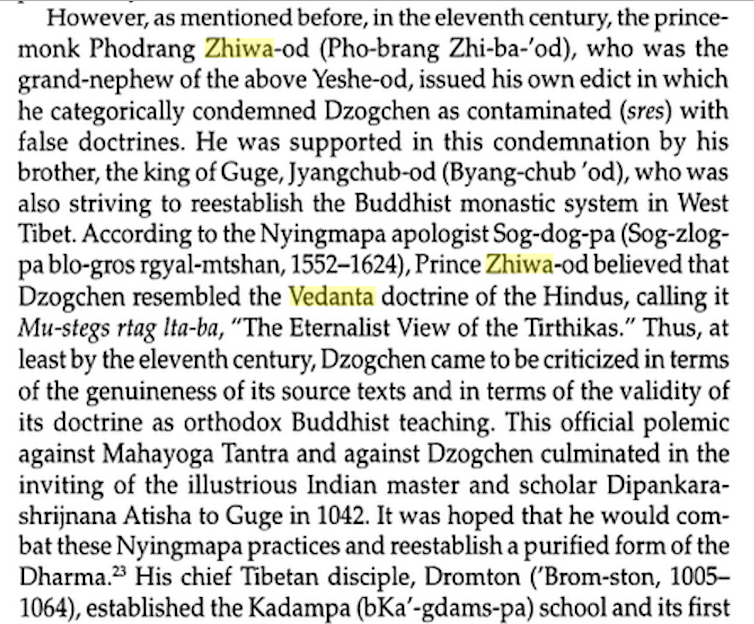
Podrang Zhiwa Ö & the Non-Indic Origins of Dzogchen (1090 AD)

**************************

Dzogchen Explorations

Okar Research

**************************

Podrang Zhiwa Ö, 1016-1111 AD

"Since the second propagation on the Buddist doctrine in Tibet, in which teachings of non-Indian origin were dismissed..."... (Kongtrul:1995..pg 28......Myriad Worlds: Buddhist Cosmology in Abhidharma, Kalachakra & Dzog-chen..... Jamgon Kongtrul Lodro Taye )

"....translator and royal monk,. lHa bla ma Zhi ba 'od (1016 – 1111) .....Lobsang Nyima Laurent, “Lha bla ma Zhi ba ‘od’s Eight Century Bronze from Gilgit”, Revue d’Etudes Tibétaines, no. 26, Avril 2013, pp. 195-214.......This paper is dedicated to the monks of Dangkhar, Heirs of the great translator and royal monk, lHa bla ma Zhi ba ’od (1016 – 1111)."....http://himalaya.socanth.cam.ac.uk/collections/journals/ret/pdf/ret_26_06.pdf

"... the early history of Dzogchen (rdzogs chen: “the great perfection”) remains unclear and the subject of controversy.......The Indic origin of the early Dzogchen texts was disputed by Podrang Zhiwa Ö, a Western Tibetan monk and ruler of the 11th century, and a proponent of the “new transmissions”. From that time on, the question of Dzogchen’s authenticity has been raised, usually by critics of the Nyingma tradition, the home of this and many other transmissions from the early period.".....http://earlytibet.com/2008/01/08/early-dzogchen-i/

"Buton's History of Buddhism in India and Its Spread to Tibet: A Treasury of ... By Butön Rinchen Drup; translated by Lisa Steinand, Ngawang Zangpo

"...The reading of the Tibetan inscription does not pose any problem. The name of Zhi ba ’od, and the title (Tib. lHa bla ma) associated with it, refers to a member of the royal family of the Guge-Purang Kingdom (Tib. Gu ge Pu hrang) in West Tibet. Although most of the biographical details of his life remain unknown, the main information regarding this charismatic figure of the later dissemination of Buddhism (Tib. bstan pa phyi dar) can be summed up as follows.....Born Yongs srong lde in the dragon year 1016, the third son of King lHa lde (r. 996 – 1023/4), and younger brother of Byang chub ’od (984 – 1078), he came to be known as Pho brang Zhi ba ’od when he received his full ordina- tion at the age of forty, in 1056. lHa bla ma Zhi ba ’od was a disciple of the notorious lo tsā ba Rin chen bzang po (958 – 1055) and eventually became the first translator of royal descent. He translated six major works, commis- sioned the translation of at least three other texts, and most certainly took part in the religious council held in Tholing (Tib. mTho lding) where he must have spent most of his life. As the religious centre of the kingdom, Tholing was the recipient of a variety of pious benefactions and constructions. Zhi ba ’od and his nephew King rTse lde, for instance, were responsible for the edification of the three-storey gSer khang which involved the commitment of more than two hundred master-artists and artisans. The temple was com- pleted within five years in 1071. Zhi ba ’od also bestowed the main temple of Tholing (Tib. dBu rtse) with clay statues representing the complete cycle of Sarvavid Vairocana (Tib. Kun rigs).29 Finally, lHa bla ma Zhi ba ’od is re- membered for his religious ordinance (Tib. bka’ shog) issued in 1092 in which he severely condemned apocryphal works, perverted tantras (Tib. sngags log), and called for the upholding of the bka’ gdams pa tradition.30 The demise of the royal monk and translator in the iron hare year 1111 marks the end of the later diffusion of Buddhism in West Tibet.....Page 204....Lha bla ma Zhi ba ‘od’s Bronze from Gilgit....http://himalaya.socanth.cam.ac.uk/collections/journals/ret/pdf/ret_26_06.pdf

Unearthing Bon Treasures: Life and Contested Legacy of a Tibetan Scripture ... By Dan Martin

The Mirror Illuminating the Royal Genealogies: Tibetan Buddhist ... By Bsod-Nams-Rgyal, Per K. Sørensen

Historical Dictionary of Tibet By John Powers, David Templeman

Click on the map to enlarge

"Purang-Guge kingdom was a small Western Himalayan kingdom which was founded and flourished in the 10th century. It covered parts of remote western Tibet and northern Ladakh....The original capital was at Burang (Wylie: spu hreng) but was moved to Tholing in the Sutlej canyon southwest of Mount Kailash. It was divided into smaller kingdoms around the year 1100 CE..... Tholing, at 12,400 feet (3,800 m), the last town before Tsaparang in the kingdom of Guge was then its capital, (163 miles from Darchen). It was founded by the great-grandson of Langdarma, who was assassinated, leading to the collapse of the Tibetan Empire....Buddhist monuments at both Tsaparang and Tholing are now mostly in ruins except for a few statues and scores of murals in good condition, painted in the western Tibetan style.....While Langdarma persecuted Buddhism in Tibet, his grandson, King Yeshe-Ö, who ruled the Guge Kingdom in the 10th century with Tholing as its capital, was responsible for the second revival or "second diffusion" of Buddhism in Tibet; the reign of the Guge Kingdom was known more for the revival of Buddhism than for its conquests. He built Tholing Monastery in his capital city in the 997 AD along with two other temples built around the same time, Tabo Monastery in the Spiti Valley of Northeast India and Khochar Monastery (south of Purang); both these monasteries are functional.".....Swenson, Karen (19 March 2000). "Echoes of a Fallen Kingdom".

Chorten of King Yeshe Ö (Tholing (Zhada)......in Tholing (Zanda), Zanda County, near the Indian border of Ladakh. It was built in 997 AD by Yeshe-Ö, the second King of the Guge Kingdom....The temple is reported to have been reconstructed after it had been demolished by the Chinese.

"Yeshe-Ö (c. 959 - 1040) (birth name, Khor-re; spiritual names: Jangchub Yeshe-Ö, Byang Chub Ye shes' Od, Lha Bla Ma, Hla Lama Yeshe O, Lalama Yixiwo, bKra shis mgon; also Dharmaraja, meaning Noble King) was the first notable lama-king in Tibet. Yeshe-Ö was a monk-king in western Tibet. Born Khor-re, he is better known as Lhachen Yeshe-Ö, his spiritual name. He was the second king in the succession of the kingdom of Guge in the southwestern Tibetan Plateau. The extent of the kingdom was roughly equivalent to the area of the kingdom Zhangzhung that had existed until the 7th century. Yeshe-Ö abdicated the throne c. 975 to become a lama. In classical Tibetan historiography, the restoration of an organized and monastic tradition of Tibetan Buddhism is attributed to Yeshe-Ö. He built Tholing Monastery in 997 when Tholing (Chinese: Zanda) was the capital of Guge. Yeshe-Ö' sponsored noviciates, including the great translator Rinchen Zangpo."......Powers, John; Templeman, David (18 May 2012). Historical Dictionary of Tibet. Scarecrow Press.

"Revival of Tibetan Buddhism.......The second dissemination of Tibetan Buddhism was brought about by Yeshe O, who was the king in the western part of Tibet. The lineage of lay Vajrayana practitioners still survived after the dark age of Tibetan Buddhism, though the monastic and scholarly forms were severely destroyed. Many influential rulers in western Tibet desired to re-establish the entire Tibetan Buddhism. They sponsored translators to India as well. Thus, the second period of transmission of Buddhism in Tibet is often called " the period of the new translations ".......In 1042, the king invited the renowned scholar, Atisha Dipankara Shrijnana (AD 979-1053). He set out a graduated path to enlightenment, known as Lam-rim, stipulated in his book " The Lamp of the Path to Enlightenment ". He also reformed the monastic disciplines, particularly the mentor-student relationship of Lamas and disciples. Being the master of the second transmission of Buddhism in Tibet, his works had a great impact on Tibetan Buddhism, not just in the royal family but also the society. He turned the warrior-like Tibetans to the Buddhists seeking for peace. With his effort, Buddhism was firmly established in Tibet......This period marked the development of major schools in Tibetan Buddhism, and distinguished between the old and the new transmission periods. More sutras were translated, more monasteries were built and more Buddhists entered Tibet on pilgrimages."......http://www.thranguhk.org/buddhism/en_buddhism.html

"Dzogchen and Advaita Vedanta.....David Paul Boaz.....http://davidpaulboaz.org/wordpress/unbounded-wholeness-dzogchen-and-advaita-vedanta-in-a-postmodern-world/

"Some leading Tibetan Lama scholars have accused Dzogchen of being a Chinese Dharma (rgya-nag gi chos), or assert that it is connected with Bon or Advaita Vedanta." ....http://vajranatha.com/teaching/DzogchenChinese.htm

The Golden Letters....Page 274.....By John Myrdhin Reynold

**************************

Email....okarresearch@gmail.com

John Hopkins.....Northern New Mexico….January 2015

**************************

Saturday, May 10, 2014

Shri Singha & the Kinnaur Valley (8th C.)

**************************

Click Here to View the Main Index

**************************

"Shri Singha (Sanskrit: Śrī Siṃha, Tibetan: ཤྲི་སིང་ཧ, Wylie: shri sing ha) was a principal disciple and dharma-son of Manjushrimitra in the Dzogchen lineage.

" Sri Simha, the Lion of Dzogchen.......Sri Simha, or Simhaprabha as he may have been known, was born in a noble family in the Cina Valley of northern India. He lived during the 8th century.......The location of the "Land of Cina" has been the cause of considerable confusion for both Tibetan historians and modern Western scholars, to the extent that even Dudjom Rinpoche's The Nyingma School of Tibetan Buddhism perpetuates the error of stating that Sri Simha came from China. Evans-Wentz, just as incorrectly, described Sri Simha as a Burmese guru. Dr. Hanson-Barber places Sri Simha in Central Asia, while Dowman has suggested that he was Khotanese. Tulku Thondup, author of Masters of Meditation and Miracles, describes Sri Simha birthplace as "a city called Shokyam on Sosha Island1 in China." None of these allocations are correct. To fully appreciate Sri Simha's background we must briefly digress into the geography of a mysterious seventh century Himalayan country called Suvarnadwipa and its southern neighbour, the Kinnaur Valley."......The Dharma Fellowship of His Holiness the 16th Karmapa, Rangjung Rigpe Dorje (1923-1981),

"Vajranatha (2007) contextualises Sri Singha in relation to the Nyingma, Manjushrimitra, Tantra, Brahman, Garab Dorje, Uddiyana, Vimalamitra, Samye and Yogachara:"....Vajranatha (2007). Dzogchen, Chinese Buddhism and the Universal Mind: Dzogchen and Chinese Buddhism.

"According to the Khandro Nyingthig tradition, it is also said that Shri Singha received teachings directly from Manjushrimitra's guru, the nirmanakaya buddha Garab Dorje. (Garab Dorje (dga' rab rdo rje), Skt. Surati Vajra, Prahevajra, Pramoda Vajra).....Garab Dorje means 'Indestructible joy.'"

"Shri Singha was the chief disciple and successor of Manjushrimitra in the lineage of the Dzogchen teachings. He was born in the Chinese city of Shokyam in Khotan and studied at first with the Chinese masters Hatibhala and Bhelakirti. In his Ocean of Wondrous Sayings, Guru Tashi Tobgyal adds that Shri Singha received a prophesy from Avalokiteshvara while traveling to Serling, telling him to go to the Sosaling charnel ground in order to be sure of the ultimate attainment. After many years Shri Singha met Manjushrimitra in the charnel ground of Sosaling, and remained with him for twenty-five years. Having transmitted all the oral instructions, the great master Manjushrimitra dissolved his bodily form into a mass of light. When Shri Singha cried out in despair and uttered songs of deep yearning, Manjushrimitra appeared again and bestowed him a tiny casket of precious substance. The casket contained his master's final words, a vital instruction named Gomnyam Drugpa, the Six Experiences of Meditation. Having received this transmission, Shri Singha reached ultimate confidence. In Bodhgaya he found the manuscripts of the tantras previously hidden by Manjushrimitra which he took to China where he classified the Instruction Section into four parts: the outer, inner, secret, and the innermost unexcelled sections. Among Shri Singha's disciples were four outstanding masters: Jnanasutra, Vimalamitra, Padmasambhava and the Tibetan translator Vairotsana." [RY: http://rywiki.tsadra.org/index.php/Shri_Singha ]

"According to the Nyingmapa tradition of Tibetan Buddhism, the Dzogchen masters Manjushrimitra and Shrisimha were already active in the Tantric milieu in India independently. However, Manushrimitra, a learned scholar of Brahman origin, was evidently an adherent of the Yogachara school before his becoming a disciple of the mysterious Prahevajra or Garab Dorje (dga'-rab rdo-rje) from the country of Uddiyana (Eastern Afghanistan). It should also be recalled that his disciple Shrisimha was said to have born and resided for some time in China (more likely Chinese Central Asia, or, more precisely, Burma, as Chogyal Namkhai Norbu told in a talk he had June 15, 2010) before coming to India. And that the latter's disciple Vimalamitra visited China (or Central Asia) before and after he came to Tibet and transmitted the Dzogchen teachings to his disciples at Samye Monastery."

"Śrī Siṃha conferred the Eighteen Dzogchen Tantras (Tibetan: rdzogs chen rgyud bco brgyad) upon Padmasambhava. The eighteen are The Penetrating Sound Tantra (Tibetan: sgra thal ‘gyur), to which was appended the Seventeen Tantas of Innermost Luminosity (Tibetan: yang gsang 'od gsal gyi rgyud bcu bdun).......

"The Reverberation of Sound, or Drataljur (Tibetan: སྒྲ་ཐལ་འགྱུར, Wylie: sgra thal 'gyur), is the root tantra of the Seventeen Tantras of the Upadesha-varga......These Seventeen Tantras are to be found in the Canon of the Ancient School, the 'Nyingma Gyubum' ....'Reverberation of Sound', 'Direct Consequence of Sound Tantra', 'Penetration of Sound', 'Interpenetrating Vibration', 'Transcendental Sound', (Tibetan: སྒྲ་ཐལ་འགྱུར, Wylie: sgra thal 'gyur).

"Kunsang (2006: p.334) in rendering the continued instructions of Sri Singha to Padmasambhava makes reference to nirmanakaya, sambhogakaya and dharmakaya and outlines:...'there are the three sections of the philosophical vehicles belonging to nirmanakaya, the three sections of Kriya and Yoga belonging to sam-bhogakaya, and the three aspects of development, completion and the Great Perfection belonging to dharmakaya. Among these, I shall explain to you the Ati Yoga of Instructions, distilling its quintessence, which is the Innermost Vajra Essence of the Unexcelled Fruition. So listen, Padmasambhava.".....Kunsang, Erik Pema (2006). Wellsprings of the Great Perfection: The Lives And Insights of the Early Masters.

"The Pith Instructions of Dzogchen consist of esoteric scriptures written down by Pramodavajra, the guru of Manjusrimitra. Thus the lineage of Dzogchen-holders is said to descend from Pramodavajra (Tib: Garab Dorje), to Manjusrimitra (Tib: Jampel She-nyen), to Sri Simha (Tib: Pel gi Sengge), and then to Sri Simha's two disciples, Jnanasutra and Vimalamitra. The latter introduced the tradition into Tibet in the time of the Sage-King Tri-srong Detsen, who reigned from circa 755 to 797 AD.".....http://www.dharmafellowship.org

"Sri Simha divided the Pith Instruction into four sub-sections, and these are known as the Exoteric Cycle, the Esoteric Cycle, the Secret Cycle, and the Supreme Secret Cycle. Before his own death he deposited copies of the first three cycles in a rock cut crypt beneath the Bodhivriksha Temple of Sugnam (Sokyam) in the land of Cina. The texts of the Supreme Secret Cycle, however, he hid separately within the pillar of the "Gate of a Myriad Blessings". It is difficult, however, to clarify as to where these places in the Kinnaur Valley may have actually been.".....http://www.dharmafellowship.org

"The Shri Singha Monastic University, founded by Gyalse Shenpen Thaye, is a Nyingmapa university in Eastern Tibet. In the tradition, it is held that a manifestation of Sri Singha marked the spot for the location of the university, hence its name. Do Khyentse Yeshe Dorje consecrated the site laying the 'foundation stone' with his phurba."

"At the age of fourteen Simha, began the classical study of grammer, logic, art, medicine and law under the direction of a great scholar, Acarya Haribhala of the Bodhivriksha Monastery in Cina. Then at the age of 18, he went north into Suvarnadwipa to be enrolled in a collage of higher religious education..... in Suvarnadwipa he received the novice vows of a Buddhist monk and began to study scripture and philosophy. At the Five Peaked Mountain4 in Suvarnadwipa he also studied all the exoteric and esoteric Tantras under the low caste Master Bhelakirti......At Soshadwipa, to the west of Bodh Gaya in India, Sri Simha met the master Manjusrimitra and was initiated into the teachings of Dzogchen. ....It is also said that Sri Simha went to Bodh Gaya and extracted from the library of the Diamond-throne Monastery the Pith Instruction (Skt: upadesa, Tib.: men-ngak-de) of the Dzogchen Tradition that Manjusrimitra had previously deposited there......Sri Simha then took the Dzogchen teachings back with him to his home town in the Cina Valley and there he settled more or less for the rest of his life, becoming a famous teacher.".....http://www.dharmafellowship.org

Manjushrimitra, Jampal Shenyen An Indian master in the Dzogchen lineage and the chief disciple of Garab Dorje.

Śrī Siṃha ('Revered Lion') = Pra-pata.

Shri Singha.....Shri Singha......ཤྲི་སིང་ཧ།..........shri sing ha

"Sosaling Charnel Ground: An indian charnel ground where many great masters and siddhas practiced.

"Most Tibetan scholars assume that the land of Li is Khotan, thousand of miles distant in Central Asia, since "Li" became the common Tibetan name for Khotan. But we know that in earlier times the Tibetan name "Li" referred to Nepal, and it is much more likely that Nepal is the place where Sri Simha would have traveled, since the latter is not such a great distance from Kinnaur, in the same Himalayan chain of mountains. What is more, the biography of the yogi-master Vajra-Humkara informs us that he met and became a student of Sri Simha in a forest grove in Nepal. Sri Simha eventually died in that land. We also know that the master Padmasambhava, who later was to enter Tibet via Nepal, was a disciple of Sri Simha.".....Dharma Fellowship (2009). Biographies: Sri Simha, the Lion of Dzogchen.

Vimalamitra's Great History of the Heart Essence, translated in Erik Pema Kunsang (translator) : Wellsprings of the Great Perfection. Rangjung Yeshe Publications, Hong Kong, 2006

The Lotus-born: The Life Story of Padmasambhava.......By Yeshe Tsogyal

**************************

Tuesday, May 6, 2014

Terms ... Dzogchen

**************************

Click Here to View the Main Index

**************************

KA

ka-ti - a crystalline translucent nerve or channel connecting the heart with the eyes

ka-dag - primordial purity, primordially pure

ka-dag chen-po - the Great Primordial Purity, a state of total primordial purity

ka-dag gi lam - the path of primordial purity

ka-dag rig-pa shes-rab rang-byung gi sgron-ma - the lamp of self-originated discriminating wisdom which is primordially pure awareness

ka nas dag-pa - primordial purity, pure from the very beginning 

kun-khyab all-pervading

kun-mkhyen - omniscient, all-knowing

kun tu snang-ba'i ting-nge-' dzin - the samadhi or state of contemplation which illuminates everything

Kun tu bzang-po - Samantabhadra (name of the Primordial Buddha) 

Kuntu bzang-mo Samantabhadri (name of the Primordial Wisdom) 

kun brtag ma rig-pa - the ignorance which conceptualizes everything

Kun-byed rgyal-po - the king who creates everything

kun-rdzob - relative

kun-rdzob bden-pa - Relative Truth

kun-gzhi - the basis of everything, alaya

kun-gzhi rnam-shes - the store consciousness, alaya-vijñana

kun-bzang dgongs-pa - the Primordial State of Samantabhadra

klong - vast expanse, vast expanse of space

klong-chen - the great vast expanse

klong-sde Longde - the Space Series (a series of texts and teachings of Dzogchen)

dkar 'jam rtsa'i sgron-ma - the lamp of the smooth white nerve 

dkar-po chig-thub - 1. panacea, the white panacea; 2. the Mahamudra teaching

bka' - precept, word, command, vacana

bka'-ma - tradition, continuous tradition (an oral tradition whose transmis¬sion has not been interrupted and is continuous)

rkyen - secondary cause, secondary condition, pratyaya

sku - Body, kaya

sku gsum - Trikaya, the 3 Bodies of the Buddha

sku gsung thugs - Body, Speech, and Mind

skye 'gags med-pa - uncreated and unceasing

skye med - uncreated, not produced, unborn

bskyed rdzogs - the generation process and the perfection process

bskyed rdzogs zung-'jug - unification of the generation process and the perfection process

bskyed-rim - generation process, steps of production, development stage, visualization process, utpattikrama

'khor-ba - Samsara, cyclical existence

'khor-Io - 1. wheel, circle, cycle; 2. chakra, psychic center (a center of psychic energy in the body)

'khor-lo bsgyur-pa'i rgyal-P - Universal Monarch, Chakravartin, a wheel¬ turning universal emperor, cakravarti-riija

'khrul rtog - delusory thoughts, deluded thoughts

'khrul rtog gi rba-dabs 'tshub-pa - turbulent waves of deluded thoughts 

'khrul snang - delusory appearances

'khrul-pa - delusion, deluded, delusory, bhriinti

'khrul-pa'i las rgyun mi chod-pa - not interrupt the current of the delusory activities of the mind

'khrul 'byams - ordinary profusion of deluded thoughts

'khru l'byams tha-mal du shor-ba - fall into the ordinary profusion of de¬luded thoughts

'khrul med - without delusion

'khruI gzhi - the basis of delusion 'khrullam the path of delusion

KHA

khyad-chos - special teaching

khrid - explanation, guiding explanation

khrid-yig - explanatory text (a manual which gives an explanation of the meditation practice)

khregs-chod / Thekchod - releasing tensions, cutting through rigidity (a special teaching of the Dzogchen Upadesha Series)

mkha' - sky, space

mkha'-'gro-ma / Dakini (a manifestation of energy in female form) 

mkhas-pa - wise, learned

mkhyen-pa - wisdom, knowledge; to know

'khor ' das - Samsara and Nirvana

'khor'das m-shan phye-ba - distinguishing between Samsara and Nirvana

grol gzhi - the basis of liberation

grol gzhi'i ye-shes ngos ' dzin - recognizing the knowledge (or gnosis) which is the basis of liberation

grol lam - the path of liberation

grol lugs - modes of liberation

grol lugs bzhi - the 4 modes of liberation

grol sa - the state of liberation

grol sa gcig-pu - unique state of liberation

grol sa gcig~po yin-par" ngo-sh~s - recognize to be the unique state of liberation

glo-bur - adventitious, accidental

glo-bur ma dag-pa - adventitious impurities

dgag sgrub med-pa - neither stopping nor creating (thoughts)

dgongs brgyud - direct transmission, Mind Lineage

dgong sgter - Mind Treasure

dgongs-pa - 1. Primordial State, Mind; 2. intention

dgra-bcOIfi-pa - Arhat, perfect saint

‘gags-med - unobstructed, without obstruction

‘ gyu-ba - movement of thought; to move

‘grel-pa - commentary

'gro sa med - (thoughts) do not go anywhere

rgod-pa - agitation, agitated

rgyang zhags chu'i sgron-ma - the lamp of the water (globelike) eye which lassos everything at a distance

rgyan - ornament (Le., thoughts and appearances are the ornaments of the mind)

rgyal-po - king

rgyal-ba - Jina, the Victorious One (syn. Buddha)

rgyal-ba dgongs brgyud - the direct mind-to-mind transmission of the Jinas rgyal-ba rigs lnga 

rgyal-sras / Jinaputra, son of the Victorious One (syn. Bodhisattva)

rgyal-sras kyi spyod-pa - Bodhisattva conduct, conduct or behavior of a Jinaputra

rgyu - cause, primary cause, hetu

rgyu'i ting-nge-'dzin - causal samadhi, causal contemplation, hetu-samadhi

rgyu'i theg-pa / Hetuyana - the Causal Vehicle

rgyud - 1.Tantra; 2. mind-stream

rgyud-sde - the Tantra Section 

rgyud smin - ripen the stream of consciousness

sgom-pa,bsgom-pa - meditation; to meditate, bhiivanii,

sgom-pa nyams su len-pa tshul - method of practicing meditation 

sgom-pa'i shes-rab - discriminating wisdom arising in meditation

sgom byung gi shes-rab - wisdom which comes forth in meditation 

sgom lam - path of meditation development, bhiivanii-miirga

sgyu-ma - illusion, miiyii

sgyu-lus, sgyu-ma'i lus - illusion body, maya-deha

sgyur-ba - transformation; to transform

sgyur lam - the path of transformation

sgra 'od zer - sounds, lights, and rays

sgrib-pa - obscuration

sgrib-pa gnyis - the 2 obscurations (emotional and intellectual)

sgrub brgyud - Lineage of the Siddhas

sgrub-thabs / sadhana - process of realization

sgrub-sde - the Sadhana Section (of Mahayoga)

sgrub-pa-po - sadhaka, practitioner of sadhana

sgro-' dogs - doubts

sgron-ma drug - the 6 lamps (aspects of light in Thodgal)

sgrol ba - 1. to liberate, to deliver; 2. rites of deliverance, magical rituals employed to slay other beings

brgyud-pa - transmission, lineage, paramparii

brgyud-pa'i bla-ma - Lineage Gurus, masters of the lineage of transmission 

bsgom-pa chen-po - the great meditation, state of total meditation 

bsgom-med - nonmeditation, without meditating

NGA

ngang - state, condition

ngang bskyangs - continuing in the state 

ngang chen-po - the great state, total state 

ngang dwangs - lucid state, luminous state

ngang bzhag chu-bo'i rgyun gyi sgom-pa - remain in a state where meditation is like the continuous flow of a river

ngang la bzhag-pa - remain in the state 

ngan sngags - evil mantras

ngan-song - evil destinies of rebirth, durgati

nges-don - real meaning, ultimate meaning, definitive meaning, 

ngo-sprad-pa - directly introduced

ngo-sprod-pa - introduction, direct introduction; to introduce

ngo-'phrad-pa - to be introduced to

ngo-bo - essence, svabhiiva

ngo-bo gcig - unique essence

ngo-shes-pa - recognition; to recognize

ngos ' dzin-pa - to recognize

ngos bzung - recognize

dngos-grub / siddhi - attainments

dngos-po - entity, a concrete thing

dngos-gzhi - principal practice, principal section

mngon-' gyur - become manifest

mngon-shes - clairvoyance, clairvoyant power, abhijftii

mngon-shes drug - the 6 clairvoyant powers

mngon-sum - 1. manifest, evident to the senses 2. perception, pratyaya

mngon-sum rjen-pa'i ye-shes - naked manifest primal awareness 

snga-'gyur - Early Translation

snga dar - the earlier spreading of the Dharma in Tibet

sngags - mantra, incantation, magic spell

sngags mying-ma - the Old Tantras

sngags nang-pa - the Inner Tantras, the Higher Tantras

sngags-pa - Tantrika, Ngagpa, a practitioner of the Mantras 

snags-lugs - theTantra system, mantranaya

sngar ' dris kyi ye-shes - a knowledge met with previously

sngon-'gro - preliminaries, preliminary practice, preliminary section

CA

cig-ear, cig-char - instantaneous, immediate

cig-car 'jug-pa - entering instantaneously

cig-car-ba – non-gradualist

cir snang rang yin - one's own state of existence manifesting everywhere 

cog-bzhag bzhi - the 4 modes of just being there

gcig - one, single, unique, single state, singularity, eka

gcig grol - liberated into a single state

gcig thag-bcad-pa - discover one single state

gcig-pu, gcig-po - single, unique

gcig shes kun grol - knowing one thing, everything is liberated

gcer grol - liberation through bare attention

gcer mthong - seeing nakedly

bca'-ba - to continue

bcos med - unfabricated, unmodified, uncorrected

bcos slad med-pa - not modified or adulterated

CHA

chad lta-ba - the view of nihilism, ucchedaviida

chen-po - great, total

chös kyi bdag-med - the insubstantiality of phenomena

chös-sku – Dharmakaya in Vajrayana

Bön-sku – Dharmakaya in Bön

chös-sku rgyal-po'i rtsal - the creative potentiality of the king who is the Dharmakaya (syn. rig-pa'i rtsal)

Bön-sku gcig-po'i yo-langs bskyang - continuing in the unique state of the Dharma-kaya

Bön-sku'i klong du dag-pa - purified into the vast expanse of the Dharmakaya

Bön-sku'i lta-ba - the view of the Dharmakaya

Bön-sku'i yo-Iangs the state (or nature) of the Dharmakaya

chös-nyid - Dharmata, Reality 

chös-nyid kyi rang ngo skyong-ba - continuing in the inherent state of Reality

chös-nyid mngon-sum kyi snang-ba - the vision of the direct perception of Reality

chös-nyid bar-do - the Bardo of Reality

chös-nyid zad-pa'i snang-ba - the vision of the consummation of Reality 

chös rnams dharmas - phenomena

chös-dbyings / Dharmadhatu - the dimension of all existence

chös lugs - an organized system of phenomena, religion

chös log - wrong teaching, perverted teaching

mchan - note

mchöd-brjod - verse of offering

'char tshul - manner of arising, how it arises

'char lugs - mode of arising

'chi-kha'i bar-do - the Bardo of Dying

JA

ji snyed-pa mkhyen-pa'i ye-shes - the Knowledge of Quantity, the knowledge which knows the quantity of all phenomena

ji lta-ba bzhin - the state of being just as it is

ji lta-ba gzigs-pa'i ye-shes - the Knowledge of Quality, the knowledge which sees the state just as it is

ji bzhin nyid - the state of being just as it is

ji bzhin-pa - the state of being just as it is

ji bzhin-par bzhugs-pa - remaining in the state of being just as it is

'ja'-Ius - the Rainbow Body

'ja'-lus 'pho-ba chen-po - the Rainbow Body of the Great Transfer

'jur dran - coarse memories

rjes - concluding section

rjes thob - subsequent realization, postmeditation experience, pristhalabdha

rjes med - without leaving a trace behind

rjes med rang dag - self-purified without leaving a trace

rjes su rnal-'byor - Anuyoga

rjes su rnal-'byor gyi theg-pa - Anuyogayana, the Vehicle of the Anuyoga Tantra

brjod-med - inexpressible (in words)

brjod med kyi rig-pa zang-thal - an indescribable directly penetrating awareness

NYA

nyams - experience, meditation experience, mystical experience

nyams gong 'phel kyi snang-ba - the vision of the development of experiences (in vision)

nyams-myong - experience; to experience

nyams zhen - attachment to experiences

nyams-len - practice; to practice

nyams su len-pa - to practice

nyams gsum - the 3 meditation experiences (of bliss, clarity, and no thought)

nyon-mongs-pa - passion, negative emotion, klesha

nyon-mongs-pa'i sgrib-pa - obscuration due to the passions 

nyon-mongs-pa'i dung klda-viiyu - passion winds, winds (or psychic energies) defiled by the passions

gnyis-med – non-dual, without duality, advaya

gnyis-'dzin - grasping at duality

gnyis-'dzin kyi 'ching-ba las 'grol-ba - liberated from bondage to dualistic thinking 

gnyen-po - antidote, pratipaksa

gnyug-ma - natural, innate, ntija

gnyug-ma'i rnal-'byor - natural yoga, natural practice

mnyam rjes - contemplation and subsequent realization

mnyam rjes kyi nyams-len - the practice of contemplation and subsequent realization

mnyam-nyid, mnyam-pa nyid - the state of identity, sameness, samatii

mnyam-bzhag - the state of even contemplation, samiihita

rnying-ma-pa Nyingmapa - the Old Tantra school

snyan brgyud - oral transmission, oral lineage, oral tradition

snying gi bu - heart-son, chief disciple

snying-gtam - heartfelt advice

snying-thig Nyingthig - the Essence of the Mind (syn. the Dzogchen Upadesha teachings)

snying-thig rdo-rje snying-po'i lam - the path of the adamantine heart of the Essence of the Mind (syn. the Dzogchen Upadesha teachings) 

snying-thig-pa - a practitioner of the Nyingthig teachings 

snying-po - 1. heart, hrdaya; 2. embryo, garbha; 3. essence, sara; 4. mind, citta

TA

ting-nge-'dzin - contemplation, the state of contemplation, samadhi 

ting-nge-'dzin chen-po - a state of total contemplation, the great contemplation, maha-samadhi

gtad-pa - fixation; to fixate the mind on 

gtad-so - concept, conception

gtad-so dang bral-ba - free of conceptions

gtad-tshigs - conclusion, criteria, reasoning

gtan la 'bebs-pa - to systematize, to set down systematically

gter-ston Terton - Treasure Master, a discoverer of hidden treasure texts 

---------

gter-ma - Terma, hidden treasure text

kha byang - entrance certificate (Aris), general (prophetic) guide (Thondup), preliminary treasure guide (Doctor)

khrom gter - crowd treasure (Aris), publicly discovered terma (Thondup)

mkha’ ‘gro brda yig - dakini script

dgongs gter - mind terma

nying byang - innermost prophetic guide (Thondup)

gter grogs - terma companion, consort

gter sgrub - preparatory practices (Thondup)

gter sgrom - treasure casket

gter ston - treasure revealer

gter tshab - substitute for terma

gter rdzas - terma objects

gter lung - prophetic terma text (Thondup)

gter srung - terma protectors

them byang - (also thems byang, them yig, or thems yig) registry, inventory list

dag snang - pure vision

byang bu - preceding prophetic inventory (Doctor)

yang gter - rediscovered terma

yang byang - inner prophetic guide (Thondup)

shog ser - yellow scrolls

sa gter - earth terma

gsang gter - secretly discovered terma (Thondup)

---------

btag-grol - liberation through wearing

rtag lta-ba - the view of eternalism, Shashvatavada

rtags - sign, indication

rtog-pa - thought, discursive thought; to think

rtogs-pa - understanding; to understand

Ita sgom du ro-gcig - a single taste as to view and meditation

Ita sgom spyod - view, meditation, and conduct

Ita sgom spyod 'bras-bu - view, meditation, conduct, and fruit

lta-ba - view, way of seeing, dristi; to see

stong-cha - on the side of emptiness

stong-nyid kyi gshis - the innate disposition which is emptiness

stong-nyid snying-rje zung-'jug - the unification of emptiness and compassion

stong-pa - empty, shunya

stong-pa nyid - emptiness, shunyata

brtag-pa - examination, vitarka; to examine, to investigate

brtan-pa thob - attain stability

bstan-bcos - philosophical treatise, treatise, sastra 

bstan-pa - teaching, doctrine, shasana; taught, reveal[/size][/color][/size]

THA

tha-dad med-pa - no difference, no distinction

thag-bcad-pa - to decide definitively, to determine decisively, to decide 

thabs- Means, Skillful Means, method, upaya

thig-le - sphere, tiny sphere, essence, bindu

thig-le chen-po - the Great Sphere, fotal sphere, mahabindu

thig-le nyag-gcig - the Unique Sphere, unique essence

thig-le stong-pa'i sgron-ma - the lamp of the empty spheres

thugs - Mind, Heart, citta

thugs-rje - 1. Energy; 2. compassion, karuna

thugs sras - heart-son, principal disciple

thun - session, meditation session

thun dang thun-mtshams - sessions and between sessions

the-tshom med - without doubts, not remaining in doubt

theg-pa - vehicle, way, yana

theg-pa dgu - the 9 vehicles

theg-pa chen-po - Mahayana, the Great Vehicle

theg-pa thams-cad kyi rtse rgyal - the victorious mountain peak of all the vehicles (to enlightenmenth(i.e., Dzogchen)

theg-pa dman-pa / Hinayana - the Lesser Vehicle

theg-pa rim dgu - the 9 successive vehicles to enlightenment

theg-pa rim dgu'irtse-bo - the pinnacle of the 9 successive vehicles 

theg-pa'i yang rtse - highest peak of all vehicles

thog-ma'i sangs-rgyas - the Primordial Buddha

thod-rgal / Thodgal - passing over the summit (the development of vision practice in the Dzogchen Upadesha)

thol byung blo rdeg - suddenly strike a thought

thos-pa'i shes-rab - discriminating wisdom arising from hearing (the teachings)

mtha' - limit, limitation, extreme, end, anta

mtha' grol - liberated from all limitations

mtha' med - unlimited, without limitation 

mtha' las 'das-pa - transcending limitations 

mthar snang - final visions

mthong lam - the path of vision, darsana-marga

DA

dag snang - pure vision

dang-po-pa - beginner

dad-pa - faith

dwangs - luster, brightness; clear, pure

dam-bca' - author's promise, the author's statement of purpose to his readers

dam-tshig sems-dpa' - symbolic being, samayasattva

dur-khrod - cremation ground

de kho na nyid - Tathata, Reality, the state of being just as it is, suchness 

de kho na nyid ting-nge-'dzin - the contemplation of Reality

de bzhin nyid - Tathata, Reality, the state of being just as it is

de bzhin gshegs-pa'i snying-po - Tathagatagarbha, inherent Buddha-nature

don - meaning, real meaning, benefit, purpose, artha

don gyi lta-ba - real view

don gyi ye-shes - real knowledge

don gcig las ma 'das-pa - not go beyond the single meaning

drag sngags - fierce mantras

drang don - conventional meaning, neyiirtha

dri-med - immaculate

gdangs - translucency, translucent

gdams-ngag - instruction

gdeng, gdengs - confidence

gdod nas dag-pa - primordially pure

gdod-ma - primordial

gdod-ma'i mgon-po - Adinatha (syn. the Primordial Buddha) 

gdod-ma'i mal-'byor - the Primordial Yoga (syn. Dzogchen)

gdod-ma'i gzhi - the Primordial Base

bdag-nyid chen-po - the Great State, the great self (syn. Dzogchen, the Primordial State)

bdag-med - without a self, insubstantial, Anatman

bdag-'dzin - grasping at a self, grasping at the reality of, atarma-graha

bde-ba - pleasurable sensation, happiness, bliss, sukha

bde-ba chen-po / Mahasukha - the Great Bliss

bde-ba'i nyams - experience of pleasurable sensation

bde-bar gshegs-pa / Sugata - (syn. Tathagata, Buddha)

bden-pa gnyis - the 2 Truths (absolute and relative)

bden-pa mthong-ba - seeing the truth

bdud - Mara, demon

mdangs - luster, brightness, bright complexion

mdo - Sutra, a discourse of the Buddha

mdo-sde spyod-pa'i dbu-ma - Sautrantika-Madhyamika 

mdo-lugs - Sutra system

'das -rjes - posthumous teachings

'du-byed samskaras - impulses, karmic formations

'du-byed kyi las - activities of the samskaras

'dul-ba Vinaya - monastic discipline, monastic ordinances

'dren-pa'ibla-ma - Guru who gives guidance

rdo-rje vajra - diamond; adamantine, diamondlike

rdo-rje theg-pa - Vajrayana

rdo-rje zam-pa - the Vajra Bridge teachings (of Dzogchen Longde)

rdo-rje gdan Vajrasana - (modern Bodh Gaya), the diamond throne of enlightenment

brda - sign, symbol

brda brgyud - symbolic transmission, the Lineage of the Mystic Signs (of the Vidya-dharas)

brda bzhi - the 4 Signs (in Dzogchen Longde practice)

bdag-nyid chen-po - the Great State, the great self (syn. Dzogchen, the Primordial State)

bdag-med - without a self, insubstantial, Anatman

bdag-'dzin - grasping at a self, grasping at the reality of, iitmagraha 

bde-ba - pleasurable sensation, happiness, bliss, sukha

bde-ba chen-po - Mahasukha, the Great Bliss

bde-ba'i nyams - experience of pleasurable sensation

bde-bar gshegs-pa - Sugata (syn. Tathagata, Buddha)

bden-pa gnyis - the 2 Truths (absolute and relative)

bden-pa mthong-ba - seeing the truth

bdud - Mara, demon

mdangs - luster, brightness, bright complexion

mdo - Sutra, a discourse of the Buddha

mdo-sde spyod-pa'i dbu-ma - Sautrantika-Madhyamika 

mdo-Iugs - Sutra system

'das -rjes - posthumous teachings

'du-byed - samskaras, impulses, karmic formations

'du-byed kyi las - activities of the samskaras

'dul-ba - Vinaya, monastic discipline, monastic ordinances

'dren-pa'ibla-ma - Guru who gives guidance

rdo-tje vajra - diamond; adamantine, diamondlike

rdo-rje theg-pa - Vajrayana

rdo-rje zam-pa - the Vajra Bridge teachings (of Dzogchen Longde)

rdo-rje slob-dpon - Vajracharya

rdo-rje gdan Vajrasana - (modern Bodh Gaya), the diamond throne of enlightenment

brda - sign, symbol

brda brgyud - symbolic transmission, the Lineage of the Mystic Signs (of the Vidya-dharas)

brda bzhi - the 4 Signs (in Dzogchen Longde practice)

Na

Nang – internal, inner, inner aspect

nang gi bla-ma - the internal Guru

nang rgyud - Inner Tantras

nang rtog - internal thoughts

nang dbyings - inner space, internal space, the internal dimension

nang 'od - inner light, internal light

nang gsal - inner luminosity, internal luminosity

nam-mkha' - sky, space, the space element, akasha

gnad - essential point

gnad gcig-po - single essential point

gnad du brdeg-pa - strike the essential point

gnad don - the real meaning of the essential point

gnad ma nor-ba - unmistaken essential point

gnad gsum ldan-pa'i lta-ba - the view which possesses the 3 essential points

gnas-pa - calm state; to abide, to be established

gnas 'phro - still or diffusing

gnas-tshul - mode of being

gnas-lugs - Natural State, natural condition

gnas-lugs ji lta-ba gzigs-pa'i ye-shes - the Knowledge of Quality, the knowledge which sees the Natural State just as it is

gnas sa med - (thoughts) do not remain anywhere

ma brgyud - oral transmission

mam-rtog - thought, discursive thought, vikalpa

mam 'rtog grol - liberate discursive thoughts

rnam-rtog ngo shes-pa - recognize discursive thoughts

mam-rtog med-pa - without discursive thoughts

mam-par rtog-pa - discursive thought, vikalpa

mam-par mi rtog-pa -without discursive thoughts, nirvikalpa 

mam-par shes-pa - consciousness, vijñana

mam-shes - consciousness, vijñana

rnal-'byor - yoga, union

mal-'byor gyi rgyud - Yoga Tantra

rnal-'byor gyi rgyud gyi theg-pa – Yoga-tantra-yana

mal-'byor chen-po -Mahayoga

mal-'byor chen-po'i rgyud kyi theg-pa – Maha-yoga-tantra-yana

rnal-'byor-pa Yogin - practitioner

rnal-'byor spyod-pa - Yogachara, Yogacharin

rnal-'byor spyod-pa'i dbu-ma - Yogachara-Madhyamika

rnal-'byor-ma - Yogini

rnal-'byor bzhi - the 4 Yogas (stages in Dzogchen Semde practice) 

rnal-'byor lam - the Path of the Yogins, the Path of the Yogins

rnal-bzhag chen-po - totally settled into the natural state, the great self-settled natural state

sna-tshogs - diversity, different kinds

sna-tshogs rdo-rje - a double vajra, vishva-yajra

snang 'char tshul - the way in which appearances arise

snang stong dbyer-med - the inseparability of appearance and emptiness

snang-ba - appearance, manifestation, vision; to appear, to manifest, to be visible 

snang-ba bzhi - the 4 Visions (in Thodgal practice)

snang-srid - all phenomenal existence, all that appears and that exists

PA 

dpal - glorious, abundant, shri

dpe - example, metaphor

dpe’i ye-shes - knowledge indicated by example 

dpyad-pa - analyzed, reason

dpyod-pa - analysis; to analyze, to investigate, vicara

spang blang med-pa - without attachment or aversion

spong lam - the path of renunciation

spyan lnga - the 5 eyes

spyi 'byams - irregular habits

spyi'byams gshis shor - falling away from one's innate disposition due to irregular habits

spyi mes chen-po - the great universal Ancestor

spyi gzhi - the universal Base

sPyod-pa - conduct, behaviour, action, carya

sPyod-pa'i rgyud - Charya Tantra

sPyod-pa'i rgyud kyi theg-pa – Charya-tantra-yana

sPyod-yul - sphere of action, the range of the activities of the senses

sprul-sku - Nirmanakaya

sprul-pa - Nirmita, emanation

sprospa - elaboration, multifarious activity, prapañca 

spros-med - without (conceptual) elaborations, aprapañca 

spros bral free of conceptual elaborations

PHA

pha-rol tu phyin-pa - perfection, paramita

pha-rol tu phyin-pa drug - the 6 perfections, the 6 paramitas

phun-sum tshogs-pa - supreme, abundant

phyag-rgya - mudra, symbol, symbolic form, gesture, consort 

phyag-rgya chen-po - Mahamudra, the Great symbol 

phyag-chen - Mahamudra, the Great Symbol

phyam gnas - even-minded

phyam gnas lhod-de – evenly minded and relaxed

phyam lhod - equanimity and relaxation

phyal-ba - omnipresent, common.

phyi - external, outer, outer aspect

phyi rgyud - Outer Tantras

phyi dar - the later spreading of the Dharma

phyi snang - external appearances

phyi dbyings - external space, the external dimension 

phyi'i bla-ma - the external Guru

'phags yul - Aryadesha, India

'pho-ba - the transference of consciousness; to transfer

'pho-ba chen-po - the Great Transfer

'phrul-ba - to emanate

'phro-ba - to emanate, to project, to diffuse, to proliferate

BA

bag-chags - karmic traces, karmic residues, unconscious propensities, viisanii 

བར་དོ bar-do - Bardo, the intermediate state between death and rebirth, antariibhava 

The 4 Bardos (bar do bzhi)

1) rang bzhin skye ba'i bar do - The natural bardo of this life

2) 'chi kha gnad gcod kyi bar do - The painful bardo of dying

3) chos nyid 'od gsal gyi bar do - The luminous bardo of dharmata

4) srid pa las kyi bar do - The karmic bardo of becoming

The 6 Bardos - Bar do drug

The 4 Bardos above with the addition of:

5) bsam gtan gyi bar do - The bardo of meditation

6) rmi lam gyi bar do - The bardo of dreaming.

dkar cha - white essence

dkar lam - whiteness experience

skye gnas - birthplace

mngal sgo - door of the womb

nyer thob - near attainment

thim rim - stages of dissolution

nag lam - blackness experience

nang rtags - inner sign

snang mched thob gsum - appearance, increase and attainment

phyi rtags - outer sign

'pho ba - transference of consciousness

bar do - intermediate state, transition, 'between'

dmar cha - red essence

dmar lam - redness experience

srog 'dzin rlung - life-supporting wind

---------

bu'i 'od gsaI - the Son Clear Light

bya-ba'irgyud - Kriya Tantra

bya-ba'I’rgyud kyi theg-pa – Kriya-tantra-yana

bya bral - free of any deliberate action

byang-chub - enlightenment, Bodhi

བྱང་ཆུབ་ཀྱ་སེམས byang-chub kyi sems - Bodhichitta, enlightened mind, the Thought of Enlightenment

It exists in Dzogchen too. 

In Semde (Sems sde) texts, Bodhicitta is a term that is synonym with Dzogchen itself or with Rigpa. In this respect, it has to be taken literally. The tibetan expression for bodhicitta is Byang chub sems, in which byang means pure, chub means perfect and sems means mind. In this perspective, this "Pure and Perfect Mind" is a little different from the relative and effective bodhicittas. In the early Semde texts, this Mind is considered as the “Quintessence of the Primordial Base” (ye gzhi snying po), i.e. the primordial state of the individual. In other words, what is designated as Great Perfection is nothing other than this state, than this Pure and Perfect Mind. There are seven « qualities » or specificities associated with this state which is:

1. free of subjectivity,
2. spontaneously accomplished,
3. Self-Arisen Wisdom,
4. without action or effort,
5. Great Bliss,
6. non-dual, and
7. free from elaborations.

This is a standard approach that you can find in Semde texts in the Nyingma and Bon traditions.....

In one of the Commentaries to the Gabpa Gukor (which is the root Dzogchen text of the whole Bönpo tradition), this state is designated as « the King of Awareness, of our own consciousness, in other words : as the Universal Base, the Pure and Perfect Mind which is Great Bliss, transcends all example liable to illustrate it, stands beyond any kind of suffering and appears in a manifest way instantaneously. » 

Pure (byang) and Perfect (chub) Mind (sems)......
It is “pure” (byang) because it does not depend on binding or freedom ; “perfect” (chub) because it does not know any death or changes ; and “mind” (sems) because it knows the real principle of non-duality. Furthermore, it is pure because it is without birth (or production) ; perfect, because it is without death or cessation ; and mind, because it is the very principle that stands beyond production and cessation. 

In the Great Tantra of the View (lTa ba rgyud chen, one Bönpo Semde text), this Mind has nine « aspects:

1. it is primordially pure, free from any stain, similar to a clear sky (mkha'),

2. it is a luminous Expanse (klong) in which everything is spontaneously perfect,

3. it is a Space (dbyings) free from the two extremes,

4. it embraces everything without partialities,

5. it transcend all discourses,

6. it cannot be grasped discursively,

7. it is immutable and independant of any cause or circumstance,

8. it is free from artifices and corruptions,

9. it is free from acceptations and rejections since the beginning.

To paraphrase this text, the state designated as bodhicitta or Pure and Perfect Mind is primordially pure and spontaneously accomplished. It is unconditioned and abides as an essence without birth or cessation and free from dualism. It is directly experienced in the recognition of the undifferentiation of Emptiness and Clarity.

To conclude, in another Bön tantra of Semde (the gSas mkhar g.yung drung ye khyebs lta ba’i rgyud), it is said :

« — Indestructible Mind whose nature is originally pure,

It is without birth, cessation, and cannot be mentally conceived

Supreme and primordial Bodhi which is free from grasping

At the erroneous path of egotic clinging,

It abides in the freedom from all elaborated limits (because)

It is, in its very essence, Manifest Buddhahood itself.

---------

byang-chub sems-dpa' - Bohisattva

byang-chub sems-dpa'i theg-pa – Bodhisattva-yana

byan'tshud-pa - concrete personal experience

bying-ba - drowsiness

byin-dabs - blessing, adhisthana

byung sa med - (thoughts) do not arise from anywhere

byed-pa-po - creator, actor, agent, kartri

bla-sgrub - Guru Sadhana

bla-na-med-pa - unsurpassed, highest, anuttara

bla-na med-pa'i rgyud - Anuttara Tantra

bla-ma - Guru, master

bla-ma'i rnal-‘byor - Guru Yoga, Unification with the Guru

blang dor med-pa - without accepting or rejecting

blang dor med-par bskyang-ba - continue without accepting or rejecting anything 

blo - mind, thought, attitude

blo-gros - intellect, mati

blo 'd'as brjod ‘braI transcending conception by the intellect and beyond expression in words"

blo Idog rnam bzhi - the 4 meditations which change one's attitude (toward life)

blo byas'ibcos-ma'i Ita sgom - view and meditation fabricated by the mind

blo byas 'jur dran - tangled,memories made by mind

dbang - initiation, empowerment; abhisheka

dbang-bskur - to confer initiation

dbang-po - sense faculty, intellectual capacity, indriya

dbang-po gzhan la rag ma lus-pa - not depend on any other power 

dbang-po rab 'bring tha-ma - superior, intermediate, and inferior capacities 

dbang-phyug - Lord, God, ishvara

dbang-phyug-pa - Shaiva, Shaivite, a follower of the god Shiva

dbang bzhi - the 4 initiations (in Anuttara Tantra) 

dbang lung khrid - initiation, authorization, and explanation 

dbu-ma - 1. middle, center; 2. Madhyamaka

dbu-ma-pa - Madhyamika

dbu-ma'i rtsa - Avadhuti, the central channel

dbyings - space, dimension, dhatu

dbyer-med - inseparability; inseparable

sbyin-pa - generosity

'bras-bu - Fruit, result, consequence, goal, phaIa

'bras-bu'i theg-pa - Phalayana, the Fruitional Vehicle 

'bras-bu'i rdo-rje theg-pa - the fruitional Vajrayana 

sbyong lam - the path of purification

sbyor sgrol - sexual rituals and slaying rituals

sbyor lam - the path of application, prayoga-marga

MA

ma skye - uncreated, unproduced, not born

ma 'gags-pa - unobstructed, unceasing, anirodha

ma bcos-pa - unfabricated, unmodified, uncontrived, uncorrected

ma bcos lhan-cig skyes-pa - unfabricated and spontaneous

ma dag las snang - impure karmic vision

ma bu 'phrad-pa - encounter of the Mother and the Son (Clear Light) 

ma bu sbyor-ba - uniting of the Mother and the Son (Clear Light)

ma'i 'od gsal - the Mother Clear Light

ma yin-pa'i chos lugs - the organized system of phenomena which does not exist in reality

ma gyeng-ba - undistracted, without distraction

ma rig-pa - ignorance, lack of awareness, avidya

man-ngag - upadesha, secret oral instruction

man-ngag gi sde - Upadesha Series (a group of texts and series of Dzogchen teachings)

mi gnyis - not two

mi myed - unfindability, not find, not obtain

mi rtog-pa - no thought, nondiscursive, without thoughts

mi rtog-pa'i nyams - experience of no thought

TSA

'tsit ta - the physical heart

tsit ta sha'i sgron-ma - the lamp of the fleshly heart

btson-sgrus - vigor, diligence

rtsa - a psychic channel, nerve, nadi

rtsa-ba - root, source, root text, muIa

rtsa-ba'i bla-ma - Root Guru

rtsa dung - the yoga of channels and energies, nadi-vayu yoga

rtsa dung thig-le'i rnal-'byor - the yoga of Nadis, Vayus, and Bindus 

rtsal - energy, creative energy, potentiality

rtsal sbyong - forceful purification

rtse-gcig - one-pointed, one-pointedness of mind

rtsol sgrub - searching for realization

rtsol-med - the effortless state; effortless, without effort 

rtsol-med kyi bstan-pa - the doctrine of the effortless state 

brtsis-med - without calculating

brtse-ba - love; to love

TSHA

tshad-med - immeasurable, unlimited, aprameya

tshad-med bzhi - the 4 unIimited states 

tshi ehad-pa - fall into despair

tshig dbang - word initiation

tshul - method, manner, mode

tshul-khrims - morality, moral precepts, sila

tshogs gnyis - the 2 accumulations (of merit and wisdom)

tshogs drug - the 6 aggregates of consciousness

tshogs lam - the path of accumulation, sambhara-marga

mtshan - name, title

mtshan-bcas - fixation with an object

mtshan-nyid - definitive characteristic, definition, laksana

mtshan-nyid theg-pa - Lakshanayana (syn. the Sutra system) 

mtshan-ma - mark, distinguishing mark, nimitta

mtshan-med - 1. without a distinguishing mark; 2. fixation without an object

DZA

'dzin-pa' - subject, that which apprehends, grahaka

rdzu-'phrul - magical power, magical display, telekinesis, psychokinesis, riddhi

rdzogs-chen - Dzogchen, the Great Perfection

rdzogs-chen sde gsum - the 3 series of Dzogchen teachings 

rdzogs-chen-pa - a practitioner of Dzogchen

rdzogs-pa - perfect, complete

rdzogs-pa chen-po - Dzogchen, the Great Perfection, mahasandhi 

rdzogs-rim - the perfection process, Sampannakrama

ZHA

zhar-byung - addendum

zhal-'chems - last testament

zhal-sgom - oral teaching and meditation practice

zhal-gdams - oral teaching, advice

zhal-lung - oral teaching

zhi-khro - Peaceful and Wrathful Deities

zhi-ba - 1. peace, peaceful, pacification, santi; 2. Ultimate Peace, Nirvana 

zhi-gnas - Shamatha, calming the mind, the state of peaceful calm, attaining peaceful calm

zhi lhag dbyer-med - the inseparability of Shamatha and Vipashyana 

zhe-sdang - anger, hatred

zhen-pa - attachment; to become attached

gzhan ngo snang tshul - how they present themselves as external appearances

gzhan du mi myed-pa'i ye-shes - a knowledge not found elsewhere outside of oneself

gzhanrig - awareness of the other (i.e., external objects)

gzhi - Base, Foundation, ground, basis

gzhi ji bzbin-pa - the Base just as it is

gzhi hyid la grol-ba - liberated into the state of the Base

gzhi dang ngo 'phrad-pa - introduced to the Base

gzhi gnas ma'i 'od gsal - the Mother Clear Light that abides as the Base 

gzlii-ma - the Base

gzhi med rtsa bral - without any base and without any source

gzhi’i 'od gsal - the Clear Light of the Base

gzhi yi ngo bo - the essence which is the Base

gzhi lam gyi 'od gsal gnyis bdyer-med - the inseparability of the Clear Lights of the Base and of the Path

gzhi lam 'bras-bu - the Base, the Path, and the Fruit

gzhir gnas - remain as the Base, abide as the Base

gzhir gnas kyi rig-pa - Awareness which abides as the Base

gzhir gnas kyi 'od gsal - the Clear Light which abides as the Base 

gzung-lugs-pa - a follower of the scriptural system

gzhon-nu bum sku - the youthful vase like Body

ZA

zag-pa med-pa'i dbyings - unpolluted dimension, the pollution less dimension (of mind)

zang-thal - direct penetration, directly penetrating

zang-thal rjen-pa'i rig-pa - a directly penetrating naked Awareness 

zang-thal-le - directly penetrating

zang ma thal'byung - impeded

zin-pa - completed, finished, accomplished, done

zung-'jug - unification, unified, united, yuganaddha

gza' gtad - concepts, conceptions

gza ’gtad dang bral-ba - free of all conceptions

gzugs-sku – rupa-kaya, Form Body

gzung-ba - object, that which is apprehended, grahya 

gzung 'dzin - subject and object

bzod-pa - patience

'A

'og 'gyu - undercurrent

‘og 'gyu 'khrul 'byams - undercurrent of proliferating delusions

'og 'gyu'i mam-rtog - undercurrent of discursive thoughts

'og-min - Akanishtha, the highest plane of existence

'od lus - the Body of Light

‘od gsal - the Clear Light

'od gsal rgyun-chad med-pa'i klong du - in the vast expanse of unceasing Clear Light

'od gsal rdo-rje snying-po'i bstan-pa - the doctrine of the adamantine es¬sence of the Clear Light (syn. Dzogchen)

'od gsal-ba'i ye-shes - the knowledge of the Clear Light, a primal awareness of Clear Light

YA

yang rtse - the pinnacle, the highest peak

yang rab - an individual of exceedingly superior capacity 

yangs-pa - vast expanse

yi-dam - Yidam, a meditation deity, devata

yid - manas,mind,functional mind

yid kyi mam-rtog - manovijñana, mind-consciousness 

yid-ches-pa - belief

yid-dpyad - mental analysis

yid la byed – pay attention, mind-work, mental activity, manasikara

yid la mi byed-pa - inattention, without mental activity 

yin-lugs - natural state of existence

yul - object

yul-can - subject

ye grol - primordial liberation

ye ji bzhin-pa - the primordial state of being just as it is

ye nas - primordial, from the very beginning

ye nas dag-pa - pure from the very beginning

ye nas shes-pa - knowledge, gnosis, cognition, primal awareness, Primordial Awareness, jñana

ye nas sangs-rgyas-pa - enlightened from the very beginning, attained Bud¬dhahood from the very beginning

ye nas lhun-grub - spontaneously perfected from the very beginning

ye phyi-mo - the Primordial Grandmother

ye med - nonexistent from the very beginning

ye rdzogs - primordially perfected

ye yod - existing from the very beginning

ye gzhi - the Primordial Base

ye gzhi snying-po byang-chub kyi sems - the Bodhichitta which is the essence of the Primordial Base

ye-shes - knowledge, gnosis, c6gnition, wisdom, primal awareness, Primor¬dial awareness jñana

ye-shes kyi sku – Jñana-kaya

ye-shes kyi tshogs - accumulation of wisdom, jñana-sambhara

ye-shes kyi rang rtsal du bskyong-ba - continue in the inherent potentiality of primal awareness

ye-shes kyi rlung - wisdom winds, wisdom airs, jñana-vayu

ye-shes brjod bral - an inexpressible primal awareness

ye-shes spyi - a general or universal primal awareness

ye-shes zang-thal - directly penetrating primal awareness

yo-langs - the unobstructed and continuous state (of the Bön sku / Dharmakaya) 

yongs su grub-pa - fully realized, fully accomplished, parinispanna

yongs su rdzogs-pa - fully perfected, completed, paripurna

yod med - existence and non-existence

gyeng-ba - distraction, distracted; to be distracted

RA

rag-pa'i mam-rtog - coarse thoughts

rang - self, itself, one's own, inherent

rang gi ngo-bo - one's own essence

rang gi rig-pa - one's own immediate awareness

rang gis rang grol - self-liberated by itself

rang gis rang rig-pa - self-aware by itself

rang grol - self-liberation, self-liberated

rang rgyud - one's own mind-stream

rang rgyud gnyis 'dzin gyi 'ching-ba las grol-ba - one's own mind-stream liberated from all bondage to dualistic thinking

rang ngo - one's own real nature, one's own face

rang ngo rang du phrad-pa - one's own face encountering itself, meeting oneself face to face

rang ngo-shes-pa - self-recognition; recognizing one's own nature (face) 

rang gcig-pa - singular unique state

rang gcig-pu - singular unique state

rang dang 'brel-ba - found within oneself, connected with oneself

rang gdangs - inherent translucent radiance

rang gnas - self-sustaining, self-abiding, self-existent

rang gnas kyi ye-shes rjen-pa - a naked self-sustaining primal awareness 

rang-snang - self-manifestation, self-manifesting

rang babs - self-occurring

rang babs gnyug-ma'i dran-pa - a natural self-occurring mindfulness 

rang-byung - self-originated

rang-byung ye-shes - self-originated knowledge, self-originated primal awareness

rang zhal mjal-ba - meeting one's own face (nature)

rang gzhan gnyis su byung - originate as oneself and as another 

rang-bzhag - self-settled, remain as itself

rang-bzhin - nature, nature, inherent nature, svabhava

rang-bzhin mam-dag - naturally pure

rang-bzhin med-pa - without any inherent nature

rang-bzhin rdzogs-pa chen-po - the natural Great Perfection

rang-rtsal - inherent energy, inherent potentiality

rang yin-pa - one's own state of existence

rang yin-par ngo-shes-pa - recognizing it as one's own state of being

rang rig - self-awareness; aware of oneself

rang rig-pa - one's own intrinsic Awareness

rang la byan tshud-pa - concrete personal experiences with regard to one self

rang-shar - self-arising

rang shes rig-pa'i rgyal-po - the King who is self-knowing Awareness 

rang sar grol - liberated into its own condition

rang sar zin - remaining in its own (original) condition

rang sems - one's own mind

rang sor zin - remaining in its own (original) condition

rang gsal - inherent clarity, inherent luminosity

rab-'byams-pa - infinite

rab 'bring tha-ma - superior, intermediate, and inferior capacities rig-cha on the side of awareness

rig stong rjen-pa - naked empty Awareness

rig stong dbyer-med - the inseparability of awareness and emptiness rig-pa 1. Awareness, immediate Awareness, intrinsic Awareness, the state of contemplation, vidya; 2. intelligence

rig-pa ngo-sprod - direct introduction to intrinsic Awareness

rig-pa gcer-bu - naked Awareness

rig-pa gcer mthong - seeing with naked Awareness

rig-pa rjen-pa - naked Awareness

rig-pa dbyings kyi sgron-ma - the lamp of the dimension of Awareness 

rig-pa tshad pheb kyi snang-ba - the vision of the increasing to the full measure of Awareness

rig-pa 'dzin-pa - vidyadhara, knowledge-holder

rig-pa'i khu-byug - the cockoo of Awareness

rig-pa'i rtsal - the potentiality of Awareness, the creative energy of Awareness

rig-pa'i rtsallhung-ba - fall into the potentiality of Awareness

rig-pa'i ye-shes - the knowledge which is immediate Awareness

rig-pa'i zang-thal - directly penetrating Awareness

rig-pa zang-thal gyi ngang - the state of directly penetrating Awareness 

rig-pa rang gnas - self-sustaining immediate Awareness

rig-ma - a consort, a female partner for tantric practice

rig-'dzin – Vidya-dhara

rig-'dzin brda brgyud - the symbolic transmission of the Vidya-dharas

rig shes - a knowing awareness

rig gsal - clear awareness, awareness and clarity

rig gsal dbyer-med - the inseparability of awareness and clarity 

ring-lugs - our own system, our own tradition

rim-gyis 'jug-pa - entering gradually

rim-gyis-pa - a gradualist

ris-med – non-sectarian

ris-med-pa - one who is non-sectarian, a follower of the Rimed or non-sectarian movement

ru-Iog - reversal, the process of reversing solid matter into radiant energy 

ru-shan - distinction, the Rushan exercises (in Dzogchen)

ro-gcig - single taste, single flavor, the state of being a single taste, ekarasa

ro-snyoms - same taste, the process of making everything into the same taste, samarasa

ro-langs - a vampire, vetalal

rol-pa - manifestation; to manifest

rung - psychic energy, wind, air, vayu

LA

la bzla-ba - to transcend, to go beyond conceptions lam the Path, path, way, road, marga lam-khyer - carry on along the path, daily practice

lam gyi 'od gsal - the Clear Light of the Path

las snang - karmic vision

lung - 1. Agama; 2. scriptural authorization, authorization 

lung-ma-bstan - a dull blank state of mind, neutral state

lung rig - scriptural citations and reasoning

lus ngag yid - body, speech, and mind

longs-sku – Sambhoga-kaya

longs-spyod rdzogs-pa'i sku – Sambhoga-kaya

SHA

shar grol - liberation as soon as it arises

shar-ba - to arise

shin tu mal-'byor - Atiyoga (syn. Dzogchen)

shin tu mal-'byor gyi theg-pa – Atiyoga-yana

shes rgyud - stream of consciousness, vijñana-santana

shes-pa - awareness; to know, to be aware

shes-bya ji snyed-pa mkhyen-pa'i ye-shes - the Knowledge of Quantity, the knowledge which knows the full quantity of what is known (i.e., conventional knowledge of phenomena)

shes-bya'i sgrib-pa - obscurations due to (erroneous) intellectual knowledge

shes-rab - wisdom, discriminating wisdom, prajña

shes-rab rang-byung gi sgron-ma - the lamp of self-originated wisdom

shes rig - an awareness which knows

shog ser - golden paper

gshis - innate disposition

gshis shor gyi gol-sa - deviation where one falls away from one's innate disposition

SA

sa - stage, state, bhumi

sa gcig-pa - single stage

sa bcu - the 10 stages, the 10 bhumis

sa-gter - earth-treasure

sangs-rgyas - Buddha, an enlightened being

sangs-rgyas-pa - Buddhahood, attaining Buddhahood

sems - mind, thoughts, thought process, citta

sems kyi ngo-bo - the essence of mind

sems kyi snang-ba - manifestation of mind

sems kyi yal-ba - the dissolving of mental activities

sems bskyed - 1. bodhichitta, producing the bodhichitta, bodhicittotpada;2. producing a thought

sems grol - liberate the mind

sems rgyud - mind-stream

sems-can - sentient being, sattva

sems-nyid - the Nature of Mind, cittata

sems-nyid kyi rang zhal bsgribs - obscuring the true face of the Nature of Mind

sems-sde - Mind Series (a group of texts and series of Dzogchen teachings) 

sems-phyogs - teachings pertaining to the Dzogchen Semde

sems 'byung - contents of mind, what arises in the mind, caitta 

sems-tsam - Chittamatra, the doctrine of Mind-Only

sems-tsam-pa - Chittamatrin, a follower of the Mind-Only doctrine (syn.Yogacharin)

sems-'dzin - fixation of mind, Semdzin (a series of meditation exercises in Dzogchen)

sems rang bzhag gnyug-ma'i ngang bskyangs - the mind continues in a natural self-settled state

sems las ' das-pa - transcending the mind

sems las ' das-pa'i ye-shes - a primal awareness which transcends the mind 

so-sa'i gling - Sosaling (name of a cremation ground in India)

srid-pa - existence (syn. salpsiira)

srid-pa'i bar-do - the Bardo of Existence

gsang sngags - the Secret Mantras (syn. Vajrayana)

gsang sngags rdo-rje theg-pa - the Secret Mantra Vajrayana

gsang spyod - secret conduct (the sexual practices of yoga)

gsang-ba - secret, secret aspect

gsang-ba'i bla-ma - the secret Guru

gsang mtshan - secret name (obtained during initiation)

gsar-ma-pa - Sarmapa, the New Tantra schools, the Newer Schools 

gsal-cha - on the side of luminous clarity

gsal stong dbyer-med - the inseparability of clarity and emptiness 

gsal-ba - clarity, luminosity, luminous clarity, clear

gsal-ba'i nyams - experience of clarity

bsam-gtan - concentration, meditation, level of concentration, dhyana 

bsam-gtan gyi mkhan-po - a teacher of Chan, a Chan master

bsam-gtan gyi rgyu tshogs - accumulate the causes of concentration 

bsam-pa'i shes-rab - discriminating wisdom arising from reflection 

bsil-ba'i tshal - Shitavana, the cool forest (cremation ground near Bodh Gaya)

bsod-nams - merit, meritorious karma, punya

bsod-nam kyi tshogs - accumulation of merit, punya-sambhara

HA

he-de-ba - a blank state of mind, a startled mind.

lhad-de-ba - startled awareness, a state of shock

lha - god, deity, Deva

lhag-mthong - vipasyana, higher insight (Pali: vipassana)

lhag-pa'i mal-'byor - Atiyoga(syn. Dzogchen)

lhan-skyes - spontaneously born

lhan-cig skyes-pa - spontaneously born, sahaja

Ihan-cig skyes-pa'i ma rig-pa - spontaneously born ignorance

lhan-cig skyes-pa'i ye-shes - spontaneously born knowledge, spontaneously born primal awareness

lha'i nga-rgyal - divine pride

lhug-pa - alert relaxation, alertly relaxed 

lhun gyis - spontaneously, effortlessly, naturally

lhun gyis grub-pa - spontaneously self-perfected, effortlessly realized, anabhoga

lhun gyis 'jug-pa - entering spontaneously

lhun gyis gnas-pa - abiding spontaneously, remaining effortlessly

lhun gyis rdzogs-pa - perfected spontaneously

lhun-grub - spontaneously self-perfected

lhun-rdzogs - spontaneously perfected

lhod-de - relaxed

lhod-pa - relaxation, relaxed; to relax

lhod-pa chen-po - the Great Relaxation, totally relaxed, a state of total relax¬ation (syn. Dzogchen)

A

a-ti - Atiyoga (syn. Dzogchen) a-ti-yo-ga Atiyoga (syn. Dzogchen) 

a-la-la - how delightful!

e-ma-ho - how wonderful!

o-rgyan - Uddiyana

In Bön: Kalden Yungdrung

http://yungdrung-rignga-ling.forums-free.com/glossary-of-related-dzogchen-words-and-terms-t189.html

**************************