Showing posts with label Arts. Show all posts

Tuesday, March 15, 2016

Druk: Dragon, the Sound of Thunder, Druk Sakyong

**************************

Click Here to View the Main Index

**************************

Druk in Tibetan means dragon but it also refers to the Sound of Thunder.

"The Bon Master Shenrap and the Redemption of Tobu Dode:......In the opening sceses of chapter 5 of the Zermik or 'Clear Eye'....a young boy named Yu Zurpuchen, who has crystal skin and sports a magical coat of mail, arrives in the Bonpo holy land of Olmo Lungring riding a turquoise dragon....the boy reveals himself to be an emanation of Sangpo Bumtri, a creator deity in the Bonpo pantheon of Gods:...At that time there came from the void sky....the little boy Yui Zurpuchen....of a complexion as clear as crystal, arrayed in a coat covered with magic writ, riding on the blue horse of the turquoise dragen....He came to Olmo Lungring, the Land of the Shen, where the savior Shenrap Miwo...before innumerable disciples preached the Bon tenets of the three Peutse....."I am Zurpuchen, the little boy of your heart....on my body whose tint is clear as crystal, I am clothed with a coat full of magic writ, I ride on the blue horse of the swift thunder dragon, that is laden with the small light bag of the To......I am an emanation of Sangpo Bumtri, I come to you, oh Shenrab....speaking thus he dismantled his dragon horse quickly.....".........A.H. Francke...gZermig: A book of the Tibetan Bonpos....Asia Major (1927) 206-213.
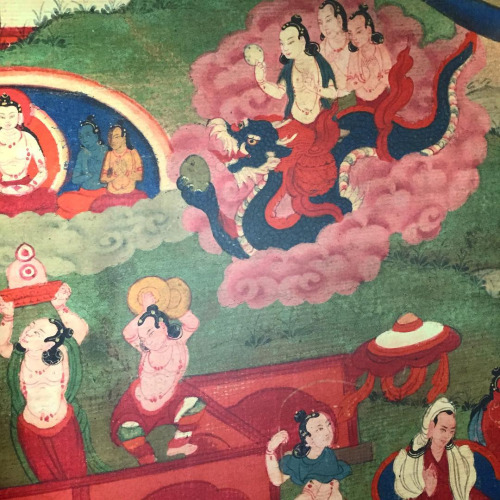
Bönpo Thanka......Musee Guimet.....Musee National des Arts

The Druk (Dzongkha: འབྲུག་) is the "Thunder Dragon" of Bhutanese mythology and a Bhutanese national symbol. A druk appears on the flag of Bhutan, holding jewels to represent wealth. In Dzongkha, Bhutan is called Druk Yul "Land of Druk", and Bhutanese leaders are called Druk Gyalpo, "Thunder Dragon Kings". During the Bhutanese mock election in 2008, all four mock parties were called the Druk Party. The national anthem of Bhutan, Druk Tsendhen, translates into English as "Kingdom of Druk".........The druk (also known as a "duk" or "dug") was adopted as an emblem by the Drukpa Lineage, which originated in Tibet and spread to Bhutan. According to traditional accounts, when the sect's founder, Tsangpa Gyare, 1st Gyalwang Drukpa, began to build Ralung Monastery, there was a violent storm. Thunder, or the "Cloud-Voice," is seen as the roar of the dragon...... Deciding that this was an omen, he named the monastery Drug-Ralung, adding the word "thunder dragon" to the name. The disciples at the monastery were known as Drugpa, or "Those of the Thunder."..... As of the 1900s, the Grand Lama of Bhutan wore a hat with thunder dragons on it to signify the origins of the sect..... As the sect became more popular, it set up monasteries in what is now Bhutan, with the result that the area became known as Dug Yul, or Land of Thunder, among both Tibetans and Bhutanese.".....

"Dzongkha (རྫོང་ཁ་; Wylie: rdzong-kha, Roman Dzongkha: Dzongkha), occasionally Ngalopkha ("language of the Ngalop people"), is the national language of Bhutan. The word "dzongkha" means the language (kha) spoken in the dzong "fortresses"—the fortress-like dzong architecture characterises monasteries established throughout Bhutan by its unifier, Ngawang Namgyal, 1st Zhabdrung Rinpoche, in the 17th century."

"The Druk Gyalpo (Dzongkha: འབྲུག་རྒྱལ་པོ་; Wylie: 'brug rgyal-po; "Dragon King") is the head of state of Bhutan. He is also known in English as the King of Bhutan...... Bhutan, in the local Dzongkha language, is known as Dryukyul which translates as "The Land of Dragons". Thus, while Kings of Bhutan are known as Druk Gyalpo ("Dragon King"), the Bhutanese people call themselves the Drukpa, meaning "Dragon people"......The current ruler of Bhutan is Jigme Khesar Namgyel Wangchuck, the 5th Druk Gyalpo."

The national flag of Bhutan (Dzongkha: ཧྥ་རན་ས་ཀྱི་དར་ཆ་; Wylie: hpha-ran-sa-kyi dar-cho) is one of the national symbols of Bhutan....The yellow signifies civil tradition and temporal authority as embodied in the Druk Gyalpo, the Dragon King of Bhutan, whose royal garb traditionally includes a yellow kabney (scarf). The orange half signifies Buddhist spiritual tradition....... The flag is based upon the tradition of the Drukpa Lineage of Tibetan Buddhism and features Druk, the Thunder Dragon of Bhutanese mythology....Historically Bhutan is known by numerous names, but the Bhutanese call the country Druk after the name of the Bhutanese thunder dragon."

"In Heaven the Turqouise Dragon Thunders
The Tiger's lightning flashes Abroad
The Lion's Mane spreads Turquoise clouds
Garuda spans the Three-fold world"
Shambhala Anthem lyrics on Dragon's Thunder: Songs of Chogyam Trungpa, Dorje Dradul of Mukpo, The Druk Sakyong.....The Sakyong holds and propagates the teachings of Shambhala, an enlightened society.....Chögyam Trungpa Rinpoche is regarded as the first in this lineage of Sakyongs, and as such he is referred to as the "Druk Sakyong", or "Dragon Earth-Protector".

"Drogon Tsangpa Gyare (1161–1211 AD)......was born into the Gya clan at a place near Kule in the Tsang province of Southern Tibet.....He met his Guru Lingchen Repa when he was 23.......After establishing Longbol (kLong rBol) and Ralung monasteries, Drogon Tsangpa Gyare went to a place called Nam Phu to build a monastery. It is said that when he and his disciples reached the place nine roaring dragons arose from the ground and soared in the sky..... The Tibetan word for dragon is 'Brug which is pronounced as 'Druk'. ....The flying dragons were taken to be an auspicious omen and the monastery and the lineage which sprang from it came to be known as the Drukpa. This school eventually became very popular in Tibet and surrounding regions. Many followers of this school were simple people, content with few material possessions, known for their deep practice of the dharma. There is a Tibetan proverb which says:
"Half the people are Drukpa Kagyupas,
Half the Drukpa Kagyupas are beggars,
And half the beggars are Drubtobs (Siddhas)."

"Kun grags ma.......gNam mtsho phyug mo, the goddess of the lake (also known as rDor rje kun grags ma or Rang byung rgyal mo in Buddhist tradition), the consort of gNyan chen Thang lha, is one of the twelve brTan ma, the ruling goddesses of Tibet. These twelve goddesses are Kun grags ma, Ya ma skyong, Kun bzang mo, bGegs kyi gtso, sPyan gcig ma, dPal gyi yum, Drag mo rgyal, Klu mo dkar mo, Bod khams skyong, sMan gcig ma, gYar mo sil and gYu sgron (in Buddhist tradition the name of each of these goddesses is preceded by the word rdo rje). Among these goddesses Kun grags ma takes precedence. She is superb, having a turquoise-coloured body, one face, two hands and three eyes of wisdom. Holding a banner of crowning victory in her right hand and a mirror of sanctity in her left, she has a great loveliness. Her indigo-blue hair hangs down to some length, and she is mounted on a Turquoise-Blue Dragon in the centre of a swirling white cloud. It is believed that Kun grags ma, the consort of gNyan chen Thang lha, is the principal one among the twelve brTan ma, the protective goddesses of Bon."......A Survey of Bonpo Monasteries by Dondrup Lhagyal, Phuntso Tsering Sharyul, Tsering Thar, Charles Ramble and Marietta Kind....Edited by Samten G. Karmay and Yasuhiko Nagano.....http://www.thlib.org/places/monasteries/publications/bon-book.php#!book=/bonpo-monasteries/wb/b5/

"The Gyalwang Drukpa's Statement on Forceful Conversion of Drukpa Monasteries (The Annual Drukpa council).....10th September 2014.......'Over the last few days I have been receiving disturbing information from Tibet regarding the forced conversion of Drukpa Lineage monasteries in the Mount Kailash region by the Karma Kagyu Lineage. My followers in Tibet tell me that nearly all of the historic Drukpa Lineage monasteries in Mount Kailash region are being forcibly occupied by the Karma Kagyu Lineage, using money, coercion and certain Chinese support. Monks of the Drukpa Lineage looking after the monasteries, are suddenly exiled from their spiritual homes by the Karma Kagyu monks.'...The Gyalwang Drukpa....The Gyalwang Drukpa.....the head of the Drukpa Lineage, one of the independent Sarma (new) schools of Vajrayana Buddhism.".....http://the17thkarmapa.blogspot.com/2014/09/the-gyalwang-drukpas-statement-on.html

"In the southern ranges of the Himalaya the myths of the dragon and of the nagas of india are mixing. Both were being mixed in the tibetan mythologic carpet under the term Klu. All different religious schools and traditions of ancient Zhangzhung and later Tibet know dragons and included them in their corpus. One highly important scripture of the Bon is named the scripture of hundred thousand dragons (Klu). It is divided into three parts: the colorful dragons, the black dragons and the white dragons. The tibetan dragon is also named Druk ('brug), Drug or Zhug as variant spellings of the same. Bhutan, the kingdom at the southern border of the Himalaya is being called Druk Yul - the land of the peaceful dragon (or: the thunder dragon land). The population consists of the Drukpa. Bhutan is the souternmost region where the tibetan buddhist sect of the Drukpa Kagyudpa ('brug pa bka' brgyud pa) can be found. Naturally the temples of this sect are called dragon temples.".....http://www.kondor.de/shaman/orient3_e.html

"You can find Druk in one corner of tibetan Prayer Flags to represent the element wood along with the horse (in the middle), the snow lion, the tiger and the khyung (Garuda). In tibetan these flags are named rLung rta - translated wind-horse or simply luck. Raising them on auspicious days increase the rLung rta of the person. The term rLung however is obviously akin to the chinese lung which translates as dragon among other meanings. Another very important meaning of this word is vital-force......Druks are living in the clouds and were later associated with gZa. .....One of the older deities of Bon is Za (gZa) who is manifesting himself in hailstorms, lightnings and energy. He has 18 faces and six arms - many deities of Tibet share this feature of multiface and multilimbs. He rides a Dragon and he causes numbness, epilepsy and madness when he is offended by blockades of normal flows of energy. Za patronizes magicians and his thanka can be seen in many monasteries".....http://www.kondor.de/shaman/orient3_e.html....

"Prayer Flags in Tibet are called lungta ("wind horse"). Traditionally, the flags would always be recognizable by the drawings of a horse at the center of the composition surrounded by four other animals—a lion, tiger, bird, and dragon...... On early Bon prayer flags, a white yak was counted as one of the four. In addition, the bird depicted on Buddhist flags is believed to be a garuda, which has its origins in Indian culture and literature, while the bird image on Bon flags has a different meaning and history.".... Himalayan Buddhist Art 101: Prayer Flags, Part 2......Jeff Watt....http://www.tricycle.com/blog/himalayan-buddhist-art-101-prayer-flags-part-2

"Another kind of tibetan spirits are the Klu which are more feared then the Druk. The myths of the Klu have mixed with the cult of the Naga in India and it is quite difficult to sort them out. The Klu are the tibetan version of the chinese water dragons and they live in fountains, rivers and seas. You can encounter them on certain special locations, too. The Klu hetched from six eggs at the dawn of creation. The king of them - Klu chen rgyal po - lives in an under water palace just like the dragonkings in china. It is to be noticed that he is being called in the more darker kind of rites to end up the lifes of the enemies quick. The female form of the Klu is Klu mo and the queen is named Yum klu mo yak. She is not one of the nice and peaceful breed and her garment are snakes.... Another much more friendly Klu mo wears a garment of cloudy silk and feathers and she patronizes young girls and women. The legendary kings of ancient Tibet before To ri long bstan had daughters of the gods and the Klu as wives. So the wive of king Gesar is named Sengjam Zhugmo, the daughter of the dragon. It is said that she was born in the thunder of a dragon. Today many women in Tibet bear the name Zhugmo. To angry one Klu can have the consequences of really bad weathers like hailstorms. Klu are regularly held responsible for illness and disease. There are certain rites to react on these more sinister deeds of them and the famous crosses of ropes play an importand part in these rites.".......http://www.kondor.de/shaman/orient3_e.html

"In Bhutan, the popularity of phallic worship is attributed to the 15th-century Buddhist teacher, Drukpa Kunley, popularly known as the “Divine Madman.” A 2011 study titled “Bhutan’s Pervasive Phallus” by French historian Francoise Pommaret and Bhutanese scholar Tashi Tobgay, says the belief in the phallus’ ability to ward off evil spirits and transform them into protective deities is traced to Drukpa Kunley, who subdued demonesses with his “thunderbolt.”....http://www.huffingtonpost.com/2014/03/03/bhutan-phallus-worship_n_4892286.html

"The 15th-century Buddhist teacher, Drukpa Kunley, popularly known as the “Divine Madman.....Drukpa Kunley (1455–1529), also known as Kunga Legpai Zangpo, Drukpa Kunleg (Tibetan: འབྲུག་པ་ཀུན་ལེགས་, Wylie: 'brug pa kun legs), and Kunga Legpa, the Madman of the Dragon Lineage (Tibetan: འབྲུག་སྨྱོན་ཀུན་དགའ་ལེགས་པ་, Wylie: 'brug smyon kun dga' legs pa), was a great master of Mahamudra in the Buddhist tradition, as well as a famous poet, and is often counted among the Nyönpa. After undergoing training in Ralung Monastery under siddha Pema Lingpa, he introduced Buddhism to Bhutan and established the monastery of Chimi Lhakhang there in 1499."....Stein, R. A. (1972). Tibetan Civilization.

Sources of Tibetan Tradition.....Page 252.....By Kurtis R. Schaeffer, Matthew Kapstein, Gray Tuttle

Dargye, Yonten (2001). History of the Drukpa Kagyud School in Bhutan (12th to 17th Century A.D.). Thimphu.

Lama Nawang Tenzin (compiler) (July 2004). The Wand That Opens the Eyes and Dispels the Darkness of the Mind. Shey, Ladakh: Pel Drukpay Tcheutsok.

Waddell, Laurence (1895). The Buddhism of Tibet Or Lamaism.

David-Neel, Alexandra. Initiations and Initiates in Tibet.

**************************

Email....okarresearch@gmail.com

March 2016

**************************

Saturday, March 12, 2016

Yungdrung Chakshing

**************************

Click Here to View the Main Index

**************************

Drenpa Namkha holds a Yungdrung Chakshing in his right hand to indicate the indestructibility and permanence of the Bon teachings.

"Yungdrung Chakshing is a symbol of continuity and willpower in the Bon religion which its followers say was the pre-Buddhist faith of the Tibetan people. It's interesting to note that the swastika here is widdershins which is unlike the Hindu one....Widdershins is a term meaning to go counter-clockwise, or to walk around an object by always keeping it on the left.....The Swastika (also known as the gammadion cross, cross cramponnée, or wanzi) (as a character: 卐 or 卍) is an ancient religious symbol that generally takes the form of an equilateral cross, with its four legs bent at 90 degrees. It is considered to be a sacred and auspicious symbol in Hinduism, Buddhism, Bon and Jainism ....It has been used as a decorative element in various cultures since at least the Neolithic. It is known most widely as an important symbol long used in Indian religions, denoting "auspiciousness....The name swastika comes from the Sanskrit word svastika (Devanāgarī: स्वस्तिक), meaning "lucky or auspicious object".....The word finds its origin in Vedic Sanskrit. As noted by Monier-Williams in his Sanskrit-English dictionary, according to Alexander Cunningham, its shape represents a monogram formed by interlacing of the letters of the auspicious words su-astí (svasti) written in Ashokan characters."......

The flag of the Yungdrung Bön with each of the colors of the five elements and the golden chakshing with 2 turquoise-colored yungdrungs as held by Buddha Tönpa Shenrap Miwoche....http://ravencypresswood.com/2013/09/24/flag-of-the-yungdrung-bon/

"The swastika, old symbol of good luck, is very present in bön and represents eternity, mostly in its anti-clockwise version......The flag has five horizontal stripes (blue, white, red, green, yellow). In the middle of the flag there is a golden yungdrung chakshing (g.yung-drung phyag-shing in Wylie transliteration), which is a bönpo scepter and symbol of immortality. On each end of the yungdrung there is a square with a swastika. The squares are shown with a blue swastika on yellow field in one instance, and with several colours between the arms of the yellow swastika in the other (blue to the left, red on top, green on the right, and white on the bottom), all on a red field within yellow border."........ Sources: http://blog.amdotibet.cn/tibetmonk/archives/103962.aspx ........http://ravencypresswood.com/2013/09/24/flag-of-the-yungdrung-bon/ .......Corentin Chamboredon, 10 February 2014........http://www.crwflags.com/fotw/flags/xt_bonpo.html

"Almost all of western Tibet constituted, before the Tibetan emperor Songtsen Gampo invaded it in the 8th c. AD, the kingdom of Zhangzhung..... Modern bönpo claim their religion had roots in this old country......some texts even claim bön was imported from old Persia to Zhangzhung before that.".....http://www.crwflags.com/fotw/flags/xt_bonpo.html

"A gleaming and spirited statue of Drenpa Namkha, the venerated long-life deity of Bön. He is regarded as the Protector of the Dark Age, and believed to be the all-embodying manifestation of the three kayas of Buddhas in Tibetan tradition. As shown in this rare bronze Drenpa Namkha as a Mahasiddha, he is seated in royal ease on a lotus throne wearing only a tiger skin. On his youthful face at the ajna chakra, he has a third-eye that revealed his transcendent knowledge. For his power to transform delusion into perfect wisdom, his left hand is holding a white kapala (skull cup) filled with blood. To affirm the absolute truth and eternal teachings of the Bön, his right hand is raised with the yungdrung chakshing (swastika vajra emblem). Whereas the one eye on his foot indicated that he could visualizes five hundred past lives. Beautifully gilded in gold and ornamented with semi-precious stones, with a swastika on a double-thunderbolt embossed on the copper base plate, this immaculate statue emanated the presence of Drenpa Namkha in an unshakeable equipoise.".....http://www.buddhamuseum.com/gilded-drenpa-namkha_93.html

"Drenpa Namkha (Tibetan: dran pa nam mkha' ) was born in the 8th century near Mount Kailash in Chunlung Ngul Kha in south-western Tibet. As a young student he was a blessed with eight principal Bon teachers. Drenpa Namkha became a self-realized supreme master of the three Bon practices, known as Sutra, Tantra and Dzogchen. Drenpa Namkha is the primary long-life deity according to Bon....Drenpa Namkha's biography in eight volumes was published by sPa-tshang Sonam Gyantsan, Delhi in 1983. Drenpa Namkha is said to have had twin sons: Tshe-dbang Rig-'dzin, a Bon teacher, and Pad-ma 'Byung-gnas..."

"The flag of Jainism was first mentioned in a holy text dating 5th century BC. It has five colors: orange or red, yellow, white, green and black or dark blue.....The swastika in the centre of the flag represents the four states of existence of soul. The four stages may be: heaven-beings or deities....human beings.....animal/birds/insects/plants.....hell beings.....It represents that the soul can embody any of these forms, owing to karma, which may escalate it to higher-level forms such as heavenly beings, or degrade it to lower-level forms such as lesser animals or hell beings....The three dots above the swastika represent the Ratnatraya (three jewels) of Jainism.....The curve above the three dots denotes Siddhashila, a place in the highest realms of Universe, composed of pure energy. It is above hell, earth, or heaven.".....

http://ravencypresswood.com/category/yungdrung-bon-sacred-symbols/

"Other names for the symbol include:
hook cross (German: Hakenkreuz), angled cross (German: Winkelkreuz) or crooked cross (German: Krummkreuz).
fylfot, chiefly in heraldry and architecture. The term was coined in the 19th century based on a misunderstanding of a Renaissance manuscript.
gammadion, tetragammadion (Greek: τετραγαμμάδιον), or cross gammadion (Latin: crux gammata; French: croix gammée), as each arm resembles the Greek letter Γ (gamma).
tetraskelion (Greek: τετρασκέλιον), literally meaning "four legged", especially when composed of four conjoined legs (compare triskelion [Greek: τρισκέλιον]).
whirling logs (Navajo (native american): can denote abundance, prosperity, healing, and luck.
The swastika has been a standardized Sanskrit character. "卍" (pinyin: wàn) and as such entered various other East Asian languages such as Japanese where the symbol is called "卍" (Hepburn: manji) or "卍字" (manji)."

**************************

Email....okarresearch@gmail.com

March 2016

**************************

Tuesday, February 23, 2016

Hadda: Greek-Buddhist Archeological Site (1st c. AD)

**************************

Click Here to View the Main Index

**************************

"Haḍḍa (Pashto: هډه‎) is a Greco-Buddhist archeological site located in the ancient region of Gandhara, near the Khyber Pass, ten kilometers south of the city of Jalalabad in eastern Afghanistan."

Click on the map to enlarge.

"Some 23,000 Greco-Buddhist sculptures, both clay and plaster, were excavated in Haḍḍa during the 1930s and the 1970s. The findings combine elements of Buddhism and Hellenism in an almost perfect Hellenistic style......Although the style of the artifacts is typical of the late Hellenistic 2nd or 1st century BC, the Haḍḍa sculptures are usually dated (although with some uncertainty), to the 1st century AD or later (i.e. one or two centuries afterward). This discrepancy might be explained by a preservation of late Hellenistic styles for a few centuries in this part of the world. However it is possible that the artifacts actually were produced in the late Hellenistic period......Given the antiquity of these sculptures and a technical refinement indicative of artists fully conversant with all the aspects of Greek sculpture, it has been suggested that Greek communities were directly involved in these realizations, and that "the area might be the cradle of incipient Buddhist sculpture in Indo-Greek style"..... John Boardman, The Diffusion of Classical Art in Antiquity

"Hadda is 10 km south of the Kabul River...... (Kābol Rōd, also called Daryā-ye Kābol), in eastern Afghanistan and tributary of the Indus....its drainage area takes up large proportions of eastern Afghanistan with the nine provinces of Nangarhār, Kunar, Laḡmān, Lōgar, Kabul, Kāpisā, Parvān, Panjšēr, and Bāmiān.....the East flowing Kabul River, which in times past, was known as the Sita, or White River.... In the year 1900 the Russian mystic George Ivanovitch Gurdjieff traveled by raft down part of this river, as part of an expedition led by Prof. Kozlov in search of the ruins of ancient Shambhala.".......http://www.dharmafellowship.org/library/essays/uddiyana.htm

Sir Alexander Burnes Map (1834)...Click on the map to enlarge.

"Captain Sir Alexander Burnes, FRS (16 May 1805 – 2 November 1841) was a Scottish traveller and explorer....His travels continued through Afghanistan across the Hindu Kush to Bukhara (the maps and narrative which he published in England in 1834)"

"Musée Guimet:: Afghanistan: Hadda......The Buddhist monastery complex at Hadda in Eastern Afghanistan, not far from Kandahar, yielded a rich trove of sculpture and painting during the French excavations of the late 1930s......Hadda, Monastery of Bagh-Gai. 3rd-4th c. AD.....Barthoux expedition 1927-28.....https://depts.washington.edu/silkroad/museums/mg/hadda.html"

The Buddhist stupa of Tapa Kalan, Hadda (near Jalalabad in the Kabul River valley

"Hadda, a small town 15 km south of Jalalabad (Eastern Afghanistan), owes its fame to the number and beauty of the remains of its Buddhist stūpas, shrines and monasteries scattered over an area of 15 km2 around the urban settlement......Throughout the period of Buddhism’s great flourishing, from the Kushans (1st–3rd century AD) into the 7th century AD, Hadda was a popular pilgrimage destination where, according to the accounts of famous Chinese pilgrims such as Faxian and Xuanzang, various relics of the Buddha’s body and belongings were preserved, each of them enshrined in a stūpa: a bone of the Buddha’s skull and uṣṇīṣa (cranial protuberance), an eyeball, the monastic robe and the ascetic staff....Exploration of the site began in 1834 with Charles Masson, who discovered Graeco-Bactrian, Indo-Scythian, Hunnic, Roman and Byzantine coins inside 14 stūpas in different sacred areas. The most important of these, Tapa Kalan, also yielded fragments of stone and stucco sculptures. Further minor investigations followed, until J. Barthoux of the Délégation Archéologique Française en Afghanistan carried out extensive excavations on various sites from 1926 to 1929.....Their astonishing beauty and liveliness, originally enhanced by a vibrant color, which has only minimally been preserved, and especially their Hellenistic touch aroused great interest......Between the mid-1960s and the end of the 1970s other sites were excavated by Afghan and Japanese teams. Tapa Shotor, one of the most interesting sites to be excavated during this period, revealed shrines housing cultic images and scenes characterized by the theatrical arrangement of the sculptures and their lively background (2nd–5th century AD) as well as an underground room, probably restricted to the monks’ meditation practices, as suggested by the painted decoration (5th–6th century AD) dedicated to the theme of meditation on death......In the course of the Afghan civil war, the majority of known archaeological sites was destroyed by the Taliban."...http://pro.geo.univie.ac.at/projects/khm/showcases/story233?language=en .

"In 1834, Charles Masson’s excavations in the region of Kabul and Jalalabad included a series of Buddhist ‘Topes’, i.e. stupas (sacred domed structures symbolizing the Buddha). Tope Kelan (Stupa 10) on the outskirts of Hadda, a village south of Jalalabad in south-eastern Afghanistan..... The relic deposit contained more than 200 coins buried along with a variety of over 100 objects including silver rings, gilded bronze, silver and gold reliquaries, glass and semi-precious beads and brass pins including a unique cockerel-headed example. These were buried as part of a Buddhist ritual aimed at earning merit in the afterlife."....http://blog.britishmuseum.org/category/collection/money-gallery/

"The Tope Kelan deposit contains five series of coins, Byzantine gold solidi, Sasanian silver coins, Alchon Hun silver coins, Kidarite Hun gold and silver coins, and a gold coin from Kashmir, all minted before AD 480. The hoard is important evidence of the Silk Route trade network that crisscrossed Europe, Central Asia to China and India in the first millennium AD. The Tope Kelan hoard is thus a testimony to the multiculturalism of ancient Afghanistan with its links to the Indian sub-continent, Iran and China.".......http://blog.britishmuseum.org/category/collection/money-gallery/

"The Buddhist Shrine Complex at Hadda. A Greco-Buddhist archeological site located in the ancient area of Gandhara, six miles south of the city of Jalalabad in eastern Afghanistan, Hadda was one of the largest Buddhist temple and pilgrimmage complexes in the world during the 1st through 3rd centuries AD.......A key location on the 2,000-mile path that pilgrims followed in the transmission of Buddhism from India to China, Hadda was an active center for manuscript translation and duplication as well as sculpture. ....More than 23,000 Greco-Buddhist sculptures made of clay or plaster, architectural decorations plus heads and figures depicting men, women, children, assorted demons, as well as the elderly, with every conceivable mode of expression and dress, every rank and status, every facial type from all corners of the known world — more faces than one would need to re-create an entire Buddhist city — were excavated from Hadda in a series of archaeological excavations during the 1930s and the 1970s. .....Sculptures from Hadda combine elements of Buddhism and Hellenism, in an almost perfect uniquely identifiable Hellenistic style. Although the style itself is suggested by experts to date from the late Hellenistic 2nd or 1st century BC, the sculptures from Hadda are usually dated, tentatively, to the 1st century AD or later. .....Given the early date, superb quality, technical refinement, variety and stupendous quantity of sculptures, Hadda must have been a "factory town" where Greek or Greek-trained artists familiar with all the aspects of Hellenistic sculpture, lived and worked in, what scholar John Boardman described as "the cradle of incipient Buddhist sculpture in Indo-Greek style." .....The transferance of Greek heros to Buddhism (e.g., Herakles being the inspiration and model for the Buddhist Bodhissatva) is fully on display at Hadda. ....A sculptural group excavated at the Hadda temple known as Tapa-i-Shotor, for example, represents a Buddha flanked by a perfectly Hellenistic figure of Tyche holding her cornucopia and Herakles holding not his usual club, but the thunderbolt associated with the Boddhisatva fiture Vajrapani."...http://www.cemml.colostate.edu/cultural/09476/afgh02-08enl.html

"Hercules and the Buddha....In Gandharan art, the Buddha is often shown under the protection of the Greek god Herakles, standing with his club (and later a diamond rod) resting over his arm...Via the Greco-Buddhist culture, Heraclean symbolism was transmitted to the far east.....Heracles was perhaps the most popular hero god of the Greeks. In the Greek colonies in Bactria and India, the club wielding lion killer, Heracles became Vajrapani a protector of Buddha. Still recognizable as a bearded Greek with a club....which became the diamond thunderbolt).... "

"In addition to sculpture, Hadda contained some of the the oldest surviving Buddhist manuscripts in the world, which are perhaps the oldest surviving Indian manuscripts of any kind,the long-lost canon of the Sarvastivadin Sect that dominated Gandhara and was instrumental in Buddhism's spread from India to China. ....Probably dating from around the 1st century AD, looted from Hadda during the 1990s and smuggled to Pakistan, these Buddhist manuscripts were written on birch bark in the Gandhari language. Discovered in a clay pot bearing an inscription in the same language eventually passed to the British Library in London and the University of Washington in Seattle. The legal ownership of these priceless manuscripts remains in dispute. ....More than 1000 of the vast assemblage of sculptures found at Hadda during the 1930s and 1970s were secured at the Kabul Museum and the Musée Guimet in Paris.".....http://www.cemml.colostate.edu/cultural/09476/afgh02-08enl.html

http://c8.alamy.com/comp/A241CC/hadda-monuments-at-darunta-on-the-road-to-hadda-afghanistan-A241CC.jpg

**************************

Email....okarresearch@gmail.com

February 2016

**************************

Saturday, January 16, 2016

Paradesha, Parádeisos, Chahar Bagh: Royal Walled Gardens of Kalapa

**************************

Click Here to View the Main Index

**************************

"The mythical paradise of Shamballa, sometimes thought to be in a parallel world or dimension , is a land of a thousand names. The Hindus call it "Paradesha" (Paradesa: Sanskrit) (Paradise....Persian: پردیس,.....High Land).....or "Aryavarsha", the land from which the Vedas came from; the Buddhists "Shambala"; the Chinese know it as " Hsi Tien", the Western Paradise of Hsi Wang Mu, the Royal Mother of the West; the Russians knew it as "Belovodye" and "Janaidar", the Christians and the Jews the "Garden of Eden". In the esoteric literature it has become known as "Shangri-La", "Agarttha" or "the Land of the Living".It has the name of "Forbidden Land"; "the Land of White Waters"; the "Land of Radiant Spirits"; the "Land of Living Fire"; the "Land of the Living Gods" and the "Land of Wonders".....Vedic society... the ancient civilization was Arya-Varsha......Taoist mythology calls it Tebu...Beneath the land of Shambhalla lies a cavernous underworld.. Its summit aligns to the wheeling constellation of Ursa Major, the Seven Stars that circle the Pole. .... The Japanese also have a Shambhalla which they have named ‘Island of the Congealed Drop’. It is situated ‘on the top of the globe' but at the same time 'at the center of the earth'. Its first roof-pillar was the earth's axis, and over it was the pivot of the vault of heaven.......The Chinese actually describe their idea of Shambhalla as the Center of the Earth, directly under Shang-te's heavenly palace, declaring it to be in the polestar. They also call it, ‘The Palace of the Center’. "....IN SEARCH OF SHAMBHALA........Mary Sutherland 2003

A Brief History of the Kalachakra....by John R. Newman....https://collab.itc.virginia.edu

"The word "paradise" entered English from the French paradis, inherited from the Latin paradisus, from Greek parádeisos (παράδεισος), from an Old Iranian *paridayda- "walled enclosure". By the 6th/5th century BC, the Old Iranian word had been adopted as Assyrian pardesu "domain". It subsequently came to indicate walled estates, especially the carefully tended royal parks and menageries. The term eventually appeared in Greek as parádeisos "park for animals" in the Anabasis of the early 4th century BC Athenian Xenophon. Aramaic pardaysa similarly reflects "royal park"."

"Paradise....The word's etymology is ultimately derived from a PIE root *dheigʷ "to stick and set up". It is reflected in Avestan as pairi-daêza-. The literal meaning of this Eastern Old Iranian language word is "walled (enclosure)", from pairi- "around" and -diz "to make, form (a wall), build". The word is not attested in other Old Iranian languages (these may however be hypothetically reconstructed, for example as Old Persian *paridayda-)."

"Sanskrit: paradise: नन्दन nandana .....Paradesa (Sanskrit) [from para beyond, above + desa region, country] The region above or beyond; said to be the highlands to which the first Sanskrit-speaking people have supposedly been traced. More truly, the cradleland of the first thinking man. It is also the sacred land in Central Asia inhabited by the Dragons of Wisdom or initiates, and in this sense is synonymous with Sambhala. .....'paradise' is believed to have probably come from the Sanskrit word 'paradesa' परदेश meaning 'foreign' land."

"Vedic society of the ancient civilization was Arya-Varsha - a civilization (not just a national culture or people). Arya Varsha translates roughly to 'enlightened world' ......Arya Varsha referred to morally developed regions......Within Arya Varsha, was Bharatha Khanda (Basically South asia), and within that Jambu Dwipa (Indian region), and within that many kingdoms and states......Arya Varsha extended all the way to Ireland the legend goes. South India was definitely part of it......Archeology suggests that there was an advanced Indus valley civilization around the saraswathi river, and at some point there was a massive drought and most cities had to be abandoned, and the population got dispersed. Then when the climate improved, people from the western areas came and settled there. As they settled, they absorbed much of the beliefs and culture of the prior people, and that became the modern system."....https://www.quora.com/What-was-the-advanced-developed-Vedic-Society-in-India-like-Was-there-a-parallel-culture-in-south-India

"Arya (Sanskrit, also ārya; Pāli: ariya) is a term frequently used in Buddhism that can be translated as "noble", "not ordinary", "valuable", "precious",[a] "pure", etc. Arya in the sense of "noble" or "exalted" is frequently used in Buddhist texts to designate a spiritual warrior or hero.....In Chinese Buddhist texts, ārya is translated as 聖 (approximately, "holy, sacred", pinyin shèng, on'yomi sei)......

THEORIES OF PARADISE........"The west first heard of Shambhala in 1627 after Catholic missionaries travelled to Tibet and heard stories about it. Some Buddhists associate it with the mythical land of Olmulungring, an invisible kingdom dating back to the 17th century BC, when its king travelled to Tibet to bring enlightenment. Some scholars think Shambhala is simply a remembrance of earlier civilisations of Central Asia which were known to exist, and had contact with Tibet. Many other scholars and traditions place Shambhala in a variety of locations. Taoist mythology calls it Tebu, a secluded land between Tibet and Szechwan. Blavatsky thought it existed somewhere in the Gobi Desert. Whilst historian Geoffrey Ashe suggested it might be in the remote Altar mountains between Russia and Mongolia. However, other traditions give a more esoteric location, explaining the mythology concerning its disappearance."

"From the time of the Achaemenid Dynasty the idea of an earthly paradise spread through Persian literature and example to other cultures, both the Hellenistic gardens of the Seleucids and the Ptolemies in Alexandria. The Avestan word pairidaēza-, Old Persian *paridaida-, Median *paridaiza- (walled-around, i.e., a walled garden), was borrowed into Ancient Greek: παράδεισος parádeisos, then rendered into the Latin paradīsus, and from there entered into European languages, e.g., French paradis, German Paradies, and English paradise. The word entered Semitic languages as well: Akkadian pardesu, Hebrew pardes, and Arabic firdaws."....Fakour M., Achaemenid Gardens

Pairidaēza....."The central "royal garden" at Pasargadae was designed to reflect this new empire. Recent international collaborative archaeological fieldwork incorporating surface, geophysical, and aerial survey has modified earlier ideas about this formally laid out, irrigated area. Excavations in the 1960s uncovered a system of limestone channels, 25 cm wide and punctuated with a deep square basin every 13 or 14 m, thus dividing the area into two rectangles. The channels probably sat flush with the ground surface. At the edges of this garden were three structures: Palace P, and two smaller pavilions. The main portico of Palace P opened directly onto the garden; a stone throne was fixed at its center, giving the ruler an uninterrupted view over the area. Some scholars have assumed that the central placement of the throne implies a second axial division of the garden into four quadrants. Recent work now indicates that this space may have incorporated a much greater area, including both a pool-like construction crossed by a bridge as well as other monumental structures. In this scenario, the pool would have acted as a channel, whose embankments were also lined with stone, drawing water from the nearby Pulvar River. The classical historian Arrian, writing in the second century a.d., left a snapshot of the park in his description of Cyrus' tomb: located approximately 1 km from the palaces, it was set in a "royal park at Pasargadae, and around it a grove of all kinds of trees had been planted. It was also watered by a stream, and high grass grew in the meadow" (Anabasis, 6.29)."....http://www.metmuseum.org/about-the-museum/now-at-the-met/features/2013/pasargadae

"Charbagh or Chahar Bagh (Persian: چهارباغ, chahār bāgh, "Four Bāghs") is a Persian-style garden layout. The quadrilateral garden is divided by walkways or flowing water into four smaller parts. In Persian, "Chār" means 'four' and "bāgh" means 'garden'.....Was there a connection between the proposed four quadrants and the "four quarters" of Cyrus' empire, to which he referred in the Cylinder text quoted above, as has been suggested by some scholars? Is the royal garden with the fourfold design, or chahar bagh, the earliest example of a feature that became a dominant characteristic of Persian garden design in the ensuing centuries?.......Chahrbagh originated from the time of Achaemenid Persia. Greek historians, such as Herodotus and Xenophon, give extensive accounts of Cyrus the Great's palatial city of Pasargadae and his four-gardens..... The tradition of paradise garden originated among the Mughals, originally from Central Asia, which is found at Babur's tomb, Bagh-e Babur, in Kabul.....

"On a recent trip to Kalapa Valley, Eva Wong, our esteemed feng shui master, felt that this valley held the secret command of the Shambhala vision and that it would affect the energy and spirit of all of our centers. Even though many of us have not seen the land, by receiving it now, Kalapa Valley will have a positive effect on all of our activities. It will have a unique role in our community since it will not be built up into a major practice center. Rather, it will have a pavilion for the practice of the sacred Werma sadhana and sacred gardens for practitioners to visit."....http://kalapavalley.shambhala.org/about/

"HAŠT BEHEŠT ....The description of a palace in the Hašt behešt of Amir Ḵosrow, with four pavilions on the cardinal points around an octagonal basin in a luxuriant garden, represents the clearest literary reconstruction of this model in Persian literature....This cosmological concept is closely connected to Islamic eschatology, in which paradise is conceived as having eight gates and eight spaces, each one decorated with a special precious stone or material. The description of paradise was further elaborated by the philosophers and Sufis who considered the eighth paradise to be the highest garden, that is, the Garden of Eden"....http://www.iranicaonline.org/articles/hast-behest-2

"Genesis describes the Garden of Eden as being "in the east, in Eden" (Gen 2:8). In the Assyrian inscriptions idinu (Accadian: edin) means "plain" and it is from this that the Biblical word is probably derived. The Garden is described as having "all kinds" of trees growing in it....As with many passages in Genesis, there is debate among Christians whether or not the story of the Garden of Eden should be taken literally or metaphorically......The traditions of its location somewhere in central Asia are numerous and persistent, and naturalists have in the past pretty generally fixed upon the portion of Central Asia stretching east from the Himalayas - often referred to as the roof of the world and from which flow four great rivers: the Indus, the Tarim, the Sur Daria (Jaxartes), and the Ainu Daria (Oxus) - as the original cradle of mankind."....http://www.conservapedia.com/Garden_of_Eden

"Professor S.H. Buchanan, a Biblical scholar during the late 19th century, was one of those believers, who put down in his work The World and the Book:......“Thus everything invites us to place the Eden of the Semites (Aryans) in the mountains of Belurtag, at the point where this chain unites with the Himalaya, toward the Plateau of Pamir... We are conducted to the same point, according to Brunoff, by the most ancient and authentic texts of the Zend-Avesta. The Hindu traditions also contained in the Mahabbarata and the Puranas, converge to the same region. There is the true Meru (Ararat) (of the Hindus), the true Albordj (of the Persians), the true river Arvanda, from which all rivers take their source, according to Persian tradition. There, according to the opinions of almost all the populations of Asia, is the central point of the world, the umbilici, the gate of the universe. There is the Uttarakura; ‘the country of happiness,’ of which Magesthanes writes. There is, finally the point of common attachment of the primitive geography, both of the Semitic and the Indo-European races.” ......The Jewish historian Flavius Josephus also hinted that the Garden of Eden had a central Asian location"......http://www.conservapedia.com/Garden_of_Eden

"Uttarakuru (Sanskrit: उत्तर कुरु) is the name of a dvipa ("continent") in ancient Hindu and Buddhist mythology......Uttarakuru country and its people are sometimes described as belonging to the real world, whereas at other times they are mythical or otherworldly spiritual beings.....Aitareya Brahmana makes first reference to Uttarakuru and Uttaramadra as real-life Janapadas. According to Aitareya Brahmana, these two nations lay beyond the Himalayan ranges (Hindukush). The Aitareya Brahmana adduces these two people as examples of republican (vairajiya) nations, where whole Janapada took the consecration of rulership.......Aitareya Brahmana again notes that Uttarakuru was a deva-kshetra or divine land......Uttarakuru also finds numerous references in Buddhist literature, sometimes as a real land and other times as a mythical region.....Ramayana testifies that the original home of the Kurus was in Bahli country. Ila, son of Parajapati Karddama was a king of Bahli, where Bahli represents Sanskrit Bahlika (Bactria)....Bahlika or Bactria may have constituted the Uttarakuru. Mahabharata and Sumangalavilasini also note that the people of Kuru had originally migrated from Uttarakutru. Bactria is evidently beyond the Hindukush.....".....Geographical Data in Early Puranas, 1972, Dr M. R. Singh

"The Aitareya Brahmana (Sanskrit: ऐतरेय ब्राह्मण) is the Brahmana of the Shakala shakha of the Rigveda, an ancient Indian collection of sacred hymns.....The Aitareya Brahmana is dated variously from 1000 BC to 500 BC."

"The Persian Garden......exemplify the diversity of Persian garden designs that evolved and adapted to different climate conditions while retaining principles that have their roots in the times of Cyrus the Great, 6th century BC. Always divided into four sectors, with water playing an important role for both irrigation and ornamentation, the Persian garden was conceived to symbolize Eden and the four Zoroastrian elements of sky, earth, water and plants. These gardens, dating back to different periods since the 6th century BC, also feature buildings, pavilions and walls, as well as sophisticated irrigation systems. They have influenced the art of garden design as far as India and Spain....They reflect the flexibility of the Chahar Bagh (Four Gardens), or originating principle, of the Persian Garden, which has persisted unchanged over more than two millennia since its first mature expression was found in the garden of Cyrus the Great's Palatial complex, in Pasargadae...The word Paradise entered European languages from the Persian root word "Pardis", which was the name of a beautiful garden enclosed behind walls. .".....UNESCO » Culture » World Heritage Centre » The List » World Heritage List......http://whc.unesco.org/en/list/1372

**************************

Email....okarresearch@gmail.com

January 2016

**************************

Sunday, October 4, 2015

Anionic and Anthropomorphic Greco-Bactrian Buddhist Art (250 BC)

**************************

Click Here to View the Main Index

**************************

"No representations of the Buddha were made for about four or five centuries. It is sometimes said that prior to this time it was 'forbidden' to make statues or pictures of the Buddha, but this is unlikely and there is no evidence of such a prohibition. A more likely explanation is that until then symbols of the Buddha (stupas, footprints, an empty throne etc.) and written descriptions of him were deemed sufficient. Whatever the reasons, the first Buddha statues were produced in about the 1st or 2nd century AD in Bactria (Afghanistan and northern Pakistan) perhaps as a result of Greek influence....".....http://www.buddhanet.net

The Kingdom of Ghandara lasted from the early 1st millennium BC to the 11th c. AD.... In 327 BC Alexander the Great conquered Gandhara....Click on the map to enlarge.

"One of the distinguishing features of the Gandharan school of art .... is that it has been clearly influenced by the naturalism of the Classical Greek style. Thus, while these images still convey the inner peace that results from putting the Buddha's doctrine into practice, they also give us an impression of people who walked and talked, etc. and slept much as we do. I feel this is very important. These figures are inspiring because they do not only depict the goal, but also the sense that people like us can achieve it if we try" (The Dalai Lama, foreword to Echoes of Alexander the Great, 2000).

"Anionic....not employing or permitting images, idols, etc...... When enforced by the physical destruction of images, aniconism becomes iconoclasm. The word itself derives from Greek εικων 'image' with the negative prefix an-....Buddhist art used to be aniconic: the Buddha was only represented through his symbols (an empty throne, the Bodhi tree, the Buddha's footprints, the prayer wheel). This reluctance towards anthropomorphic representations of the Buddha, and the sophisticated development of aniconic symbols to avoid it (even in narrative scenes where other human figures would appear), seem to be connected to one of the Buddha's sayings, reported in the Digha Nikaya, that discouraged representations of himself after the extinction of his body......Although there is still debate, the first anthropomorphic representations of the Buddha himself are often considered a result of the Greco-Buddhist interaction."

Click on the map to enlarge

"Foucher's most famous work was L'Art Gréco-Bouddhique du Gandhara in which he described how Buddhist art prior to Pan-Hellenism was principally aniconic .representing the Buddha by depicting elements of the Buddha's life instead of depicting the Buddha himself. Foucher argued that the first sculpted images of the Buddha were heavily influenced by Greek artists. He coined the term "Greco-Buddhist art".......Foucher especially considered Hellenistic free-standing Buddhas as "the most beautiful, and probably the most ancient of the Buddhas", assigning them to the 1st century BC, and making them the starting point of the anthropomorphic representations of the Buddha ....archeological discoveries in Central Asia however (such as the Hellenistic city of Ai-Khanoum and the excavation of Sirkap in modern Pakistan), have been pointing to rich Greco-Bactrian and Indo-Greek civilizations in these areas, reviving the Hellenistic thesis."....the Greco-Buddhist bas-reliefs.......The Beginnings Of Buddhist Art.....by A.Foucher......

"Kushana coins present some of the earliest images of the Buddha......Gold coin of Kanishka I with a representation of the Buddha (c.120 AD).......Kanishka standing..Kushan-language legend in Greek script ϷΑΟΝΑΝΟϷΑΟ ΚΑΝΗϷΚΙ ΚΟϷΑΝΟ ("Shaonanoshao Kanishki Koshano"): "King of Kings, Kanishka the Kushan"......Reverse: Standing Buddha in Hellenistic style, forming the gesture of "no fear" (abhaya mudra) with his right hand, and holding a pleat of his robe in his left hand. Legend in Greek script: ΒΟΔΔΟ "Boddo", for the Buddha. Kanishka monogram (tamgha) to the right."

Greek Buddha Face

"Greco-Buddhist art is the artistic manifestation of Greco-Buddhism, a cultural syncretism between the Classical Greek culture and Buddhism, which developed over a period of close to 1000 years in Central Asia, between the conquests of Alexander the Great in the 4th century BC, and the Islamic conquests of the 7th century AD. Greco-Buddhist art is characterized by the strong idealistic realism and sensuous description of Hellenistic art and the first representations of the Buddha in human form, which have helped define the artistic (and particularly, sculptural) canon for Buddhist art throughout the Asian continent up to the present. It is also a strong example of cultural syncretism between eastern and western traditions......The origins of Greco-Buddhist art are to be found in the Hellenistic Greco-Bactrian kingdom (250 BC- 130 BC), located in today’s Afghanistan, from which Hellenistic culture radiated into the Indian subcontinent with the establishment of the Indo-Greek kingdom (180 BC-10 BC). Under the Indo-Greeks and then the Kushans, the interaction of Greek and Buddhist culture flourished in the area of Gandhara, in today’s northern Pakistan, before spreading further into India, influencing the art of Mathura, and then the Hindu art of the Gupta empire, which was to extend to the rest of South-East Asia. The influence of Greco-Buddhist art also spread northward towards Central Asia, strongly affecting the art of the Tarim Basin, and ultimately the arts of China, Korea, and Japan."....https://en.wikipedia.org/wiki/Greco-Buddhist_art

"Some of the oldest Buddha statues were recorded in the city of Gandhara.....in the northern Pakistan and northeastern Afghanistan, Gandhara was the center of Hindu culture and Greco-Buddhist culture..... Gandhara culture took a height of a peak during the reign of the Great Kushan King Kanishka (128-151).....A remarkable example of Greco-Buddhist Statuary which was built in Gandhara is The Standing Buddha Statues which reside in the Tokyo National Museum. The statue is dated around 1st or 2nd Century CE......“the most beautiful, and probably the most ancient of the Buddhas”.....These statues can be said as the starting point of the anthropomorphic representations of the Buddha."

The Seated Buddha from Gandhara is one of the early Buddha statue built which was discovered at the site of Jamal Garhi in ancient Gandhara.

"The exact date of the Buddha's birth is disputed, with Nepalese authorities favoring 623 B.C., and other traditions favoring more recent dates, around 400 B.C.......Regardless, by 249 B.C. Lumbini had became one of the four sacred centers of Buddhism, marked by sanctifying inscriptions and a pillar left there in 249 B.C. by the Indian emperor Ashoka, who helped spread Buddhism across Asia."....

"Buddhist Shrine (550 B.C.)......the earliest ever Buddhist shrine. This 6th century timber structure was found underneath of Maya Devi Temple in Lumbini......The center of the shrine was unroofed, the team found, and contained mineralized tree roots, surrounded by clay floors worn smooth by visitors. It was likely an ancient bodhigara, or tree shrine......The tree roots appear to have been fertilized, and although bodhigara are found in older Indian traditions, the shrine lacked the signs of sacrifices or offerings found at such sites......It was very clean, in fact, which points to the Buddhist tradition of nonviolence and nonofferings....excavations at the site point to its cultivation starting around 1000 B.C., followed by the development of a Buddhist monastery-like community by the sixth century B.C......The new evidence from this project shows that this ritual activity was taking place centuries prior to the Asokan levels, and this is really significant and interesting,"....Oldest Buddhist Shrine Uncovered In Nepal May Push Back the Buddha's Birth Date ...By Dan Vergano, National Geographic.......2013

"Gāndhāra, a district traditionally placed in the extreme northwest of the Indian subcontinent. It was located along both banks of the Indus, around the famous cities of Takshaśilā (Taxila) and Pushkalāvatī (modern Charsada, northeast of Peshawar).....Gandhari in the Rigveda, along with the Balhikas (Bactrians) ...The name Gandhārī first occurs in the Rigveda (I, 126,7; late 2nd millennium B.C.E.) in the phrase Gandhārīnām avikā (ewe of the Gandharans), and also in the somewhat later Atharva Veda. The name is used, around 400 B.C., by Pānini, who himself probably hailed from Gāndhāra."...http://www.iranicaonline.org/articles/gandhara-

"As soon as the Greeks invaded India to form the Indo-Greek kingdom, a fusion of Hellenistic and Buddhist elements started to appear, encouraged by the benevolence of the Greek kings towards Buddhism. This artistic trend then developed for several centuries and seemed to flourish further during the Kushan Empire from the 1st century AD.....Greco-Buddhist art depicts the life of the Buddha in a visual manner, probably by incorporating the real-life models and concepts which were available to the artists of the period......The Bodhisattvas are depicted as bare-chested and jewelled Indian princes, and the Buddhas as Greek kings wearing the light toga-like himation. The buildings in which they are depicted incorporate Greek style, with the ubiquitous Indo-Corinthian capitals and Greek decorative scrolls. Surrounding deities form a pantheon of Greek (Atlas, Herakles) and Indian gods (Indra).".....https://en.wikipedia.org/wiki/Greco-Buddhist_art

"GANDHĀRAN ART: The region attained its peak of prosperity in the Kushan period (1st to 3rd centuries AD), when it became one of the strongholds of Buddhism, and developed an advanced urban life where the Gandhāra art flourished.... In the 1st century AD, Parthian and Roman merchants brought in the art and culture of their respective lands and local Hellenistic art tradition, and Buddhist missionaries the elements of Buddhist art. This last factor was developed into a synthesis combining eastern Hellenistic and Bactrian styles with the Indian art of anthropomorphic representations of the Buddhist personages.".....http://www.iranicaonline.org/articles/gandharan-art

"Buddha (Śākyamuni/Gotama/Shaka) (buddha/bodhisattva; Indian; Male).....Also known as: Śākyamuni; Shakyamuni; Buddha; Sakamano Boudo (Bactrian spelling); Boddo; Dharmacakra; Gautama; Gaudama; Siddhartha (Prince); Shaka (Japanese); Gotama (Pali).....The historical Buddha, whose clan name is Śākya and whose personal name Siddhartha. Son of Queen Maya (q.v.) and King Suddhodana."

" Of the numerous divinities depicted on the coins of Kanishka I and Huvishka, most are given Iranian names, e.g., ardoxšo (Av. ašiš vaŋuhi), aθšo “fire,” farro (Av. xᵛarənah-), lrooaspo (masc.; cf. Av. drvāspā-), mao “moon,” miiro (in many spellings; Av. miθra-), nana (Sogd. nny), oado “wind,” oaxšo “Oxus,” oēšo (Av. vayuš, conflated with the Indian Śiva, ōoromozdo (Av. ahurō mazdǡ), orlagno (Av. vərəθraγna-), and teiro (Mid. Pers. tīr)........ The coinage of Kanishka includes issues portraying boddo “Buddha,” sakamano boudo “Śākyamuni,” and mētrago boudo “Maitreya”......while that of Huvishka attests foreign gods and demigods such as ērakilo “Heracles,” sarapo “Sarapis,” maasēno “Mahāsena,” and skando komaro “Skanda Kumāra.” After Huvishka the repertoire of reverse types contracts sharply, the only deities named on the coins of the last Kushans being ardoxšo and oēšo."......http://www.iranicaonline.org/articles/bactrian-language

".... The difficulty of assigning a single origin to the Gandharan art...... three different interpretations have arisen:
1.) .....the Greeks had exerted a primary impact on the making of the Gandhāran art, and connected it with the rise of the Greco-Bactrian state and, following its fall, the influx of Greek population into northwest India.
2.).....influences from the west, namely, Roman, Palmyran and Parthian.
3.).....the roots of Gandhāran art exclusively in India.
In recent decades, excavations at Ai-Khanum and the Oxus temple (c. 280 BC ) considerably strengthened the position of those scholars who advocate the theory of Greek influence coming from Bactria and of Bactrian contribution. At the same time, the Oxus temple provided archaeological evidence for the presence of considerable Roman influence. All these trends integrated with Indian artistic foundation within the frames of Buddhist ideology. A rapid standardization of Buddhist iconography took place. It started, as demonstrated by materials from Taxila and Butkara I, as early as the 1st century BC. Local architects, sculptors and artists familiar with the Hellenising tradition combined these elements of different origin to create their own artistic repertoire, canons and models, and this development represent the Gandhāran style.".....http://www.iranicaonline.org/articles/gandharan-art

"Krishna said in the Bhagavad Gita, Chapter 12, Verse 5, ...'it is much more difficult to focus on God as the unmanifested than God with form, due to human beings having the need to perceive via the senses.'.....'For those whose minds are attached to the un-manifested, impersonal feature of the Supreme, advancement is very troublesome. To make progress in that discipline is always difficult for those who are embodied.'.....http://www.bhagavad-gita.org/Gita/verse-12-04.html

"Bharhut (Hindi: भरहुत) is a village located in the Satna district of Madhya Pradesh, central India. It is known for its famous relics from a Buddhist stupa. The Bharhut sculptures represent some of the earliest examples of Indian and Buddhist art......The Bharhut stupa may have been first built by the Maurya king Ashoka in the 3rd century BC, but many works of art were apparently added during the Shunga period, with many friezes from the 2nd century BC.....In conformity with the early aniconic phase of Buddhist art, the Buddha is only represented through symbols, such as the Dharma wheel, the Bodhi tree, an empty seat, footprints, or the triratana symbol......"

**************************

Email....okarresearch@gmail.com

October 2015

John Hopkins....Northern New Mexico

**************************

Thursday, June 25, 2015

Yeshe kyi spyan, Buddha Wisdom Eyes and Miksang

**************************

Click Here to View the Main Index

**************************

"On virtually every stupa, which is a shrine of Buddhism, in Nepal, there are giant pairs of eyes staring out from the four sides of the main tower.......These are Buddha Eyes (also known as Wisdom Eyes), and they look out in the four directions to symbolize the omniscience (all-seeing) of a Buddha. The Buddha eyes are so prevalent throughout the country that they have become a symbol of Nepal itself......Between the Buddha's eyes where the nose would be is a curly symbol that looks like question mark. This is the Nepali character for the number 1, which symbolizes unity of all the things as well as the one way to reach enlightenment—through the Buddha's teachings. Above this is a third eye, symbolizing the all-seeing wisdom of the Buddha.".......Swayambunath Stupa, Kathmandu - Sacred Destinations

"The earliest written record of the Swayambunath Stupa's existence is a 5th-century stone inscription, but scholars believe there was probably a shrine here as early as the 1st century. Even before that, it is likely that animist rites took place on this hill. Swayambunath is one of Nepal's oldest Buddhist temples and it has an ancient atmosphere, especially when one approaches on foot with the pilgrims."...http://www.sacred-destinations.com/nepal/kathmandu-swayambhunath-stupa

Number one....ek (A-kh) .... १ .... एक ...... Ek

Ancient buddhism stupa with buddha eyes in gyantse tibet.

"Miksang is a Tibetan word meaning "good eye." It represents a form of contemplative photography based on the Dharma Art teachings of Chögyam Trungpa, in which the eye is in synchronisation with the contemplative mind. The result of this particular perception of the world, combined with photography, produces a peculiar and open way of seeing the world. ".....Midal, Fabrice (2004) Chögyam Trungpa: His Life and Vision

"Dzi bead (Tib. གཟི།; pronounced "zee"; alternative spelling: gzi) is a type of stone bead of uncertain origin worn as part of a necklace and sometimes as a bracelet. In several Asian cultures, including that of Tibet, the bead is considered to provide positive spiritual benefit. These beads are generally prized as protective amulets ......The number of "eyes," circular designs on the Dzi stones, is considered significant. The symbolic meaning of these beads is based on the number and arrangement of the dots. The highest number of eyes on ancient dzi is twelve....Dzi stones made their first appearance between 2000 and 1000 BC.....a few hundred thousand were supposedly brought back by Tibetan soldiers from Persia or ancient Tajikistan during a raid. The malicious effect of the “evil eye” was taken very seriously by these people. Dzi were considered to counteract the evil eye. The artisans who made the dzi created amulets with “eyes” on them as a “fight fire with fire” form of protection."....https://en.wikipedia.org/wiki/Dzi_bead

An ancient goat eye bead from a site in Warad-Sin, Iraq. This ancient Mesopotamian bead is very similar to the Luk Mik beads used by Tibetans. Beads like these are also found in Afghanistan and Bactria.

"Five eyes.....The five kinds of vision, or literally “five eyes” (Skt. pañcacakṣu; Tib. chen nga; Wyl. spyan lnga) are:
Māṃsacakṣu.....the eye of flesh (Skt. māṃsacakṣu; Wyl. sha’i spyan), which refers to an eye faculty developed through the force of one’s merit, having the ability to see all forms, gross or subtle, from one hundred leagues through to the limits of the three thousand-fold universe;
Divyacakṣu.... the divine eye (Skt. divyacakṣu; Wyl. lha’i spyan), which is the effortless ability to see the births and deaths of all beings and is a result of the practice of meditation in past lives... From a human perspective, devas share the characteristic of being invisible to the physical human eye. The presence of a deva can be detected by those humans who have opened the divyacaksu (Pali: dibbacakkhu),
Prajñācakṣu.....the wisdom eye (Skt. prajñācakṣu; Wyl. shes rab kyi spyan), which sees the truth of dharmata;
Dharmacakṣu.....the Dharma eye (Skt. dharmacakṣu; Wyl. chos kyi spyan), which is the knowledge of the Dharma of scripture (or transmission) and realization, and of the faculties of noble beings who possess this Dharma;
Buddhacakṣu.....the Buddha eye (Skt. buddhacakṣu; Wyl. ye shes kyi spyan), which is the primordial wisdom (yeshé) that sees all aspects of everything that can be known.... ability to the appearance and the natural purity of phenomenon at the same time.........ye shes kyi spyan.......the eye of wisdom [RY].......spyan lnga, eye of wisdom [JV].........wisdom eyes [RY] .
.......http://www.rigpawiki.org

"...the five eyes; five levels of vision/ clairvoyance: the physical eye, divine eye, the eye of knowledge, the Dharma eye, and the buddha eye. [TRS 56-2] expl; the five eyes, ཤའི་སྤྱན་ལྷའི་སྤྱན་ཤེས་རབ་ཀྱི་སྤྱན་ཆོས་ཀྱི་སྤྱན་སངས་རྒྱས་ཀྱི་སྤྱན་ "......http://dictionary.thlib.org

"From the heart to the eyes there is a connecting vessel-path (maidao). It is the most secret duct (ji mimi guan) like crystal whose name is Kati. ...This Crystal Duct is a vessel-path linking the heart to the eyes and is qualified as li ..., "a principle absolutely free from any error".......the Far-reaching Water Lamp is a vessel that from the navel wheel passes through the heart and opens into the eyes. From the back of the brain it divides into two branches which look like wild ox horns (below the brain it becomes a single root). ...The smooth and luminous tip of this horn-like branch is the pupil; it is "like the light on the surface of clear water allowing light to move and reflecting objects; this is why it is called Vessel of the Far-reaching Water Lamp ... ." It is at the same time a synonym of the Crystal Duct, the "principle" which links the four following vessels (Ch. qimai ...) :
(1) Kati—The Great Golden Vessel (Ch. gadi/jiadi da jinmai ..., Tib. ka ti gser gyi rtsa chen) located inside the central channel and linking this channel to the center of the heart;
(2) The White Silk Thread Vessel (Ch. baisixian mai ..., Tib. dar dkar skud pa) enclosed in the Kati Vessel and going through the Brahmå Cavity (Ch. fanxue ..., Tib. tshang bu). This is the path for the practice of transferring consciousness (Ch. powa ..., kaiding fa ..., Tib. ’pho ba);
(3) The Subtly Coiled Vessel (Ch. xixuan mai ..., Tib. phra la ’dril ba) located inside the four wheels of navel, heart, throat, and sinciput;
(4) The Crystal Duct Vessel (Ch. jingguan mai ..., Tib. shel sbug can), a synonym of the Vessel of the Far-reaching Water Lamp, is the channel which links the heart to the eyes and supports the manifestations of countless luminous spheres and bright strands (Ch. wushu mingdian lianxi guangming ...).
....."rDzogs-chen in China".......rDzogs-chen is Bon........Monica Esposito : "rDzogs-chen in China : from Chan to "Tibetan Tantrism"". In :- E’COLE FRANC,AISE D’EXTRE^ME-ORIENT, E’TUDES THE’MATIQUES 22 = Monica Esposito (editrix) : Images of Tibet in the 19th and 20th Centuries. 2 Voll., continuously paginated. Paris, 2008. pp. 473-548 (in 2nd Vol.). ......http://texts.00.gs/rDzogs-Chen_in_China.htm

Four lamps (Wyl. sgron ma bzhi) — terms related to the path of tögal
the far-reaching water lamp (rgyang zhags chu'i sgron ma)
the lamp of the basic space of awareness (rig pa dbyings kyi sgron ma)
the lamp of empty spheres (thig le stong pa'i sgron ma)
the lamp of naturally arising wisdom (shes rab rang byung gi sgron ma)
http://www.rigpawiki.org/index.php?title=Four_lamps

"Ajna (Sanskrit: आज्ञा, IAST: Ājñā, English: "command") or third-eye chakra is the sixth primary chakra according to Hindu tradition......Ajna is white in color, with two white petals. Inside the pericarp is the Shakti Hakini. It is depicted with a white moon, six faces, and six arms holding a book, a skull, a drum, and a rosary, while making the gestures associated with granting boons and dispelling fears. The downward pointing triangle above her contains a moon-white lingum. In some systems the deity Ardhanarishvara, a hermaphrodite form of Shiva-Shakti, symbolising the primordial duality of subject and object, resides within the lingum. Above that triangle is another smaller triangle containing the bija mantra, Aum......Bija or Seed mantra: The seed syllable is Aum, or "Pranava Om," the supreme sound."....https://en.wikipedia.org/wiki/Ajna

"The Eye Of Horus is an Egyptian symbol of protection, royal power and good health. Horus was the ancient Egyptian sky god who was usually depicted as a falcon, and his right eye was associated with the Sun God RA who ruled in all parts of the created world: The Sky, The Earth and The Underworld.....The Egyptians worshipped the Sun as the sun was seen as the ruler of all of creation. RA is always shown with a sacred sun disk on his head which represents enlightenment and connection to Divine Intelligence."

**************************

Email....okarresearch@gmail.com

June 2015

John Hopkins....Northern New Mexico

**************************

Sunday, November 2, 2014

The Origins of Yoni-Lingam & Yab-Yum Images

**************************

Click Here to View the Main Index

**************************

"Yab Yum .... Shiva-Shakti. ...Yoni-lingam. ....Sacred union.......The enlightened ones gaze upon each other with pure devotion, unaffected by earthly desires. The union of god and goddess expresses the balance of male and female, creation and energy. .....Sacred Hindu texts include sexual imagery, which scholars believe is meant to be taken as metaphor; a dialog between the goddess and the god.......The intent of the deities in the yab yum pose is the same as the yoni-lingam forms worshiped in every Shiva temple in India......Shiva-Shakti, the Sacred Marriage of Lady and Lord, depicts a condition of enlightenment where male and female human principles, anima and animus, yin and yang, are perfectly combined in a balanced way.".....http://www.sacredsource.com/

Traditional flower offering to a Lingam in Varanasi

"The lingam (also linga, ling, Shiva linga, Shiv ling, Sanskrit लिङ्गं, liṅgaṃ, meaning "mark", "sign", or "inference") is a representation of the deity Shiva used for worship in temples. In traditional Indian society, the linga is rather seen as a symbol of the energy and potential of Shiva himself. ....The lingam is often represented alongside the yoni, a symbol of the goddess or of Shakti, female creative energy. The union of lingam and yoni represents the "indivisible two-in-oneness of male and female, the passive space and active time from which all life originates".....

"The Shiva Purana describes in its first section, the Vidyeshwar Samhita, the origin of the lingam, known as Shiva-linga, as the beginning-less and endless cosmic pillar (Stambha) of fire, the cause of all causes.....Shiva is pictured as emerging from the Lingam – the cosmic pillar of fire – proving his superiority over gods Brahma and Vishnu....This is known as Lingodbhava..... the linga is considered the first form to arise when creation occurs, and also the last form before the dissolution of creation. "

".... although most sculpted images (murtis) are anthropomorphic, the aniconic Shiva Linga is an important exception....

"There is a hymn in the Atharvaveda which praises a pillar (Sanskrit: stambha), and this is one possible origin of linga-worship......Some associate Shiva-Linga with this Yupa-Stambha, the sacrificial post. In that hymn a description is found of the beginningless and endless Stambha or Skambha and it is shown that the said Skambha is put in place of the eternal Brahman. As afterwards the Yajna (sacrificial) fire, its smoke, ashes and flames, the soma plant and the ox that used to carry on its back the wood for the Vedic sacrifice gave place to the conceptions of the brightness of Shiva's body, his tawny matted-hair, his blue throat and the riding on the bull of the Shiva. The Yupa-Skambha gave place in time to the Shiva-Linga......In the Linga Purana the same hymn is expanded in the shape of stories, meant to establish the glory of the great Stambha and the supreme nature of Mahâdeva (the Great God, Shiva)....."

"The oldest example of a lingam in India which is still used for worship is in Gudimallam. According to Klaus Klostermaier, it is clearly a phallic object, and dates to the 2nd century BC.....A figure of Shiva is carved into the front of the lingam.....Gudimallam is a small village located in Srikalahasti Mandal, of the Chittoor district of Andhra Pradesh, India.....

"Shiva, arguably the most ancient of the Indian deities with prehistoric origins is worshipped much more commonly in the form of the Lingam, or the phallus. Shiva is the Cosmic Male, and the Cosmic Father -- The consort of the Great Goddess or Cosmic Mother. Evidence of phallic worship in India dates back to prehistoric times. Stone Lingams with several varieties of stylized "heads", or the glans, are found to this date in many of the old temples, and in museums in India and abroad. The famous "man-size" lingam in the Parashurameshwar Temple in the Chitoor District of the Indian State of Andhra Pradesh, better known as the Gudimallam Lingam, is about 1.5 metres (5 ft) in height, carved in polished black granite. Dated back to ca. 2300–2800 BC, it is one of the existing lingams from the pre-Buddhist period. The almost naturalistic giant lingam is distinguished by its prominent, bulbous "glans", and an anthropomorphic form of Parashurama carved in high relief on the "shaft". Shiva Lingams in India have tended to become more and more stylized over the centuries, and existing lingams from before the 6th century show a more leaning towards the naturalistic style, with the "glans" clearly indicated."

Ekamukhalinga (Shiva linga with one face), Jammu, Kashmir or Afghanistan..."Mukhalinga or Mukhalingam (literally "linga with a face", mukhaliṅga) is a linga with one or more human faces....The one-faced mukhalinga is called eka-mukhalinga, "linga with a single face". ....Mukhalingas are found throughout India[6] and Nepal and Afghanistan....One of earliest specimen of a mukhalinga is a five-faced one in Bhita, which is dated to second century BC....Alain Daniélou says that mukhalingas of Shiva resemble similar depictions of phalluses with carved faces from Greece and those from Celtic Europe. He also notes the phalluses with full human figures are also found in France and India, citing the second-century icon of Gudimallam as an early example."......Alain Daniélou (1995). The Phallus: Sacred Symbol of Male Creative Power.

"The axis mundi (also cosmic axis, world axis, world pillar, columna cerului, center of the world, world tree), in religion or mythology, is the world center or the connection between Heaven and Earth. As the celestial pole and geographic pole, it expresses a point of connection between sky and earth where the four compass directions meet. At this point travel and correspondence is made between higher and lower realms. Communication from lower realms may ascend to higher ones and blessings from higher realms may descend to lower ones and be disseminated to all. The spot functions as the omphalos (navel), the world's point of beginning."

Ancient Roman carving of Mithra – dated between 300-400 CE....Possibly a Shiva Lingum .. 'Mithra' and 'Varun' and two roman solidiers worship lingam (sun god) and to the left its the moon god... (Louvre Museum)

"Stambha....also spelled as Skambha, is believed to be a cosmic column. It is believed that the stambha functions as a bond, which joins the heaven (Svarga) and the earth (prithvi). A number of Hindu scriptures, including the Atharva Veda, have references to stambha. In the Atharva Veda, a celestial stambha has been mentioned, and that has been described as a scaffold, which supports the cosmos and material creation......In Indian architecture, different types of Stambhas have been mentioned....most well known stambhas of India are the ones erected during the reign of Ashoka the Great, and they bear different types of royal edicts."

"Ashoka ascended to the throne in 269 BC inheriting the empire founded by his grandfather Chandragupta Maurya. ....The inscriptions on the pillars described edicts about morality based on Buddhist tenets.... Some of these Stupas contained networks of walls containing the hub, spokes and rim of a wheel, while others contained interior walls in a swastika shape. The wheel represents the sun, time, and Buddhist law (the wheel of law, or dharmachakra), while the swastika stands for the cosmic dance around a fixed center and guards against evil...."

An illustration of the significance of Mount Kailash. It shows the holy family of Shiva and Ganesha.

**************************

Email....okarresearch@gmail.com

John Hopkins.....Northern New Mexico….November 2014

**************************