Showing posts with label Trungpa. Show all posts

Tuesday, March 15, 2016

Druk: Dragon, the Sound of Thunder, Druk Sakyong

**************************

Click Here to View the Main Index

**************************

Druk in Tibetan means dragon but it also refers to the Sound of Thunder.

"The Bon Master Shenrap and the Redemption of Tobu Dode:......In the opening sceses of chapter 5 of the Zermik or 'Clear Eye'....a young boy named Yu Zurpuchen, who has crystal skin and sports a magical coat of mail, arrives in the Bonpo holy land of Olmo Lungring riding a turquoise dragon....the boy reveals himself to be an emanation of Sangpo Bumtri, a creator deity in the Bonpo pantheon of Gods:...At that time there came from the void sky....the little boy Yui Zurpuchen....of a complexion as clear as crystal, arrayed in a coat covered with magic writ, riding on the blue horse of the turquoise dragen....He came to Olmo Lungring, the Land of the Shen, where the savior Shenrap Miwo...before innumerable disciples preached the Bon tenets of the three Peutse....."I am Zurpuchen, the little boy of your heart....on my body whose tint is clear as crystal, I am clothed with a coat full of magic writ, I ride on the blue horse of the swift thunder dragon, that is laden with the small light bag of the To......I am an emanation of Sangpo Bumtri, I come to you, oh Shenrab....speaking thus he dismantled his dragon horse quickly.....".........A.H. Francke...gZermig: A book of the Tibetan Bonpos....Asia Major (1927) 206-213.
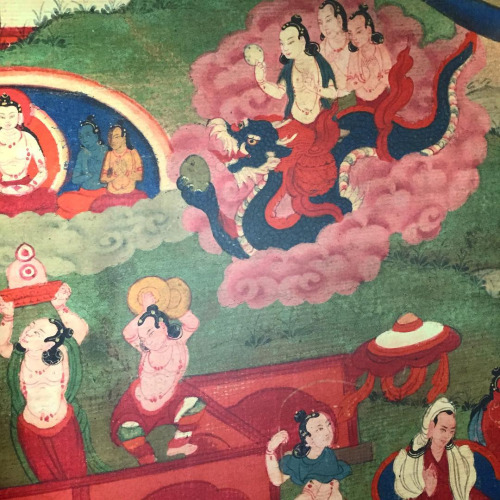
Bönpo Thanka......Musee Guimet.....Musee National des Arts

The Druk (Dzongkha: འབྲུག་) is the "Thunder Dragon" of Bhutanese mythology and a Bhutanese national symbol. A druk appears on the flag of Bhutan, holding jewels to represent wealth. In Dzongkha, Bhutan is called Druk Yul "Land of Druk", and Bhutanese leaders are called Druk Gyalpo, "Thunder Dragon Kings". During the Bhutanese mock election in 2008, all four mock parties were called the Druk Party. The national anthem of Bhutan, Druk Tsendhen, translates into English as "Kingdom of Druk".........The druk (also known as a "duk" or "dug") was adopted as an emblem by the Drukpa Lineage, which originated in Tibet and spread to Bhutan. According to traditional accounts, when the sect's founder, Tsangpa Gyare, 1st Gyalwang Drukpa, began to build Ralung Monastery, there was a violent storm. Thunder, or the "Cloud-Voice," is seen as the roar of the dragon...... Deciding that this was an omen, he named the monastery Drug-Ralung, adding the word "thunder dragon" to the name. The disciples at the monastery were known as Drugpa, or "Those of the Thunder."..... As of the 1900s, the Grand Lama of Bhutan wore a hat with thunder dragons on it to signify the origins of the sect..... As the sect became more popular, it set up monasteries in what is now Bhutan, with the result that the area became known as Dug Yul, or Land of Thunder, among both Tibetans and Bhutanese.".....

"Dzongkha (རྫོང་ཁ་; Wylie: rdzong-kha, Roman Dzongkha: Dzongkha), occasionally Ngalopkha ("language of the Ngalop people"), is the national language of Bhutan. The word "dzongkha" means the language (kha) spoken in the dzong "fortresses"—the fortress-like dzong architecture characterises monasteries established throughout Bhutan by its unifier, Ngawang Namgyal, 1st Zhabdrung Rinpoche, in the 17th century."

"The Druk Gyalpo (Dzongkha: འབྲུག་རྒྱལ་པོ་; Wylie: 'brug rgyal-po; "Dragon King") is the head of state of Bhutan. He is also known in English as the King of Bhutan...... Bhutan, in the local Dzongkha language, is known as Dryukyul which translates as "The Land of Dragons". Thus, while Kings of Bhutan are known as Druk Gyalpo ("Dragon King"), the Bhutanese people call themselves the Drukpa, meaning "Dragon people"......The current ruler of Bhutan is Jigme Khesar Namgyel Wangchuck, the 5th Druk Gyalpo."

The national flag of Bhutan (Dzongkha: ཧྥ་རན་ས་ཀྱི་དར་ཆ་; Wylie: hpha-ran-sa-kyi dar-cho) is one of the national symbols of Bhutan....The yellow signifies civil tradition and temporal authority as embodied in the Druk Gyalpo, the Dragon King of Bhutan, whose royal garb traditionally includes a yellow kabney (scarf). The orange half signifies Buddhist spiritual tradition....... The flag is based upon the tradition of the Drukpa Lineage of Tibetan Buddhism and features Druk, the Thunder Dragon of Bhutanese mythology....Historically Bhutan is known by numerous names, but the Bhutanese call the country Druk after the name of the Bhutanese thunder dragon."

"In Heaven the Turqouise Dragon Thunders
The Tiger's lightning flashes Abroad
The Lion's Mane spreads Turquoise clouds
Garuda spans the Three-fold world"
Shambhala Anthem lyrics on Dragon's Thunder: Songs of Chogyam Trungpa, Dorje Dradul of Mukpo, The Druk Sakyong.....The Sakyong holds and propagates the teachings of Shambhala, an enlightened society.....Chögyam Trungpa Rinpoche is regarded as the first in this lineage of Sakyongs, and as such he is referred to as the "Druk Sakyong", or "Dragon Earth-Protector".

"Drogon Tsangpa Gyare (1161–1211 AD)......was born into the Gya clan at a place near Kule in the Tsang province of Southern Tibet.....He met his Guru Lingchen Repa when he was 23.......After establishing Longbol (kLong rBol) and Ralung monasteries, Drogon Tsangpa Gyare went to a place called Nam Phu to build a monastery. It is said that when he and his disciples reached the place nine roaring dragons arose from the ground and soared in the sky..... The Tibetan word for dragon is 'Brug which is pronounced as 'Druk'. ....The flying dragons were taken to be an auspicious omen and the monastery and the lineage which sprang from it came to be known as the Drukpa. This school eventually became very popular in Tibet and surrounding regions. Many followers of this school were simple people, content with few material possessions, known for their deep practice of the dharma. There is a Tibetan proverb which says:
"Half the people are Drukpa Kagyupas,
Half the Drukpa Kagyupas are beggars,
And half the beggars are Drubtobs (Siddhas)."

"Kun grags ma.......gNam mtsho phyug mo, the goddess of the lake (also known as rDor rje kun grags ma or Rang byung rgyal mo in Buddhist tradition), the consort of gNyan chen Thang lha, is one of the twelve brTan ma, the ruling goddesses of Tibet. These twelve goddesses are Kun grags ma, Ya ma skyong, Kun bzang mo, bGegs kyi gtso, sPyan gcig ma, dPal gyi yum, Drag mo rgyal, Klu mo dkar mo, Bod khams skyong, sMan gcig ma, gYar mo sil and gYu sgron (in Buddhist tradition the name of each of these goddesses is preceded by the word rdo rje). Among these goddesses Kun grags ma takes precedence. She is superb, having a turquoise-coloured body, one face, two hands and three eyes of wisdom. Holding a banner of crowning victory in her right hand and a mirror of sanctity in her left, she has a great loveliness. Her indigo-blue hair hangs down to some length, and she is mounted on a Turquoise-Blue Dragon in the centre of a swirling white cloud. It is believed that Kun grags ma, the consort of gNyan chen Thang lha, is the principal one among the twelve brTan ma, the protective goddesses of Bon."......A Survey of Bonpo Monasteries by Dondrup Lhagyal, Phuntso Tsering Sharyul, Tsering Thar, Charles Ramble and Marietta Kind....Edited by Samten G. Karmay and Yasuhiko Nagano.....http://www.thlib.org/places/monasteries/publications/bon-book.php#!book=/bonpo-monasteries/wb/b5/

"The Gyalwang Drukpa's Statement on Forceful Conversion of Drukpa Monasteries (The Annual Drukpa council).....10th September 2014.......'Over the last few days I have been receiving disturbing information from Tibet regarding the forced conversion of Drukpa Lineage monasteries in the Mount Kailash region by the Karma Kagyu Lineage. My followers in Tibet tell me that nearly all of the historic Drukpa Lineage monasteries in Mount Kailash region are being forcibly occupied by the Karma Kagyu Lineage, using money, coercion and certain Chinese support. Monks of the Drukpa Lineage looking after the monasteries, are suddenly exiled from their spiritual homes by the Karma Kagyu monks.'...The Gyalwang Drukpa....The Gyalwang Drukpa.....the head of the Drukpa Lineage, one of the independent Sarma (new) schools of Vajrayana Buddhism.".....http://the17thkarmapa.blogspot.com/2014/09/the-gyalwang-drukpas-statement-on.html

"In the southern ranges of the Himalaya the myths of the dragon and of the nagas of india are mixing. Both were being mixed in the tibetan mythologic carpet under the term Klu. All different religious schools and traditions of ancient Zhangzhung and later Tibet know dragons and included them in their corpus. One highly important scripture of the Bon is named the scripture of hundred thousand dragons (Klu). It is divided into three parts: the colorful dragons, the black dragons and the white dragons. The tibetan dragon is also named Druk ('brug), Drug or Zhug as variant spellings of the same. Bhutan, the kingdom at the southern border of the Himalaya is being called Druk Yul - the land of the peaceful dragon (or: the thunder dragon land). The population consists of the Drukpa. Bhutan is the souternmost region where the tibetan buddhist sect of the Drukpa Kagyudpa ('brug pa bka' brgyud pa) can be found. Naturally the temples of this sect are called dragon temples.".....http://www.kondor.de/shaman/orient3_e.html

"You can find Druk in one corner of tibetan Prayer Flags to represent the element wood along with the horse (in the middle), the snow lion, the tiger and the khyung (Garuda). In tibetan these flags are named rLung rta - translated wind-horse or simply luck. Raising them on auspicious days increase the rLung rta of the person. The term rLung however is obviously akin to the chinese lung which translates as dragon among other meanings. Another very important meaning of this word is vital-force......Druks are living in the clouds and were later associated with gZa. .....One of the older deities of Bon is Za (gZa) who is manifesting himself in hailstorms, lightnings and energy. He has 18 faces and six arms - many deities of Tibet share this feature of multiface and multilimbs. He rides a Dragon and he causes numbness, epilepsy and madness when he is offended by blockades of normal flows of energy. Za patronizes magicians and his thanka can be seen in many monasteries".....http://www.kondor.de/shaman/orient3_e.html....

"Prayer Flags in Tibet are called lungta ("wind horse"). Traditionally, the flags would always be recognizable by the drawings of a horse at the center of the composition surrounded by four other animals—a lion, tiger, bird, and dragon...... On early Bon prayer flags, a white yak was counted as one of the four. In addition, the bird depicted on Buddhist flags is believed to be a garuda, which has its origins in Indian culture and literature, while the bird image on Bon flags has a different meaning and history.".... Himalayan Buddhist Art 101: Prayer Flags, Part 2......Jeff Watt....http://www.tricycle.com/blog/himalayan-buddhist-art-101-prayer-flags-part-2

"Another kind of tibetan spirits are the Klu which are more feared then the Druk. The myths of the Klu have mixed with the cult of the Naga in India and it is quite difficult to sort them out. The Klu are the tibetan version of the chinese water dragons and they live in fountains, rivers and seas. You can encounter them on certain special locations, too. The Klu hetched from six eggs at the dawn of creation. The king of them - Klu chen rgyal po - lives in an under water palace just like the dragonkings in china. It is to be noticed that he is being called in the more darker kind of rites to end up the lifes of the enemies quick. The female form of the Klu is Klu mo and the queen is named Yum klu mo yak. She is not one of the nice and peaceful breed and her garment are snakes.... Another much more friendly Klu mo wears a garment of cloudy silk and feathers and she patronizes young girls and women. The legendary kings of ancient Tibet before To ri long bstan had daughters of the gods and the Klu as wives. So the wive of king Gesar is named Sengjam Zhugmo, the daughter of the dragon. It is said that she was born in the thunder of a dragon. Today many women in Tibet bear the name Zhugmo. To angry one Klu can have the consequences of really bad weathers like hailstorms. Klu are regularly held responsible for illness and disease. There are certain rites to react on these more sinister deeds of them and the famous crosses of ropes play an importand part in these rites.".......http://www.kondor.de/shaman/orient3_e.html

"In Bhutan, the popularity of phallic worship is attributed to the 15th-century Buddhist teacher, Drukpa Kunley, popularly known as the “Divine Madman.” A 2011 study titled “Bhutan’s Pervasive Phallus” by French historian Francoise Pommaret and Bhutanese scholar Tashi Tobgay, says the belief in the phallus’ ability to ward off evil spirits and transform them into protective deities is traced to Drukpa Kunley, who subdued demonesses with his “thunderbolt.”....http://www.huffingtonpost.com/2014/03/03/bhutan-phallus-worship_n_4892286.html

"The 15th-century Buddhist teacher, Drukpa Kunley, popularly known as the “Divine Madman.....Drukpa Kunley (1455–1529), also known as Kunga Legpai Zangpo, Drukpa Kunleg (Tibetan: འབྲུག་པ་ཀུན་ལེགས་, Wylie: 'brug pa kun legs), and Kunga Legpa, the Madman of the Dragon Lineage (Tibetan: འབྲུག་སྨྱོན་ཀུན་དགའ་ལེགས་པ་, Wylie: 'brug smyon kun dga' legs pa), was a great master of Mahamudra in the Buddhist tradition, as well as a famous poet, and is often counted among the Nyönpa. After undergoing training in Ralung Monastery under siddha Pema Lingpa, he introduced Buddhism to Bhutan and established the monastery of Chimi Lhakhang there in 1499."....Stein, R. A. (1972). Tibetan Civilization.

Sources of Tibetan Tradition.....Page 252.....By Kurtis R. Schaeffer, Matthew Kapstein, Gray Tuttle

Dargye, Yonten (2001). History of the Drukpa Kagyud School in Bhutan (12th to 17th Century A.D.). Thimphu.

Lama Nawang Tenzin (compiler) (July 2004). The Wand That Opens the Eyes and Dispels the Darkness of the Mind. Shey, Ladakh: Pel Drukpay Tcheutsok.

Waddell, Laurence (1895). The Buddhism of Tibet Or Lamaism.

David-Neel, Alexandra. Initiations and Initiates in Tibet.

**************************

Email....okarresearch@gmail.com

March 2016

**************************

Saturday, January 10, 2015

Perennialism & the Secular Vision of Shambhala

**************************

Click Here to View the Main Index

**************************

"The Perennial philosophy (Latin: philosophia perennis), also referred to as Perennialism, is a perspective in the philosophy of religion which views each of the world’s religious traditions as sharing a single, universal truth on which foundation all religious knowledge and doctrine has grown."

"In his version of Shambhala, Chogyam Trungpa chose the story that links its origins with the Buddha and a King named Dawo Sangpo, though at times he too referred to the Shambhala legend as older and more extensive than Buddhism. In this story, the king wanted the teachings, but he wanted to retain his kingly prerogatives - ministers, musicians, dancers, feasts, the arts, and so forth. The Buddha, according to this version, dismissed his monks and gave special teachings to King Dawo Sangpo based on enlightened "rulership." Whatever their origins, the teachings have remained a part of Tibetan legendary history, and Chogyam Trungpa was inspired to renew them in a form that could be used in the twentieth century......Consistent with the legends, the most important part of the Way of Shambhala, as Chogyam Trungpa presented it, is the vision of a society that could be created in this age with sane, intelligent, and gentle people. This vision is to be realized through the disciplined application of meditation practice to our daily life. Shambhala Training, which is the method of this way, is based on traditional Buddhist meditation practice. However, instead of exploring the origins of mind and the development of ego, as Buddhism does, Shambhala begins with our actual sensual existence in the ordinary phenomenal world. It sees this existence as permeated with good energy beyond the individual self and, at the same time, blocked and distorted by our neurotic relationships to ourselves and the world......Chogyam Trungpa sketched in the outlines of what a Shambhala culture means. “Shambhala is our way of life. The Shambhala principle is our way of life. Shambhala is the Central Asian kingdom that-developed in the countries of the Middle East, Russia, China, and Tibet altogether. The basic idea of Shambhala vision is that a sane society developed out of that culture, and we are trying to emulate that vision. That particular system broke down into the Taoist tradition and Bon tradition of Tibet, the Islamic tradition of the Middle East, and whatever tradition Russia might have. It has broken into various factions.......“What we are trying to present here is that there is a comprehensive philosophy and wisdom which is not necessarily that of the West or the East. We are trying to present the possibility that we can actually bring together out of those different factions the warrior tradition of basic goodness.”.......Shambhala the Path of the Warrior by William A. Gordon.......http://www.quietspaces.com/Shambhala/kingdom.html

"Agostino Steuco (1497–1548) coined the term philosophia perennis, drawing on the neo-Platonic philosophy of Marsilio Ficino (1433–1499) and Giovanni Pico della Mirandola (1463–94)."

"In the early 19th century this idea was popularised by the Transcendentalists. Towards the end of the 19th century the Theosophical Society further popularized the concept under the name of "Wisdom-Religion" or "Ancient Wisdom". In the 20th century it was popularized in the English-speaking world through Aldous Huxley's book The Perennial Philosophy as well as by the strands of thought which culminated in the New Age movement."

"Secularity (adjective form secular, from Latin saecularis meaning "worldly" or "temporal") is the state of being separate from religion, or not being exclusively allied with or against any particular religion.....From the 1970s to 1990s, Shambhala Training explained itself as “a secular path of meditation.” It was: explicitly non-Buddhist....not a religion; without dogmatic beliefs; compatible with atheism and secular humanism......compatible with any religion, including Christianity......Secular mindfulness meditation is commonplace now, but this was radical then. Shambhala was an opportunity to learn advanced Buddhist meditation techniques without having to buy into Buddhist beliefs and institutions. For me, and tens of thousands of others, that was hugely valuable.......Officially, Shambhala Training synthesized several spiritual traditions from around the world. In reality, its founder, Chögyam Trungpa Rinpoche, drew mainly on the specific, unusual Vajrayana system he learned in Tibet....Shambhala could be understood entirely naturalistically.".... David Chapman.....https:/meaningness.wordpress.com/2014/01/09/shambhala-training-was-secular-vajrayana/

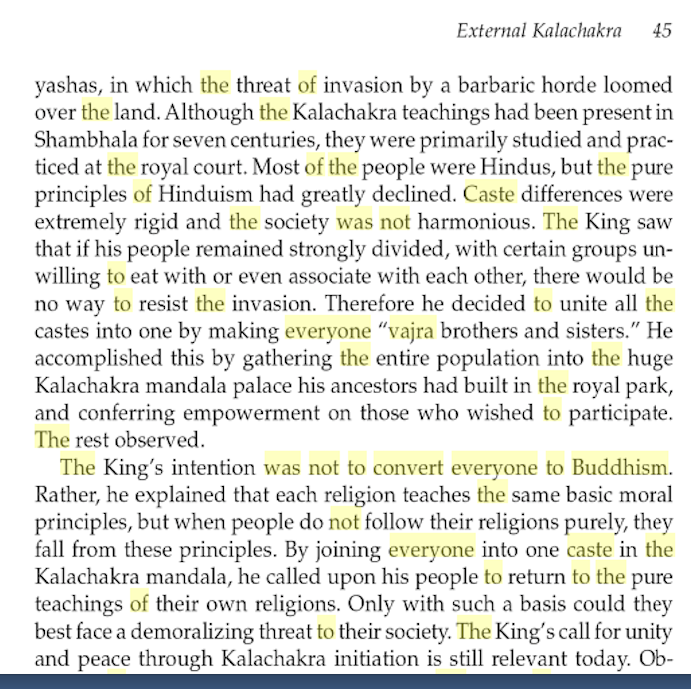
Introduction to the Kalachakra Initiation...Page 45..By Alexander Berzon

"Kalachakra and the VAJRA CASTE...."The purpose of the Vajra Caste was not force everyone to convert to Buddhism but for people to re-discover the purity of their own traditions. The Kalachakra empowerment is given to anyone who wishes to participate. No one is asked to give up their own religion. The Kalachakra, open to all who wish to participate, has the power to benefit all beings on this planet."...https://collab.itc.virginia.edu/access/content/group/9f340e95-f808-4bc0-80bc-b23bcadd072e/copyrighted%20pdfs%20of%20texts/newmanbriefhistorykalachakra.pdf

"Shahāb ad-Dīn" Yahya ibn Habash as-Suhrawardī (Persian: شهاب‌الدین سهروردی‎, also known as Sohrevardi) was a Persian philosopher, a Sufi and founder of Illuminationism, an important school in Islamic mysticism that drew upon Zoroastrian and Platonic ideas. The "light" in his "Philosophy of Illumination" is a divine and metaphysical source of knowledge. He is sometimes given the honorific title Shaikh al-ʿIshraq "Master of Illumination" and sometimes is called Shaikh al-Maqtul "the Murdered Master", referring to his execution for heresy. Mulla Sadra, the Persian sage of the Safavid era has termed Suhrawardi as "the Reviver of the Traces of the Pahlavi (Iranian) Sages", and Suhrawardi, in his magnum opus "The Philosophy of Illumination", thought of himself as a reviver or resuscitator of the ancient tradition of Persian wisdom.".....Ziai, H.(1997), “Al-Suhrawardi”, Encyclopaedia of Islam,

"Ernst Christian Ludwig von Bunsen or Ernest de Bunsen (Rome, 1819-London, 1903) was an Anglo-German writer whose speculative works proposing common origins of Buddhism, Essene Judaism and Christianity were later taken up as part of racist Aryan mythology.....The Angel-Messiah of Buddhists, Essenes and Christians (London, 1880).....

The Collected Works of Chogyam Trungpa: Volume Eight: Great Eastern Sun: Fully Human ... By Chogyam Trungpa

"Perennialism is a perspective within the philosophy of religion which views each of the world’s religious traditions as sharing a single, universal truth on which foundation all religious knowledge and doctrine has grown. According to this view, each world religion, including but not limited to Christianity, Islam, Judaism, Hinduism, Taoism, Confucianism, Shinto, Sikhism, and Buddhism, is an interpretation of this universal truth adapted to cater for the psychological, intellectual, and social needs of a given culture of a given period of history. The universal truth which lives at heart of each religion has been rediscovered in each epoch by saints, sages, prophets, and philosophers. These include not only the 'founders' of the world's great religions but also gifted and inspired mystics, theologians, and preachers who have revived already existing religions when they had fallen into empty platitudes and hollow ceremonialism......Perennialists argue that although the sacred scriptures of the world religions are undeniably diverse and often superficially oppose each other, one can discern a common doctrine regarding the ultimate purpose of human life. Typically this doctrine is posited as mystical insofar as it views the summum bonum of human life as an experiential union with the supreme being (sometimes perceived as an "energy" such as the universe) which can only be achieved by undertaking a programme of physical and mental 'purification' or 'improvement'.".....Charles Schmitt, Perennial Philosophy: From Agostino Steuco to Leibniz, Journal of the History of Ideas. P. 507, Vol. 27, No. 1, (Oct. – Dec. 1966)

"Perennialism may be contrasted with conventional religious orthodoxy or fundamentalism, which demarcates clear lines of truth and falsehood separating religions.....Orthodoxy (from Greek ὀρθός, orthos ("right", "true", "straight") and δόξα, doxa ("opinion" or "belief", related to dokein, "to think"),) is adherence to accepted norms, more specifically to creeds, especially in religion. In the Christian sense the term means "conforming to the Christian faith as represented in the creeds of the early Church"."

"Many perennialist thinkers (including Armstrong, Huston Smith and Joseph Campbell) are influenced by Hindu reformer Ram Mohan Roy and Hindu mystics Ramakrishna and Swami Vivekananda.,who themselves have taken over western notions of universalism. They regarded Hinduism to be a token of this Perennial Philosophy." .....King, Richard (2002), Orientalism and Religion: Post-Colonial Theory, India and "The Mystic East", Routledge

"Islam......From the beginning, Islam has considered itself to be the final flourishing of perennial wisdom before the “end of times”. The Qur'an is replete with references to earlier religious figures from the Jewish and Christian traditions, considering that Abraham, Moses, Jesus, Mary and other holy figures were always muslim (i.e. they submitted to god, and believed in one god only). The idea of a single religious truth is more apparent among the Sufi or mystical traditions of Islam, with parallelisms in the Judaeo-Christian and Hindu tradition, than it is among orthodox scholars, who recognise the Jewish and Christian truths, but by necessity reject all beliefs that seem contrary to Islam (such as the Trinity, the sonship of Christ, or the reality of the crucifixion). Some very vocal versions of Islam on the other hand (e.g. Salafism), reject in their entirety all other religious traditions, such as Hinduism and Buddhism.".... Classification of Knowledge in Islam by Dr. Osman Bakar, 1998

**************************

Email....okarresearch@gmail.com

John Hopkins.....Northern New Mexico….January 2015

**************************

Monday, February 24, 2014

Chogyam Trungpa: The Bon Way of Life (Page 2)

**************************

Click Here to View the Main Index

**************************

…'basic law'….."The natural law and order of this world is not “for” or “against.” Fundamentally, there is nothing that either threatens us or promotes our point of view. The four seasons occur free from anyone’s demand or vote. Hope and fear cannot alter the seasons. There is day; there is night. There is darkness at night and light during the day, and no one has to turn a switch on and off. There is a natural law and order that allows us to survive and that is basically good, good in that it is there and it works and it is efficient…..We often take for granted this basic law and order in the universe, but we should think twice. We should appreciate what we have. Without it, we would be in a total predicament. If we didn’t have sunlight, we wouldn’t have any vegetation, we wouldn’t have any crops, and we couldn’t cook a meal. So basic goodness is good because it is so basic, so fundamental. It is natural and it works, and therefore it is good, rather than begin good as opposed to bad."….Basic goodness & the genuine heart of sadness – Chögyam Trungpa

….'Bo'……gShen-rab Myi-bo….Yungdrung Bön and the Bө Murgel tradition of Buryatia…..

'Ancient Khotanese scrolls'….."Stein's greatest discovery was made at the Mogao Caves also known as "Caves of the Thousand Buddhas", near Dunhuang in 1907. It was there that he discovered the Diamond Sutra, the world's oldest printed text which has a date (corresponding to AD 868), along with 40,000 other scrolls….After the Tang Dynasty, Khotan formed an alliance with the rulers of Dunhuang."

…."ancient scrolls found in afghanistan"…(???).."Historically speaking, Dzogchen appears to have originated somewhere in Central Asia outside of both India and Tibet as Upadesha (man-ngag), or secret oral instructions, communicated privately from a realized master to a disciple. At least, that is the Tibetan tradition. In the Buddhist tradition, this mysterious region was designated as Uddiyana (Orgyan), which appears to be identifiable as Eastern Afghanistan before the Muslim era."……..Oral Tradition from Zhang-Zhung: An Introduction to the Bonpo Dzogchen Teachings of the Oral Tradition from Zhang-Zhung ~ John Myrdhin Reynolds

Great King of Bon…."The Bon tradition holds that the early kings of Tibet were adherents of Bon who gave their royal patronage to the religion and contributed to its propagation far and wide in the kingdom……The introduction of Buddhism into Tibet is interpreted as a catastrophe that caused the suppression of Bon leading to the ‘setting of the sun of the doctrine’….. "A Beginner’s Guide to the Bon Religion of Tibet by Tsering Dhundup….Tsering Dhundup, teaches English at an International Community School in London, but teaches Tibetan language at the Tibet House Trust at the weekends. He is a Buddhist and hails from the predominantly Bon area of Shar khog in eastern Tibet.

Bellezza, John Vincent. (2010). "gShen-rab Myi-bo, His life and times according to Tibet’s earliest literary sources." Revue d’Etudes Tibétaines Number 19 October 2010, pp. 31–118.

"…Bo refers to the Bo Murgel, who practice in the lands around Lake Baikal, Siberia and Mongolia. Bon refers to the teachings of Buddha Tonpa Shenrab, who came out of Zhang Zhung to Tibet around 18,000 years ago, according to the head teacher of today's Bonpo practioners. The author does prove his point, I believe, that these two cultures have common origins….comparing the ancient Bön religion with the Siberian shamanic tradition of Lake Baikal. …. the author draws on his many years of experience in both Yungdrung Bön and the Bө Murgel tradition of Buryatia to bring this subject to life and help us unlock some hidden aspects of both " ….Bo Bon: Ancient Shamanic Traditions of Siberia and Tibet in Their Relation to the Teachings of a Cen….by Dmitry Ermakov

'Lord of Taksik'….Taksik …stag gzigs…ta zig…sTag gzigs….(Trom Gesar)….."Much has been written on the identification of Trom (khrom or phrom). Geographically, it seems to refer to the Central Asian lands west of Tibet whose inroads into Tibet were via the Silk Route. Culturally, it seems to refer to the Greek or Persian culture that had permeated so far east by the eighth century. It can be no coincidence that the Galenos from Trom named above bore the same name as the celebrated Greek physician who graced the Roman courts in the second century b.c.e. Because of this, Beckwith identifies Trom with Rome. Desi Sangé Gyatso and others equate Trom with Taksik (stag gzigs, ta zig), which is tempting to identify with Tajikistan. However, the Five Chronicles, cited by Jampa Trinlé, disputes the identity of Trom with Taksik, stating that Taksik is in the west and Trom in the north. Trinlé goes on to say that some commentators place Taksik to the west of Xinjiang and north of Afghanistan, and that the Bön tradition speaks of regions called Taksik Trom and Taksik Olmo Lungring…… Pawo Tsuklak Trengwa talks of the “Hor (Mongolians) similar to the barbarian Taksik or Turks.” It may be that there is an overlap between Trom and the ancient land of Shangshung, from whence came the Bön practices. "….Mirror of Beryl: A Historical Introduction to Tibetan Medicine…. by Desi Sangye Gyatso (Author) , Gavin Kilty (Translator)

.."Shen rab was born in Sam bha la (sTag gzigs) in the west in the town called Yans pa can, in the dwelling place of the 33 Gods, the palace called Barpo so brgyad"……(Kvaerne: 1971..pg 220

'Creation of the universe….in contrast to the spirituality of Buddhism'….cultural evolution and psychological evolution….

…'nine gods created the world…attune himself to those gods…fulfill whatever is demanded by the cosmic order'

"Shiwa Okar is featured in a work composed by the influential Tibetan Buddhist lama Chögyam Trungpa, particularly a long verse epic composed in Tibet called The Golden Dot: The Epic of the Lha, the Annals of the Kingdom of Shambhala, and in terma he revealed beginning in 1976. The Golden Dot was lost in Trungpa Rinpoche's flight from Tibet in 1959. As Robin Kornman, a Buddhist scholar and student of his, explained:
“ Trungpa Rinpoche began to reconstruct the original text after escaping Tibet, and it is this later work to which we refer. The first chapter describes the creation of the world by nine cosmic gods (shrid pa 'i lha) who appear in the form of native Tibetan deities known as drala (dgra bla), or war gods. These gods represent primal or originary aspects of the phenomenal world. For example, one of these lha stood for all kinds of light. Glancing in many directions, this diety created all of the lights existing in the world, including the sun, the moon, the light of the planets and stars, and the inward luminosity of consciousness itself. Another represented space and the sense of direction ... In Trungpa Rinpoche's epic these were directed by a ninth lha called Shiwa Okar ... a sort of absolute principle behind creation and the nature of reality. After these nine cosmic deities have created the world, [Shiwa Okar] goes to the things they have created and invests each one with an animistic spirit, a drala….."…."The Influence of the Epic of King Gesar of Ling on Chogyam Trungpa" by Robin Kornman. in Recalling Chogyam Trungpa, ed. Midal. Shambhala Publications, 2005. ISBN 1-59030-207-9 pg. 363-364

shrid pa 'i lha…..

"Buddhism is normally thought of as a nontheistic tradition, and this raises the question of how such spirits, gods, and deities are to be understood within the Tibetan Buddhist framework. Certainly in Tibetan life, whether it is a question of the malevolent mamos, the potentially beneficent hearth god, the deities of the god realms, or the dharma protectors or tantric yidams, the nonhuman beings are understood at least on one level as more or less independent, objective entities. They are beings with whom one must be in constant relation, even though they are nonhuman and usually not visible…..At the same time, however, from the point of view of the philosophical and meditative tradition, all such nonhuman beings are ultimately seen as aspects of one’s own mind and not separate from it. But what does this actually mean? Frequently, particularly in the West, this standard Buddhist assertion is taken to indicate that such spirits and deities, taken as external beings by ordinary Tibetans, are not really external at all; that in fact they are mistaken projections of psychological states. This, then, becomes a justification for treating them as nonexistent and provides a rationale for jettisoning them from Western adaptations of the tradition. The problem with this approach is that it reflects a misunderstanding of what is meant by the statement that such entities are aspects of mind and inseparable from mind….. here is the really critical point: it is not only the beings of the unseen world that have this status, but all of the phenomena of duality. In the Tibetan view, ourselves, other people, trees, mountains and clouds—indeed all of the phenomena of the entire so-called internal and external universe—are nothing other than false objectifications and solidifications of nondual awareness."….On the Importance of Relating to Unseen Beings By Reginald A. Ray

Tendrel…..cosmic law…nidana…."The Tibetan word tendrel (rten ‘brel) is an abbreviation of the term ten-ching drelwar jungwa (rten cing ‘brel bar ‘byung ba). It is a translation of the Sanskrit term pratitya-samutpada, which has been variously translated as “dependent arising, dependent co-origination, interdependence, relativity, auspicious coincidence,” and so on. ."….http://nalandatranslation.org/offerings/choosing-the-right-word/dependent-arising-tendrel/

"pratītyasamūtpada dependent origination, Buddhist principle of phenomena arising in mutual dependence; equivalent to T tendel….tendrel [T rten ’brel] Tibetan translation of pratītyasamūtpada; has additional meanings of karmic connection, omen, sign of positive future event…."…http://www.routledge.com/cw/samuel-9780415456654/s1/glossary/

**************************

Sunday, February 23, 2014

Chogyam Trungpa: The Bon Way of Life (Page 1)

**************************

Click Here to View the Main Index

**************************

"…Accurate information concerning higher spiritual training in Bon is extremely difficult to obtain….information concerning 'the pure tradition' of their religion…..most of the original Bon texts were eventually destroyed or fell subject to heavy Buddhist editing…."…..

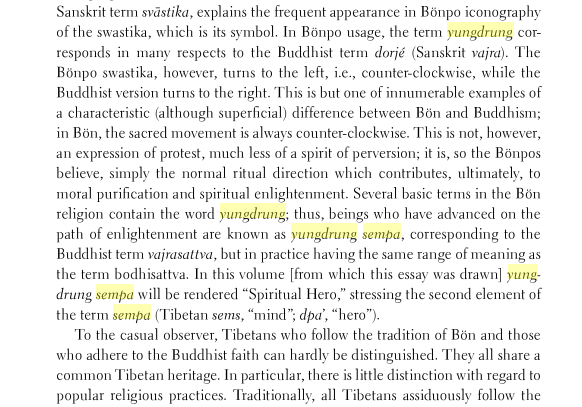
White Bon…."Bonpo believe their culture to have originated in the land of Olmo Lungring (located in a larger country referred to as Tazig)… from Tazik (stag-gzig) or Iranian speaking Central Asia to the northwest. [8] This form of Bon is known also as Yungdrung Bon (g.yung-drung bon), "the Eternal Teaching," a term which could be reconstructed into Sanskrit as "Svastika-dharma," where the swastika or sun-cross is the symbol of the eternal and the indestructable, corresponding in most every respect to the Buddhist term vajra or diamond (rdo-rje)….(http://vajranatha.com/articles/traditions/dzogchen.html)….

"An ancient statue with a swastika on it they brought back from Tibet was probably carved from a meteorite that crashed on the Siberia-Mongolia border….According to researchers, the 10-kilogram figure of the "Iron Man" which features a large swastika, a good-luck symbol in Buddhism, most likely fell from space some 15,000 years ago…… it was made in the Bon culture in the 11th century, it is absolutely priceless and absolutely unique worldwide," Elmar Buchner of the University of Stuttgart told the online journal Meteoritics and Planetary Science….a chemical analysis revealed that the statue came from the Chinga meteorite, which crashed in the area of what is now the Russian and Mongolian border."

"The work of Shenrap still exists in Tibet in the form of 400 volumes, but it has undergone heavy Buddhist editing."
Shen = divine,heavenly,ally
Rap = Supreme One
Miwo = Great Man
…Chogyam Trungpa: 1978..pg 220

Svastika in Bon represents an unchanging and indestructible quality…also connotes richness and plenty…it is often used as a symbol of wealth, appearing as a decoration on an individuals Chugle bag, a bag containing objects sacred to the God of Wealth

"Chugla is the Bon God of the wealth.It recompenses thriftiness and punishes Verschwendung (wastefulness) with poverty and all diseases, which accompany with swelling, like e.g. Ulcers. It is the protection God of the buyers and the household, its animals is sheep, Yaks and horses. It rides on a yellow horse or a lion and an identical deceives a golden hat in form of a bloom with four sheets by, as well as over its golden armament. In its rights it carries a multicolor victory banner, into its linking a scroll, from its moutha river of jewels pours."….http://wikipedia.qwika.com/de2en/Bön

"Jambhala/Kubera….In his right hand he holds a mongoose that spits out precious gems. Many people question what the association of Jambhala is with the mongoose. Art historians, depending upon folk interpretation, often explain that the mongoose became the main attribute of Jambhala because the serpents are the protectors of subterranean wealth and a mongoose controls them. Buddhist Sanskrit texts, however, refer to a different reason or story for the mongoose's association with wealth. It was said that wealthy people in ancient India carried a purse made of mongoose's hide and that when they gambled they often shook the purse. The mongoose or mongoose's hide then regurgitated gold coins and other precious things from its mouth. This seems to be the reason why in Jambhala's iconography the mongoose is always shown vomiting jewels. The mongoose that Jambhala holds then does not represent the actual creature but acts as a metaphor for his generosity."….http://www.dharmasculpture.com/product/3n48.html

"Yungdrung Sempa: Spiritual Heros…..Svastikasattva…..The Yungdrung Sempa is a vey good companion in all the worlds of Samsara…. These heros never lose (their motivation / vow)….the Bodhisattva / Yungdrung Sempa view that Samsara would be never emptied….

changchub sem [T byang chub sems] Tibetan equivalent to bodhicitta.

changchub sempa [T byang chub sems dpa’] Tibetan equivalent to bodhisattva.

byang chub sems dpa' - Bodhisattva…..Those who are in the Mahayana path are called byang chub sems dpa', or bodhisattva in Sanskrit. If there's a word you see over and over again in Tibetan Buddhist literature, this is it. There are other short forms of this, too, such as byang sems dpa'.

"…..byang chub in Sanskrit is bodhi, ……sems dpa' is spiritual warrior, sattva. The interesting part here is that sems is mind, so it's like someone who is doing a battle against one's own mind, and has conquered it, far more difficult than conquering external enemies….To be very technical, only someone who has developed ultimate compassion, or bodhichitta, is considered a byang chub sems dpa', and is on the Mahayana path…..according to the lower Middle way school, those who have developed bodhichitta, and later experience emptiness directly, they will get the seeds to not only having a realization of no self, and no subject-object differentiation, they also get the realizations of all phenomena lacking any self-existence. This is needed, as the goal is to help all sentient beings, and only an omniscient being could properly do that. "…Jigtenmig - Classical Tibetan Language Blog

"The swastika has an extensive history. It was used at least 5,000 years before Adolf Hitler designed the Nazi flag. The word swastika comes from the Sanskrit svastika, which means “good fortune” or “well-being." The motif (a hooked cross) appears to have first been used in Neolithic Eurasia, perhaps representing the movement of the sun through the sky. To this day it is a sacred symbol in Hinduism, Buddhism, Jainism, and Odinism. It is a common sight on temples or houses in India or Indonesia. Swastikas also have an ancient history in Europe, appearing on artifacts from pre-Christian European cultures….archeologist Heinrich Schliemann. Schliemann discovered the hooked cross on the site of ancient Troy……"….UNITED STATES HOLOCAUST MEMORIAL MUSEUM

" Giuseppe Tucci, David Snellgrove, and other scholars have worked to reconstruct the theology and iconography of early Bon, and have researched the question of Bon's origins, its history, and the extent of its relation to Buddhism. Tucci and other scholars believe that Bon preceded the introduction of Buddhism into Tibet. They identify divination and exorcism as central elements of the indigenous folk religion but also of Bon, and believe that both the folk religion and the more structured Bon contributed to the undeniably shamanistic aspect of Tibetan religious practice and customs. In this view, Bon brought a multiplicity of gods, demons, and spirits of nature into the Tibetan Buddhist pantheon, where they joined the gods absorbed from Indian tantrism. Tucci attributed Bon's formal doctrinal structure to a later borrowing from Buddhism. According to the standard history, Bon vied with Buddhism for dominance during the early centuries after the introduction of the new religion, and during the period between the first and second diffusions. In any case, Buddhism prevailed, but Bon, or some form of it, has survived in parts of Tibet as well as in remote Himalayan areas, such as Dolpo in northwestern Nepal, and there has recently been a Bon revival in the West. …..According to this line of thought, the Bon that has survived was so heavily influenced and infused with later adaptations and borrowings from Buddhism that its original form can no longer be definitively distinguished from what is now the majority religion. Yet Buddhism was also heavily influenced by Bon: both shared traditions of magic and exorcism, and both were influenced by the still potent "folk religion." (Tucci considers that Bon was also influenced by Persian Zoroastrianism and by Shaivism, the cult of Shiva, which reached Tibet from the states on the western edge of the Himalayas.) "…..http://library.brown.edu/cds/BuddhistTempleArt/txtfiles/Buddhism.txt

The Heart of the Buddha: Entering the Tibetan Buddhist Path (Shambhala Publications) by Chogyam Trungpa

**************************

Saturday, February 22, 2014

Chogyam Trungpa: Dege, Tibet & Mt Pago-punsum

**************************

Click Here to View the Main Index

**************************

"My birthplace was a small settlement on a high plateau of north eastern Tibet. Above it, the celebrated mountain Pago-punsum rises perpendicularly to more than eighteen thousand feet, and is often called the 'the pillar of the sky'. It looks like a tall spire; its mighty crest towers under perpetual snows, glittering in the sunshine."….Chogyam Trungpa…Born in Tibet

"….Derge (also Dêgê, Tibetan སྡེ་དགེ་, Wylie: sde dge) is a town in Dêgê County in Garzê Tibetan Autonomous Prefecture in China's Sichuan province. It was once the center of the Derge Kingdom of Kham or Eastern Tibet…..Derge was formerly the seat of the kings of the kingdom of Derge, whose 1300-year lineage was broken with the death of the last male heir in the 1990s…The town also contains several historic Tibetan monasteries, notably Palpung Monastery, Gongchen Monastery, Kathok Monastery, Palyul Monastery, Shechen Monastery and Dzogchen Monastery….

"I have kept the name Mukpo as my family name, my identity, my pride." (Trungpa:1984..pg 94)

"The Hengduan Mountain Range, which mostly runs north to south, extends through much of Garnze prefecture. The Yangtze, Meokong and Salween Rivers all cut deep gorges through this rugged range. The highest mountain in this range, and the highest mountain in Garnze prefecture, is Minya Konka མི་ཉག་གངས་དཀར་རི་བོ་, known in Chinese as Gongga Shan. This glaciated peak rises to 7556 meters. There are many other mountains in the prefecture that rise above 6000 meters, notably Trola Mountain in Dege county, which rises to 6168 meters and Mt. Chenresig in Dabpa county (Daocheng), which rises to 6032 meters."

"Que’er Shan (aka: Chola Mountain), is a prominent mountain in a virtually untouched region of Western Sichuan. This is a mountain covered year round in snow and ice. Chola Mountain is the highest peak in a glaciated range of peaks, many of which are unclimbed…..

Chola Mountain or Trola Mountain、Chola Shan、Que'er Mountain、Que'er Shan (simplified Chinese: 雀儿山; traditional Chinese: 雀兒山; pinyin: Què'ér Shān) is a mountain range in western Sichuan Province,China. Chola or Trola is Tibetan name, which means the big bird's wing. The highst peak share the same name ( Tibetan name : Rongmai Angzha ) is 6,168m. However, others claim, CHOLA is just another name for snow mountain, given by local Tibetans. The Chinese phonetic transliteration for CHOLA uses two characters: Que Er, and written so on official maps. Hence, many foreign guide books use the literal translation of the Chinese Characters: Sparrow. So, mistakenly CHOLA became "Bird Mountain". Another view presented on the origin of "Chola" was given by Sir Richard Temple in the Proceedings of the Royal Geographical Society and monthly record of Geography, Volume 3, 1881. Lake Region of Sikkim, on the Frontier of Tibet, by Sir Richard Temple(p. 334). By Royal Geographical Society (Great Britain). According to him, ...Tso is a common termination in Tibetan names, meaning water, and is sometimes pronounced tcho; in fact, Europeans cannot tell whether natives are saying tso or tcho. It mealy means a lake. Nimyetso is Nimye Lake. And I ought to take this opportunity of mentioning that the termination la means a pass, so that Chola, or Cho-la mealy means lake-pass, and Yakla, or Yak-la, is nothing more than the pass of the Yak, the famous Tibetan cow....

Yilhun Lhatso…(aka: ), located at the foot of Chola Mountain (Que’er Shan)……The turquoise glacier lake peacefully lies at the foot of the 6187m Mt. Chola (chin. Que'er Shan) in the county of Derge.

Garzê Tibetan Autonomous Prefecture (Tibetan: དཀར་མཛེས་བོད་རིགས་རང་སྐྱོང་ཁུལ་; Chinese: 甘孜藏族自治州) — is an autonomous prefecture occupying the western arm of Sichuan province, People's Republic of China. It is sometimes spelled as "Kardze" and Garzin by non-government sources……

"The concentration of Bonpo monasteries and communities in the eastern part of Tibet is attributed to the Buddhist persecution of the religion in Central Tibet during the imperial period."

"….The 2,412km long Sichuan-Tibet Highway starts from Chengdu of Sichuan on the east and ends at Lhasa of Tibet on the west. The road stretches into Lhasa passing Ya’an, Garze and Chamdo. …..Chengdu-> Xiaojin-> Danba-> Daofu-> Luhuo-> Garze-> Manigango-> Dege-> Gyamda-> Chamdo-> Bongda-> Baxoi-> Bomi-> Nyingchi-> Bayi-> Gongbo Gyamda-> Lhasa…….2412km in length with the highest point at Queer Mt. of 4916m…..Derge ……As the cultural center of Tibet, Derge has the famous Dege Printing House. A plenty of spectacular hiking possibilities exist in the backcountry. The origin of Tibetan woodcarving and engraving printing technology, Yinjing temple keeps the most delicate, complete and oldest printing procedures. Temple of Babang, Zongsa and Zuqing are also famous. Natural scenery includes New Luai, Axu Grassland…..

"Resting in a valley on the upper reaches of the Jinsha and Yalong Rivers and bordering Tibet, Dege (Derge) is the westernmost city in Sichuan before a ragged mountain trail heads to the vast Tibetan highland. It remains one of the least-explored regions of China. …..Dege was named after the Dege clan, which means 'land of mercy' in Tibetan. Historically, Dege was one of three ancient centers of Tibetan Buddhism culture, together with Lhasa in Tibet and Xiahe in Gansu. In the 17th and 18th centuries, the influence of the Dege clan covered several counties at the juncture of present-day Sichuan, Tibet and Qinghai. Dege County today sits at the heart of this ancient domain……Dege is of great historic significance as the birthplace of Khampa culture, the hometown of Gesar King and an important stop along the ancient Tea-Horse Caravans Road….."

The town of Gengqing on the reaches of the Sequ River is 500 years old, and is now the county seat of Dege. The 30-kilometer river valley was the original preserve of the Dege clan. Gengqing became a holy site in Tibetan Buddhism because it had a printing house for turning out scriptures."….Dzongsar Monastery…. located in a remote valley of southern Dege. It has a long history of progressive thinking in the Buddhist world. The monastery was founded 1200 years ago, first as a Bon monastery promulgating Tibet's traditional animist faith, later changed to the Nyingma sect, then Kagyu. 500 years ago the valley was wrested from the hands of King Gesar's generals and attached to the then-ascendent Dege Kingdom. In 1959 the most important temples were destroyed during a political movement against Liu Shaoqi, a rare instance of destruction of a Tibetan monastery prior to the Cultural Revolution….

Sichuan (Chinese: 四川; pinyin: About this sound Sìchuān, known formerly in the West by its postal map spellings of Szechwan or Szechuan) ….significant minorities of Tibetans, Yi, Qiang and Naxi reside in the western portion that are impacted by inclement weather and natural disasters, environmentally fragile, and impoverished. Sichuan's capital of Chengdu is home to a large community of Tibetans, with 30,000 permanent Tibetan residents and up to 200,000 Tibetan floating population.

The full moon calendar 1939.....
Thursday, 5 January 1939....
Saturday, 4 February 1939,....
Sunday, 5 March 1939....
Tuesday, 4 April 1939....

"..... the expedition visited Samye, which was surrounded by a three-meter-high, whitewashed wall on top of which were 2,300 small clay chörten. They were impressed by the cleanliness of the monastery, its location making Samye seem to them one of the most beautiful places in Tibet. The main temple had been renovated a few years previously under the direction of the provincial governor, making it among Tibet’s most beautiful and valuable buildings. By their estimate, the population was about 300 to 400 people, including the monks....Not far from Samye they were amazed as they approached the five white chörten of Zunggar.... “These miraculous figures, artfully sculpted out of the cliff, were still intertwined with the original stone.”.....Tibet in 1938–1939: The Ernst Schäfer Expedition to Tibet

**************************

Sunday, September 1, 2013

The Mukpo Clan & the Black Headed People

**************************

Click Here to View the Main Index

Email....okarresearch@gmail.com

**************************

MUKPO CLAN...The six clans (dong) of Tibet: Mukpo, Gade, Drupa, Denma, Shenpa, Tagrong, Dege(?)..."I have kept the name Mukpo as my family name, my identity, my pride." (Trungpa:1984..pg 94)

...."rMu bza (Mu wife) was the grandmother of Gesar." "sMug'po gdong or Idong, one of the four original tribes of Tibet from which the people of gLing were descended. Ancient saying: 'The descendants of the Mugpo Dong race think only of conquering other peoples." (Norbu: 1995..pg 5-8)

".... a thirteenth century manuscript called "The Appearance of the Little Black-Headed Man" (dBu nag mi'u dra chag), and in that case a yak is substituted for the snow lion, which had not yet emerged as the national symbol of Tibet. In the text, a nyen (wylie: gNyan, mountain spirit) kills his son-in-law, Khri-to, who is the primeval human man, in a misguided attempt to avenge his daughter. The nyen then is made to see his mistake by a mediator and compensates Khri-to's six sons with the gift of the tiger, yak, garuda, dragon, goat, and dog. The first four brothers then launch an exhibition to kill robbers who were also involved with their mother's death, and each of their four animals then becomes a personal drala (wylie: dgra bla, "protective warrior spirit") to one of the four brothers. The brothers who received the goat and dog choose not to participate, and their animals therefore do not become drala. Each of the brothers represents one of the six primitive Tibetan clans (bod mi'u gdung drug), with which their respective animals also become associated.".....Karmay, Samten G. The Arrow and the Spindle: Studies in History, Myths, Rituals and Beliefs in Tibet. Mandala Publishing: 1998 pg. 420

"The term "Sumerian" is the common name given to the ancient non-Semitic inhabitants of southern Mesopotamia, Sumer, (4th millennium BC).....by the Semitic Akkadians. The Sumerians referred to themselves as ùĝ saĝ gíg-ga (cuneiform: 𒌦 𒊕 𒈪 𒂵), phonetically uŋ saŋ giga, literally meaning "the black-headed people"....... W. Hallo, W. Simpson (1971). The Ancient Near East. New York: Harcourt, Brace, Jovanovich. p. 28.

The garuda and the dragon have their origin in Indian and Chinese mythology, respectively. However, regarding the origin of the animals as a tetrad, "neither written nor oral explanations exist anywhere" with the exception of a thirteenth century manuscript called "The Appearance of the Little Black-Headed Man" (dBu nag mi'u dra chag), and in that case a yak is substituted for the snow lion, which had not yet emerged as the national symbol of Tibet.

Within the territory of Olmo Lung-ring there are seven royal races (rgyal rigs) and chief among them is the clan of Mu shen (dmu-gshen) from which Tonpa Shenrab descended. Thus the word "gshen" is also the name of a clan, as well as the term for a kind of practitioner. Besides the Mushen, there were six more royal races or clans (rgyal rigs) ruling in Olmo Lung-ring: "Hos", "Shag", "dPo", "rGya", "gTo", and "gNyan". There are also classes of ministers, merchants, artisans, commoners, and so on.

Tonpa Shenrab was born at the palace Barpo Sogye of Tagzig Olmo Lung Ring. His father was Gyalbon Thodkar of the Mu clan and his mother Yonchi Gyalzhedma.

The major ancestral tribes of Tibet ....
The Se (se), closely associated with the Azha (a zha) tribe
The Ba (sbra or dbra)
The Dön (ldon, ‘don, gdon, sdon) associated with Minak (mi gnag)
The Tön (ston, gton, don) associated with Sumpa (sum pa)
The Ga (lga, sga, rga, dga’)
The Dru ('bru) divided into white, black and mixed
The Ma or Mu (smra, rma, dmu, rmu, smu) which corresponds with the clan name of the founder of Bon
The Wa and Da (dpa, zla)
The Go (sGo)
(R.A. Stein, in Les Tribus Anciennes des Marches Sino-Tibetaines)

..."The personal 'shen' of the Shangshung King Thothori was of the Mu clan." (Stein: 1972..pg 230)

...."Shenrab Miwo's clan is considered to be descended from the bMu deities, an ancient class of celestial deities. dMu is also the name of one of the four original tribes of Tibet." (Tharthang: 1986..pg 114)

..."According to legend, a messenger of Phyva goes to the heaven of dMu, asking for a dMu king to rule over the black headed men." (Bansal: 1994..pg 86)

..."then the dMu people, belonging to gShen rabs forefather dMu-rgyal"..(Francke: 1950: 169)

....."one of the six semi-legendary royal races of Olmolungring: dMu, dPo, Shag, rGya, gNyan, Hos"..(Norbu: 1995..pg 271)...

"The Bonpo texts further speak of the three portals or doors of Zhang-zhung and some of these texts assert that Tazig is the middle door (sgo bar-ma). According to Lopon Tenzin Namdak, the outer door (sgo phyi-pa) is Zhang-zhung itself, the middle door (sgo bar-ma) is Tazig, and the inner door (sgo phug-pa) is Olmo Lung-ring. From the innermost gate outwards this represents the movement or progress of the teachings of Yungdrung Bon into the outer world and especially Tibet. At that time Tazig was said to have been inhabited by the "sTag-gzig hos rigs", the royal race (rgyal rigs) of the "Hos" or Persians (the Chinese "Hu"). But in an even earlier time the people belonged to the lineage of the "rGyal-bu 'thing-ge". And in the "Ma-rgyud" is found the story of the emperor Gyer-wer of Tazig who ruled most of the known world......Within the territory of Olmo Lung-ring there are seven royal races (rgyal rigs) and chief among them is the clan of Mu shen (dmu-gshen) from which Tonpa Shenrab descended. Thus the word "gshen" is also the name of a clan, as well as the term for a kind of practitioner. Besides the Mushen, there were six more royal races or clans (rgyal rigs) ruling in Olmo Lung-ring: "Hos", "Shag", "dPo", "rGya", "gTo", and "gNyan"......http://www.surajamrita.com/bon/Shambala.html

..."gdong: face, a synonym of cha-chen; clan, beak, countenance"...For a description of the different lineages see: (Karmay: 1972)

"Based on the statuaries and steles of Babylonia, the Sumerians were “of dark complexion, short stature, but of sturdy frame, oval face, stout nose, straight hair, full head; they typically resembled the Dravidians, not only in cranium, but almost in all the details.” (A Study in Hindu Social Polity by Chandra Chakaberty, Delhi: Mittal Publications, 1987, pg. 33)

"The Cyrus the Great Cylinder is said to be the first charter of right of nations in the world ... Cyrus says there that he shepherded with justice and righteousness all the black-headed nations that he conquered their lands....The phrase "black-headed people" ocurs very often in sacred cuneiform texts.... in a prayer to Nergal, there exists the verse "Bel, thy father, hath given thee the Black-headed people, all living creatures."......

".....the inscriptions of the Sumerian King Shulgi (c. 2161 - 2113 BC)..... "The theme of the black-headed people is recurrent and appears twice in Shulgi C, once in Shulgi P, and once in Shulgi V.... it seems that there was an ethnic difference between the barbarous Gutians and all of the black-headed people of ancient Mesopotamia, not between the Sumerians and Akkadians."....http://www.gmalivuk.com/otherstuff/fall02/echanows.htm

"The title Shenrab Miwoche means ‘the great human being who is the supreme Shen practioner.’ The ancient word gshen is untranslateble and is sometimes used as a synonym for Bon and Bonpo. Shen was also the name of the clan to which Tonpa Shenrab belonged, that is, dMu-gshen, the celestial Shen. The Shen clan (gshe gdung-rus) continues as one of the principal Bonpo lineages even today. In the early days, transmission of the teachings was often through family lineages.” -Bonpo Dzogchen Teachings.....http://bonpo.wordpress.com/

dMu Demons. On occassion, identified as dMu, Lha, Lha, Hindu Deva, rMu, rMu, lha or lha.
dMu-bDud Kam-Po Sa-Zan A Bon sky god. Also commonly referred to as dMu-bDud Kam-Po Sa-Zan.
dMu-rgyal Early ancestors of the race. These were the first beings to employ ritual and magic. They were followed by the 'dre. At times, known as dMu-rgyal.

"Nangzher Lopo (snang bzher lod po) was born in the eighth century somewhere near Darok Tso, a large freshwater lake located in the western Changtang (byang thang)....on his father's side, Nangzher Lopo belonged to the Gurib (gu rib; also: gu rub), a clan native to Zhangzhung (zhang zhung). Zhangzhung was a kingdom that flourished in western Tibet until being annexed by the Tibetan emperor Songtsen Gampo (srong btsan sgam po) in the seventh century. The Gurib clan, which continues to this day, was derived from the Mu (dmu), one of the greatest and most ancient genealogical groupings in Tibet......Nangzher Lopo mastered many Bon traditions and ritual practices as a younger man. The chief teacher of Nangzher Lopo was Tapihritsa (ta pi hri tsa), the last master of an exclusively orally transmitted mind training lineage known as the Zhangzhung Nyengyu (zhang zhung snyan rgyud), an important school of Bon Dzogchen."....http://treasuryoflives.org/biographies/view/Nangzher-Lopo/13164

**************************

Email....okarresearch@gmail.com

John Hopkins.....Northern New Mexico….September 2013

**************************

Wednesday, March 27, 2013

Shambhala Vision: Secular, Sectarian & Rime

**************************

Dzogchen Explorations

Okar Research

**************************

"The Shambhala teachings, originally conceived by Chögyam Trungpa as Secular practices for achieving enlightened society.....Shambhala, as originally proclaimed by Chögyam Trungpa, which state that "there is a natural source of radiance and brilliance in the world, which is the innate wakefulness of human beings. This is the basis, in myth and inspiration, of the Kingdom of Shambhala, an enlightened society of fearlessness, dignity and compassion." Furthermore, Shambhala vision applies to people of any faith, not just people who believe in Buddhism... the Shambhala vision does not distinguish a Buddhist from a Catholic, a Protestant, a Jew, a Moslem, a Hindu. That's why we call it the Shambhala kingdom. A kingdom should have lots of spiritual disciplines in it.".....Trungpa, Chogyam (1999). "Great Eastern Sun - The Wisdom of Shambhala". ISBN 1-57062-293-0

"After the year 2000, with the merging of the secular teachings of Shambhala and the Buddhist teachings of Vajradhatu into Shambhala Buddhism, completion of Shambhala Vajrayana Seminary (which itself requires taking Buddhist refuge and bodhisattva vows, as well as Buddhist vajrayana samaya vows) became a condition for receiving the highest Shambhala teachings, such as those of Werma and the Scorpion Seal Retreat. Taking Refuge requires that one is not actively involved in any other religion than Buddhism."...http://en.wikipedia.org/wiki/Shambhala_Buddhism

"The word secular simply means "not related specifically to religion or to a particular religious group." ......One way of categorizing kinds of schools is by whether they are secular (sometimes called non-sectarian) or sectarian. .....Secularity is best understood, not as being "anti-religious", but as being "religiously neutral"......Secular and secularity derive from the Latin word saecularis meaning of a generation, belonging to an age.".....http://en.wikipedia.org/wiki/Secularity

"Sectarian tends to be defined as a particular sect, often religious......Sectarianism includes the idea that the particular sect to which one belongs is the right and proper one, and that others belonging to other sects, even if they’re still of the same overhead religious group have it completely wrong.....Members of a religious or political group may believe that the success of their particular objectives, requires aggressively seeking converts from other groups."......http://en.wikipedia.org/wiki/Sectarian

"Rime Movement, the Non-sectarian movement......"Rime (pronounced Ree-may), in its spirit, is non-sectarian. Rime is a movement within Tibetan Buddhism where a person studies not just one lineage of Tibetan Buddhism, but studies and learns from many. The point is to preserve many of the teachings and traditions and also to remove sectarian views.....All the great Rime practitioners, they learned from the other traditions, but they kept their tradition or lineage as the centerpiece of their practice......

"Jamgön Kongtrul Lodrö Tayé (Tib. འཇམ་མགོན་ཀོང་སྤྲུལ་བློ་གྲོས་མཐའ་ཡས་, Wyl. ‘jam mgon kong sprul blo gros mtha’ yas) (1813-1899) - widely known for synthesizing the knowledge and experience of the many lineages of Buddhism in Tibet. This synthesis is recorded in 'The Five Great Treasures'. He was recognized by all schools of Buddhism in Tibet as one of the greatest masters of the Rimé (ecumenical) movement.

"Rojak" is a mishmash.....Malaysia is somewhat akin to "rojak". It is a mishmash of culture, religion, customs, people and language all rolled in one......Malaysia indeed is one of the few countries in the world where the major cultures and religions meet in one huge melting pot...On the island of Penang, the "rojak" of different Buddhist traditions become even more interesting, as traditional Straits Chinese lace their temples side by side with Burmese stupas, Thai wats, Sinhalese viharas and Tibetan centres. It is here, in Penang, that Malaysian Buddhism pays its true homage to the vibrant diversity of the various schools that dot ."....http://www.centrebouddhique.net/content/view/124/31/

"Ecumenical......Of worldwide scope or applicability; universal......Concerned with establishing or promoting unity among churches or religions.....[From Late Latin oecmenicus, from Greek oikoumenikos, from (h) oikoumen (g), (the) inhabited (world), feminine present passive participle of oikein, to inhabit, from oikos, house; see weik-1 in Indo-European roots.]."......http://www.thefreedictionary.com/ecumenical

"The Kalachakra refers to many different traditions, for example the Hindu; Saivite, Samkya, Vaishnava, the Vedas, Upanisads and Puranas traditions, but also Jainism. For example, the Kalachakra mandala includes deities which are equally accepted by Hindus, Jainas and Buddhists.".....http://en.wikipedia.org/wiki/Kalachakra

**************************

Email....okarresearch@gmail.com

John Hopkins.....Northern New Mexico….March 2013

**************************

Friday, March 8, 2013

Skandhas: Five Human Attributes

**************************

Click Here to View the Main Index

**************************

"In Buddhist phenomenology and soteriology, the skandhas (Sanskrit) or khandhas (Pāli, aggregates in English) are the five functions or aspects that constitute the human being. The Buddha teaches that nothing among them is really "I" or "mine"....Prior to the Buddha, the Pali word khandha had very ordinary meanings: A khandha could be a pile, a bundle, a heap, a mass. It could also be the trunk of a tree. In his first sermon, though, the Buddha gave it a new, psychological meaning, introducing the term clinging-khandhas to summarize his analysis of the truth of stress and suffering. Throughout the remainder of his teaching career, he referred to these psychological khandhas time and again."..... Thanissaro Bhikkhu, Five Piles of Bricks: The Khandas as Burden and Path. Access to Insight. 2002.

"The five skandhas….
"form" or "matter" (Skt., Pāli rūpa; Tib. gzugs): external and internal matter. Externally, rupa is the physical world. Internally, rupa includes the material body and the physical sense organs.\
"sensation" or "feeling" (Skt., Pāli vedanā; Tib. tshor-ba): sensing an object as either pleasant or unpleasant or neutral.
"perception", "conception", "apperception", "cognition", or "discrimination" (Skt. samjñā, Pāli saññā, Tib. 'du-shes): registers whether an object is recognized or not (for instance, the sound of a bell or the shape of a tree).
"mental formations", "impulses", "volition", or "compositional factors" (Skt. samskāra, Pāli saṅkhāra, Tib. 'du-byed): all types of mental habits, thoughts, ideas, opinions, prejudices, compulsions, and decisions triggered by an object.
"consciousness" or "discernment" (Skt. vijñāna, Pāli viññāṇa, Tib. rnam-par-shes-pa):

"Trungpa says when we are working with emotions we are dealing with the fourth and fifth skandhas, concept and consciousness. Our emotional discomfort comes from a conflict between our ego which wants to be in control, and fundamental ignorance, our lack of understanding of the true nature of our emotions, which is energy, merely phenomenon arising in the moment. As a result of this conflict we experience ambivalence and an inability to make an informed decision about. For example: I have to choose between going to dinner with friends or staying home going to bed early and getting some rest. In that moment of confusion conceptional mind starts rationalizing the situation and it's like having two voices in my head, one arguing that I should go out and the other one arguing that I should stay home. Trungpa calls this way of finding our way in the world “crude and childish.” We create the illusion of security through categorization, analyzing how thoughts fit together, putting them in boxes and trying make decisions, all in an effort to create a sense of security. This effort freezes the energy that our emotions really are and as Trungpa says “the world is seen as being absolutely solid and stiff. Everything is frozen movement, frozen space, solidified. . . We see the colors as they are, but somehow they are plastic colors rather than rainbow colors. And this solid quality is the dualistic barrier. . .” Like Machig Labdrön before him Trungpa suggests a similar way out of this painful dualistic relationship with emotions. Practice relating to our emotions in their fundamental state, as energy. Once we do this the fear, paranoia and shame drop away and we can relate to powerful emotions properly. Trungpa says “Then you are like someone who is completely skilled in his profession, who does not panic, but just does his work completely, thoroughly.”x So how do us mere mortals learn to do this? We need skillful means to help us learn to work with emotions. Working with our demons as Machig Labdrön teaches, cuts through the dualism and then we can work with the fundamental energy of our emotions."

"Skandha (devanāgarī: स्कन्ध) is a Sanskrit term usually translated as "aggregate". It used in Buddhism to refer to the five functions or aspects that constitute the human being. In Theosophy the concept is frequently used in a similar (albeit not identical) way, though they are regarded to constitute the personality, not the totality, of a human being.....

"In Theosophy, skandhas are defined them as follows:Skandha or Skhanda (Sk.). Lit., “bundles”, or groups of attributes; everything finite, inapplicable to the eternal and the absolute. There are five —esoterically, seven— attributes in every human living being, which are known as the Pancha Shandhas. These are (1) form, rûpa; (2) perception, vidâna; (3) consciousness, sanjnâ; (4) action, sanskâra; (5) knowledge, vidyâna. These unite at the birth of man and constitute his personality. After the maturity of these Skandhas, they begin to separate and weaken, and this is followed by jarâmarana, or decrepitude and death."....Helena Petrovna Blavatsky, The Theosophical Glossary (Krotona, CA: Theosophical Publishing House, 1973)

**************************

Email....okarresearch@gmail.com

John Hopkins.....Northern New Mexico….March 2013

**************************