Thursday, March 5, 2015

Khyungtrul Jikme Namkha Dorje (1897-1955) Rimé/Bon

**************************

Click Here to View the Main Index

**************************

Notes on the famous Bon/Rimé lama Khyungtrul Jikme Namkha Dorje (Khyung-sprul ’jigs-med nam-mkha’ rdo-rje),
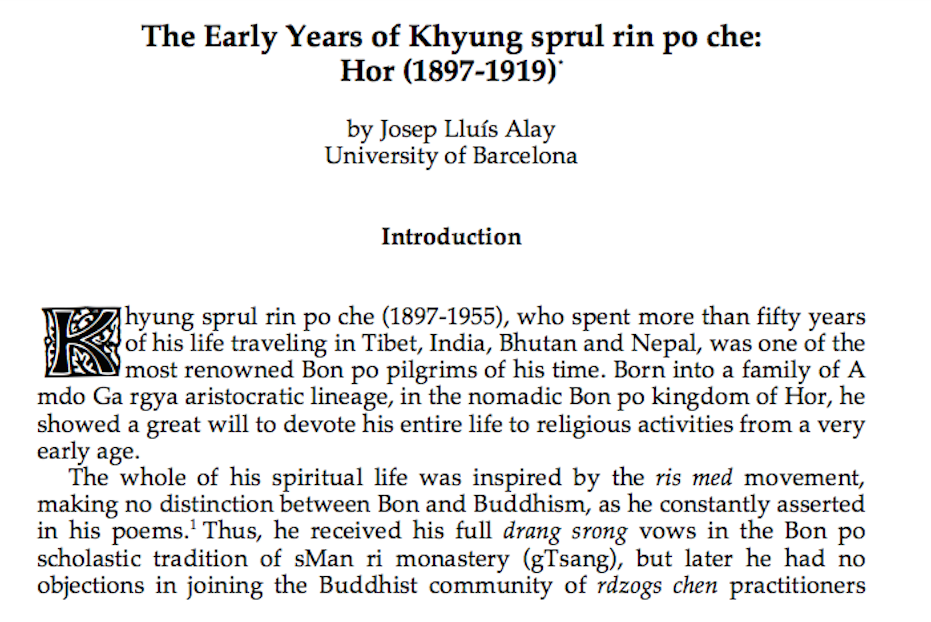
Josep Lluís Alay Rodríguez.....The Early years of Khyung sprul rin po che: Hor (1897-1919), Revue d'Etudes Tibetaines 20, 205-230, 2011....the director of Heritage, Museums and Archives of the City Council . He is also Professor of Contemporary History of Tibet and Mongolia at the Faculty of Geography and History the University of Barcelona ....In 2010 he received a doctorate in Contemporary History from the University of Barcelona with a thesis on the Lama Tibetan Khyung Sprul Rin Po Che : Khyung Sprul Rin Po Che, A beggar Tibetan: his life and travel in Kinnaur and Western Tibet.

".....The second Orgyan visiter who came there from Tibetan-speaking regions, Khyungtrul, (1897-1955)....a Bönpo, went there somewhere toward the mid-20th century. He tells the story in chapter eleven of his autobiography. By some weird coincidence — or is it? — this same Khyungtrul was perhaps Giuseppe Tucci's (1894 – 1984) best friend among the western Tibetans. They bumped into each other not only near Kailash, but also in lushly green Kinnaur."......http://tibeto-logic.blogspot.com

The Dawn of Tibet: The Ancient Civilization on the Roof of the World.....By John Vincent Bellezza

Pilgrimage in Tibet.....By Alex McKay

Giuseppe Tucci, Travels of Tibetan Pilgrims in the Swat Valley, Greater India Society (Calcutta 1940). But the original publication is quite rare, so you are more likely to find it as reprinted here: Giuseppe Tucci, Opera Minora, Giovanni Bardi (Rome 1971), vol. 2, pp. 369-418.

Per Kvaerne, Khyung-sprul ’Jigs-med nam-mkha’i rdo-rje (1897-1955): An Early Twentieth-Century Pilgrim in India, contained in: Alex McKay, ed., Pilgrimage in Tibet, Curzon (Richmond 1998)

"Fortress Face (Mkhar-gdong) is located in southwestern Tibet, in the upper Sutlej valley. This site was equated with the fabled Horned Eagle Valley Silver Castle (Khyung-lung dngul-mkhar) by the famous Bon lama Khyungtrul Jikme Namkha Dorje (Khyung-sprul ’jigs-med nam-mkha’ rdo-rje), some 70 years ago. Of course, in Tibetan literature, Horned Eagle Valley Silver Castle is recorded as the main capital of the Zhang Zhung kingdom. The highly degraded ruins of Fortress Face cover approximately 20,000 m², making it one of the largest ancient strongholds in Upper Tibet. In addition to the parapet wall that once lined much of the rim of the mesa, the summit is blanketed in piles of rubble and depressions. There are also small standing wall segments on the summit, but not enough remains intact to gauge ground-plans. Nonetheless, from the amount of debris dispersed on the site it would appear that significant structures once stood here......According to three elderly disciples of Khyungtrul Jikme Namkha Dorje I have had the opportunity to interview, this lama pronounced Castle Face the Horned Eagle Valley Silver Castle after discovering what he believed was a statue of the 8th century CE Bon saint Drenpa Namkha (Dran-pa Nam-mkha’) at the site. Bon sources tells us that Drenpa Namkha’s father, Gyungyar Mukö (rGyung-yar mu-Khod), was the king of Zhang Zhung; his capital none other than Horned Eagle Valley Silver Castle....This identification of Fortress Face with horned Eagle Valley Silver Castle, however, escaped Giuseppe Tucci during his 1935 to the region.".....Professor David Germano.....http://www.tibetarchaeology.com/may-2011/

Colin Millard, The Life and Medical Legacy of Khyung sprul ’Jigs med nam mkha’i rdo rje (1897-1955)

"The Rimé movement is a movement involving the Sakya, Kagyu and Nyingma schools of Tibetan Buddhism, along with Bon scholars......Having seen how the Gelug institutions pushed the other traditions into the corners of Tibet's cultural life, Jamyang Khyentse Wangpo and Jamgön Kongtrül compiled together the teachings of the Sakya, Kagyu and Nyingma, including many near-extinct teachings. Without Khyentse and Kongtrul's collecting and printing of rare works, the suppression of Buddhism by the Communists would have been much more final..... Rimé movement was universalistic (and encyclopaedic), rimed (pa) (the antonym of risu ch'edpa) meaning unbounded, all-embracing, unlimited, and also impartial."......Seyfort Ruegg quoted in Samuel, Goeffrey (1993). Civilized Shamans. Buddhism in Tibetan Societies, p. 538

"From June to August 2012, a survey and excavation to the Khardong city-site (so called “Khyung-lung dngul-mkhar”) and the Garuda cemetery have been conducted jointly by Institute of Archaeology, CASS and Tibetan Institute of Antiquities Preservation. The new findings reveal that the Garuda cemetery is a site which contains a large number of tombs from the Zhangzhung period, contemporary to the Han-to-Jin period in the Central Plain of China, and it bears a close relationship with the city-site of “Khyung-lung dngul-mkhar”..... it could be rated as the hitherto found earliest city-site in Tibet, and also one of the well preserved city-site with richest cultural deposits. Though the date of construction and being used is waiting for further study, the new findings are of great value for researches on the Zhangzhung city’s layout and evolution."...New Discovery of Zhangzhung Archaeology in Ngari, Tibet.....From:Chinese Archaeology Writer:Tong Tao Date:2012-09-03

**************************

Email....okarresearch@gmail.com

March 2015

John Hopkins....Northern New Mexico

**************************

Wednesday, March 4, 2015

Udegram: Uḍḍiyāna & the Palace of King Indrabhuti

**************************

Click Here to View the Main Index

**************************

"Uḍḍiyāna is mostly known as the legendary homeland of Padmasambhava, the great teacher who, summoned to Tibet by the king Trisong Detsen in the mid-eight century AD, introduced there an esoteric form of Buddhism – an inextricable melding of magic and mysticism – which is thought to be at the roots of Vajrayāna. Much less is known about Uḍḍiyāna as a historical region, which archaeology has long since identified with an area centred on modern-day Swat (north-western Pakistan). Excavations and surveys revealed here an astonishing wealth of Buddhist remains and civil settlements that to a large extent match the ancient topography of Uḍḍiyāna as described in Indian, Greek, Chinese and Tibetan sources."....http://www.oeaw.ac.at/uddiyana

"Udegram: the Castle (5th-14th cent. AD), tentatively identified by Tucci as the Palace of Indrabhuti described by Tibetan pilgrims"....http://www.oeaw.ac.at/uddiyana/

Click on the map to enlarge

"... the Chinese pilgrim Song Yun, who visited the country in 520 AD, convey to us a vivid picture of Uḍḍiyāna: the pleasant weather, the abundance of crops, the sound of the bells that in the evening clang from the many Buddhist monasteries, the colours of the flowers that, everywhere and in every season, the land produces and people offer to the Buddha....... Much different, one century later, are the words of another famous Chinese pilgrim, Xuanzang. He describes scarce crops, ruined monasteries, and a small population of monks who, incapable of understanding the true meaning of the doctrine, seem to be instead committed to magic and charms.".....http://www.oeaw.ac.at/uddiyana/

"Song Yun and his companions then travelled through Chitral and met the kings of the Swat Valley or Udyana.".....Chavannes, Édouard (1903). Voyage de Song Yun dans l'Udyāna et le Gandhāra. (in French)

Panorama of the Swat valley from above Udegram fort....Benjamin J. Fleming. ....http://www.sas.upenn.edu/~bfleming/material_culture/neelis.html

"Swat has been inhabited for over two thousand years and was known in ancient times as the Udyana.... In 327 BC, Alexander the Great fought his way to Udegram and Barikot and stormed their battlements. In Greek accounts, these towns have been identified as Ora and Bazira, respectively.... by 305 BC, the region had become a part of the Mauryan Empire....

"Bazira (Old Indian: Vajira): citadel in the vallet of the river Swat, captured by Alexander the Great, modern Barikot in Pakistan."

"Systematic archaeological investigations have been carried out since 1956 by the Italian Archaeological Mission in Pakistan (IAMP) of the IsIAO (Italian Institute for Africa and the Orient, formerly IsMEO, Italian Institute for Middle and Far East) in close collaboration with the Department of Archaeology and Museums, Govt. of Pakistan...... Among excavated sites, mention must be made of the Buddhist centres of Butkara I, the main Buddhist settlement of the region, identified by Tucci (1978: 60-61) as the splendid Talo/Tolo visited by Songyun and the Dhumatʻala of the Tibetan pilgrim O rgyan pa (Id.: 1971: 369 ff., 396 ff., 399), Saidu Sharif I, Panr I and Gumbat, and of the urban sites of Aligrama, Udegram (Ora/Oḍi in Greek and Indian sources), and Barikot (Bīr-koṭ-ghwaṇḍai; Bazira/Vajīrasthāna in Greek and Indian sources).".....http://www.oeaw.ac.at/uddiyana/

"Practically everyone in Tibetan Studies has long been convinced that the Swat Valley, in northern Pakistan, is the same as Orgyan, the birthplace of the Tibetan cultural hero Guru Rinpoché — Pemajungné, Padmasambhava, also known as Orgyan Guru."....http://tibeto-logic.blogspot.com

"Tibetanists believe Swat Valley is none other than Orgyan is because of the account of the Drugpa Kagyüpa teacher Orgyanpa Rinchen Pal, who went there in the 13th century. Giuseppe Tucci half a century ago published a long article tracing Orgyanpa’s itinerary....Not many other Tibetan speakers actually reached Orgyan and returned to tell the tale. The only ones I know of with certainty are Tagtsangrepa and Khyungtrul. "....http://tibeto-logic.blogspot.com

"Tagtsangrepa Ngawang Gyatso...is best remembered as the founder of Hemis Monastery in Ladakh."......http://tibeto-logic.blogspot.com

".....The second Orgyan visiter who came there from Tibetan-speaking regions, Khyungtrul, (1897-1955)....a Bönpo, went there somewhere toward the mid-20th century. He tells the story in chapter eleven of his autobiography. By some weird coincidence — or is it? — this same Khyungtrul was perhaps Giuseppe Tucci's (1894 – 1984) best friend among the western Tibetans. They bumped into each other not only near Kailash, but also in lushly green Kinnaur."......http://tibeto-logic.blogspot.com

The Dawn of Tibet: The Ancient Civilization on the Roof of the World.....By John Vincent Bellezza

"...The original Sanskrit name of Swat — both the river and its valley — is Suvastu."

"... It is said that the Swat valley was filled with fourteen hundred imposing and beautiful stupas and monasteries, which housed as many as 6,000 gold images of the Buddhist pantheon for worship and education."

"In the spring of 326 BCE, Alexander the Great conquered the beautiful valley of the river Swat. While he was besieging Massaga, his adjutant Coenus was sent to Bazira, but he failed to take the fort. Although Alexander came to his assistance, he decided to take nearby Ora first, which was larger and seemed to be on the point of receiving reinforcements. ....Coenus therefore built a fortified camp to check the inhabitants of Bazira, who belonged to the tribe of the Assaceni. Seeing that the Macedonians had taken up defensive positions, the Indians attacked their enemies, but they were defeated by the soldiers of Coenus. The siege of Bazira continued until Ora had been taken. When the defenders learned that the other fort had fallen, they fled across the Shang-La pass to Aornus, a rock citadel near the Indus."....http://www.livius.org/place/bazira-barikot/.....

Arrian, Anabasis 4.27-28

Aurel Stein, On Alexander's Track to the Indus (1929, 2003) 35-42

Giuseppe Tucci, Travels of Tibetan Pilgrims in the Swat Valley, Greater India Society (Calcutta 1940). But the original publication is quite rare, so you are more likely to find it as reprinted here: Giuseppe Tucci, Opera Minora, Giovanni Bardi (Rome 1971), vol. 2, pp. 369-418.

Per Kvaerne, Khyung-sprul ’Jigs-med nam-mkha’i rdo-rje (1897-1955): An Early Twentieth-Century Pilgrim in India, contained in: Alex McKay, ed., Pilgrimage in Tibet, Curzon (Richmond 1998)

**************************

Email....okarresearch@gmail.com

March 2015

John Hopkins....Northern New Mexico

**************************

Tuesday, February 24, 2015

Eusebeia & Dharma on the Edict of King Ashoka at Kandahar (258 BC)

**************************

Click Here to View the Main Index

**************************

"Venerate me and make offerings."

"Eusebeia (Greek: εὐσέβεια from εὐσεβής "pious" from εὖ eu meaning "well", and σέβας sebas meaning "reverence", itself formed from seb- meaning sacred awe and reverence especially in actions) is a Greek word abundantly used in Greek philosophy as well as in the New Testament, meaning to perform the actions appropriate to the gods. The root seb- (σέβ-) is connected to danger and flight, and thus the sense of reverence originally described fear of the gods."

Click on the map to enlarge

Bilingual (Greek and Aramaic) inscriptions by king Ashoka at Kandahar (Shar-i-kuna). (3rd century BC). Preserved at Kabul Museum. ...Fragments of Edict 13 have been found in Greek, and a full Edict, written in both Greek and Aramaic has been discovered in Kandahar. It is said to be written in excellent Classical Greek, using sophisticated philosophical terms. In this Edict, Ashoka uses the word Eusebeia ("Piety") as the Greek translation for the ubiquitous "Dharma"

"Eusebeia..... (ευσεδεια)...( Greek)......meritorious piety; ‘to change nothing of what our forefathers have left behind’ – this is eusebeia (Isocr.7.30); for Platonists, piety means not simply bringing the sacrificial offerings and fulfilling of cultic duties, but also humility, supported by philosophy and combined with love ( eros), faith ( pistis) and knowledge ( gnosis) that finally lead to assimilation to God."....The Golden Chain: An Anthology of Platonic and Pythagorean Philosophy, by Dr. Algis Uždavinys

"The word was used in Classical Greece where it meant behaving as tradition dictates in one's social relationships and towards the gods. One demonstrates eusebeia to the gods by performing the customary acts of respect (festivals, prayers, sacrifices, public devotions). By extension one honors the gods by showing proper respect to elders, masters, rulers and everything under the protection of the gods."

"Dharma (/ˈdɑrmə/; Sanskrit: धर्म dharma, Pali: धम्म dhamma) is a key concept with multiple meanings in the Indian religions Hinduism, Buddhism, Sikhism and Jainism.....In Hinduism, dharma signifies behaviors that are considered to be in accord with rta, the order that makes life and universe possible, and includes duties, rights, laws, conduct, virtues and ‘‘right way of living’’..... In Buddhism dharma means "cosmic law and order", but is also applied to the teachings of the Buddha..... In Buddhist philosophy, dhamma/dharma is also the term for "phenomena"...... In Jainism dharma refers to the teachings of the Jinas and the body of doctrine pertaining to the purification and moral transformation of human beings. For Sikhs, the word dharm means the "path of righteousness"."

A Handbook of Ancient Religions.....edited by John R. Hinnells

"Eusebeia and dharma.....Above rock inscription is from Indian Emperor Asoka, from 258 BC, and found in Afghanistan. The inscription renders the word Dharma in Sanskrit as Eusebeia in Greek, suggesting Dharma in ancient India meant spiritual maturity, devotion, piety, duty towards and reverence for human communit.....This rock inscription contained Sanskrit, Aramaic and Greek text. According to Paul Hacker, on the rock appears a Greek rendering for the Sanskrit word dharma: the word eusebeia..... Scholars of Hellenistic Greece explain eusebeia as a complex concept. Eusebia means not only to venerate gods, but also spiritual maturity, a reverential attitude toward life, and includes the right conduct toward one’s parents, siblings and children, the right conduct between husband and wife, and the conduct between biologically unrelated people. This rock inscription, suggests dharma in India, about 2300 years ago, was a central concept and meant not only religious ideas, but ideas of right, of good, of one’s duty toward the human community.".....Paul Hacker (1965), Dharma in Hinduism, Journal of Indian Philosophy, Volume 34, Issue 5

"In Socrates' usage, virtue is the ability to do what is right and resist doing what is wrong. As we learn especially from the Crito, Socrates holds that wrong actions harm the soul. Because the soul is more important to us than the body, we should care about nothing so much as virtue, and Socrates understands his role in Athens as that of shaming Athenians into taking this most important concern seriously .....The principal virtues of interest to Socrates in this group of dialogues are courage (andreia), reverence or piety (eusebeia, to hosion), wisdom (sophia), temperance or sound-mindedness (sophrosune), and justice (dikaiosune)."....Stanford Encyclopedia of Philosophy

"Euthyphro's conception of 'to hosion', holiness.....

Greek Sculpture.....By Nigel Spive

**************************

Email....okarresearch@gmail.com

February 2015

John Hopkins....Northern New Mexico

**************************

Friday, February 20, 2015

The Alpide Belt of Sacred Mountains & the Hindu Kush of Bactria

**************************

Click Here to View the Main Index

**************************

"The Alpide belt or the Alpine-Himalayan orogenic belt includes an array of mountain ranges which extends along the southern margin of Eurasia, stretching from Java to Sumatra through the Himalayas, the Mediterranean, and out into the Atlantic. It includes the Alps, the Carpathians, the mountains of Anatolia and Iran, the Hindu Kush, and the mountains of Southeast Asia. ....

Click on the map to enlarge

Main ranges:
Cantabrian Mountains (Basque Mountains), Pyrenees, Alps, Sudetes, Carpathians, Balkans, and Crimean Mountains in Europe
Atlas Mountains in Northern Africa, Baetic System (Sierra Nevada and Balearic Islands), Apennine Mountains, Dinaric Alps (Hellenides) and Aegean Islands (Crete, Karpathos and Rhodos) in Southern Europe
Pontic Mountains, Caucasus Mountains, Armenian Highland, Alborz, Kopet Dag, Hindu Kush, Pamir Mountains, Tian Shan, Kunlun Mountains, Hengduan Mountains, the Indochina (Annamite Range) and Malay Peninsula in Asia
Cyprus (Troodos Mountains), Taurus Mountains, Zagros Mountains, Makran Highland, Sulaiman Mountains, Karakoram, Himalayas, Patkai, Chin Hills, Arakan Mountains, Andaman and Nicobar Islands in South Asia

"Cave Dwellings & Troglodytes of Old Iran.....While the plains of Mesopotamia are often touted as the cradle of civilization, early Stone Age hominines/hominids* (genus Homo - hereafter called hominids) left scant evidence of their presence in the plains. It is in the foothill of the Zagros Mountains bordering Mesopotamia to the east and the north - or for that matter the hills of Greater Aryana (Iran, Central Asia, Pakistan, Azerbaijan, Eastern Iraq, Kurdistan and Eastern Turkey) as a whole - that we find evidence of what early Stone Age hominids left behind in caves and rock shelters. Prehistoric cave dwelling have been found throughout the region of Greater Aryana from Shanidar in Kurdistan to Teshik-Tash in Uzbekistan and the Sel'ungur Cave in Kyrgyzstan . The region is also home to present-day cave dwelling communities whose residents have been given the technical name troglodytes."..... Zoroastrian Heritage Author: K. E. Eduljee.....http://www.heritageinstitute.com/zoroastrianism/cavedwellings/index.htm

"The Hindu Kush (/kʊʃ, kuːʃ/; Pashto/Persian/Urdu: هندوکش‎), also known as Pāriyātra Parvata (Sanskrit: पारियात्र पर्वत), Caucasus Indicus, or Paropamisadae (ancient Greek: Παροπαμισάδαι), is an 800 km (500 mi) long mountain range that stretches between central Afghanistan and northern Pakistan. It is a subrange of the Hindu Kush Himalayan range. It divides the valley of the Amu Darya (the ancient Oxus) to the north from the Indus River valley to the south.....The highest point in the Hindu Kush is Tirich Mir (7,708 m or 25,289 ft) in Chitral District of Khyber Pakhtunkhwa, Pakistan. "

"Origin of name Hindu Kush....The name of the mountain in Sanskrit is 'Pariyatra' and the Greeks called it 'Paropamisadae'. The word 'Hindu Kush" is a Persian word meaning 'Hindu-Killing"..... The word Koh or Kuh means "mountain" in some local languages.....Some believe it to be the name derived from the rule of the Hindu god Rama's son, Kusha, who ruled in Kasur, in present day Punjab, Pakistan......In the time of Alexander the Great, the Hindu Kush range was referred to as the Caucasus Indicus or the "Caucasus of the Indus" (as opposed to the Greater Caucasus range between the Caspian and Black Seas), and some past authors have considered this as a possible derivation of the name "Hindu Kush". However, many other theories have been propounded by different scholars and writers for the origins of the modern name Hindu Kush. Hindū Kūh (ھندوکوه) and Kūh-e Hind (کوهِ ھند) are usually applied to the entire range separating the basins of the Kabul and Helmand rivers from that of the Amu River (ancient Oxus), or more specifically, to that part of the range lying northwest of the Afghan capital Kabul. Sanskrit documents refer to the Hindu Kush as Pāriyātra Parvata (पारियात्र पर्वत).....Some sources state that the term Hindu Kush originally applied only to the peak in the area of the Kushan Pass, which had become a center of the Kushan Empire by the 1st century CE. This mountain range was also called Paropamisadae by Hellenic Greeks in the late first millennium BCE."

"Tirich Mir (Pashto/Khowar/Urdu: ترچ میر‎) (alternatively Terich Mir, Terichmir and Turch Mir) is the highest mountain of the Hindu Kush range, and the highest mountain in the world outside of the Himalayas-Karakoram range, located in Khyber Pakhtunkhwa, Pakistan, near the Afghanistan–Pakistan border

"Damavand is a significant mountain in Persian mythology. It is the symbol of Iranian resistance against despotism and foreign rule in Persian poetry and literature. In Zoroastrian texts and mythology, the three-headed dragon Aži Dahāka was chained within Mount Damāvand, there to remain until the end of the world. In a later version of the same legend, the tyrant Zahhāk was also chained in a cave somewhere in Mount Damāvand after being defeated by Kāveh and Fereydūn. Persian poet Ferdowsi depicts this event in his masterpiece, the Shahnameh:

"Hindus believe Mt.Kailash to be the abode of Lord Shiva. Like many of the Hindu gods, Shiva is a character of apparent contradictions. He at once the Lord of Yoga and therefore the ultimate renunciate ascetic, yet he is also the divine master of Tantra, the esoteric science that regards sexual union as the most perfect path to spiritual enlightenment. According to legend, immortal Shiva lives atop Kailash where he spends his time practicing yogic austerities, making joyous love with his divine consort, Parvati.....Kailash is sacred to other religions as well. The Jains call the mountain Astapada and believe it to be the place where Rishaba, the first of the twenty-four Tirthankaras attained liberation. Followers of Bon, Tibet's pre-Buddhist, shamanistic religion, call the mountain Tise and believe it to be the seat of the Sky Goddess Sipaimen. Additionally, Bon myths regard Tise as the sight of a legendary 12th century battle of sorcery between the Buddhist sage Milarepa and the Bon shaman Naro Bon-chung. Milarepa's defeat of the shaman displaced Bon as the primary religion of Tibet, firmly establishing Buddhism in its place. While the Buddha is believed to have magically visited Kailash in the 5th century BC, the religion of Buddhism only entered Tibet, via Nepal and India, in the 7th century AD. Tibetan Buddhists call the mountain Kang Rimpoche, the 'Precious One of Glacial Snow', and regard it as the dwelling place of Demchog (also known as Chakrasamvara) and his consort, Dorje Phagmo. Three hills rising near Kang Rimpoche are believed to be the homes of the the Bodhisatvas Manjushri, Vajrapani, and Avalokiteshvara."

**************************

Email....okarresearch@gmail.com

February 2015

John Hopkins....Northern New Mexico

**************************

Thursday, February 19, 2015

Sovereign King of Sutras, the Sacred Golden Light (500 AD)

**************************

Click Here to View the Main Index

**************************

"During the third turning of the wheel, the Buddha is said to have taught the gser 'od dam pa'i mdo (Supreme Golden Rays Sutra)...The Golden Light Sutra or Suvarṇaprabhāsa Sūtra (Sanskrit: सुवर्णप्रभासोत्तमसूत्रेन्द्रराज, IAST: Suvarṇaprabhāsottamasūtrendrarājaḥ), also known by the Old Uygur title Altun Yaruq, is a Buddhist text of the Mahayana branch of Buddhism. In Sanskrit, the full title is The Sovereign King of Sutras, the Sublime Golden Light."

"The sutra was originally written in Sanskrit and was translated several times into Chinese ....and later translated into Tibetan and other languages.....The name of the sutra derives from the chapter called "The Confession of the Golden Drum", where the bodhisattva Ruchiraketu dreams of a great drum that radiates a sublime golden light, symbolizing the dharma or teachings of Gautama Buddha....its fundamental message, which teaches that the Four Heavenly Kings protect the ruler who governs his country in the proper manner.....the sutra also expounds the vows of the goddesses Sarasvatī (Lakṣmī ) and Dṛḍhā (the earth goddess Sthāvarā or Dṛḍhā) to protect any bhikṣu who will uphold and teach the sutra...."

"On a linguistic rampage through the etymology of "magic" (Old Persion maguš) I stumbled across something fascinating. Acc. to Wiki, maguš denoted followers of Zoroaster (Persian Zaratuštra), whom the Greeks believed had the ability to "read the stars, and manipulate the fate that the stars foretold." …..The "zar" in Zaratuštra is from old Eastern-Iranian zar, meaning "gold." That was an eyebrow-raiser - gold in Tibet is gser (pronounced "ser"). …..Turns out a folk etymology of Zaratuštra is zaraϑa, "golden", plus *uštra, "light" (from the root uš, "to shine"). …..gser 'od (pronounced "ser ö") is a well-used phrase in Tibetan meaning "golden light," and 'od 'phro (pronounced "ö tro") means "to shine; radiating light rays." …..Sorry this is all sort of meander-y, but suffice it to say, the Persian "zar* + *uštra" and Tibetan "ser + ö tro" both having to do with golden light, would be considered a worthy topic of exploration in the linguistic field. …..Aside from linguistic curiosities, a big question to me would be whether there was a central aspect of Zoroastrian teachings having to do with "golden light," and whether that golden light feature was considered magical, supernatural, healing, etc. It could be coincidental, too--a famous teacher/physician who just happened to have a personal name meaning "golden light." ……During the third turning of the wheel, the Buddha is said to have taught the gser 'od dam pa'i mdo (Supreme Golden Rays Sutra), which contains a chapter entitled nad thams cad zhi bar byed pa'i rgyud (The Ways of Completely Curing Diseases). "….http://newbuddhist.com/discussion/8487/buddhism-in-regards-to-magic-o/p3

"gser 'od dam pa…..Sutra of the Sacred Golden Light ……the eighth of the rdzogs chen ston pa bcu gnyis Sacred Golden Light Sutra; Sutra of the Sacred Golden Light; Sublime Golden Light …..sutra of the sacred golden light"…..http://rywiki.tsadra.org/index.php/gser_'od_dam_pa

"Three Turnings of the Wheel of Dharma (Skt. tridharmacakra; Tib. chö khor rimpa sum; Wyl. chos 'khor rim pa gsum) — the three major series of teachings given by the Buddha, according to the Indo-Tibetan Buddhist tradition. To 'turn the wheel of Dharma' means to teach the Dharma.:
The first turning took place in the Deer Park at Sarnath, Varanasi, where Buddha taught the Four Noble Truths.
The intermediate turning on the absence of characteristics took place on Vulture's Peak Mountain near Rajagriha.
The final turning on the complete revelation took place in Vaishali and other places and included the sutras that explain the three natures, such as the Lankavatara Sutra.

"The holy Sutra of Golden Light is the king of the sutras. It is extremely powerful and fulfills all one's wishes, as well as bringing peace and happiness for all sentient beings, up to enlightenment. It is also extremely powerful for world peace, for your own protection, and for the protection of the country and the world. Also, it has great healing power for people in the country. Anyone can read this text, Buddhists and non-Buddhists, who desire world peace. This also protects individuals and the country from what are labeled natural disasters of the wind element, fire element, earth element, and water element, such as earthquakes, floods, cyclones, fires, tornadoes, etc. They are not natural because they come from causes and conditions that make dangers happen. They come from people’s past inner negative thoughts and actions, and from external conditions. The benefits of reading this sutra are immeasurable. Reciting just a few lines of the Sutra of Golden Light creates more merit than making immeasurable offerings to the Buddha. Reciting this Sutra directs one's life towards enlightenment. There is so much merit. One's life becomes so easy—whatever one wishes for one receives. There is unbelievable purification. One liberates numberless sentient beings from the oceans of samsaric suffering and brings them to enlightenment.".....http://www.lamayeshe.com/index.php?sect=article&id=328&chid=1511

"Sutra of Golden Light (Suvarna-prabhasa-uttamaraja) was popular in China since the 6th century. It includes the philosophy of Buddha’s nature, the methods of confession and the benefits of reciting/spreading this sutra. One of the benefits is that the country would gain protection from the Four Heavenly Kings. This belief caused people to increase their faiths in the Heavenly Kings in Central Asia, especially the Khotanese, before they converted to Islam. The philosophical part of this sutra later merged with the Lotus Sutra and the confession ceremony is a monastic practice, therefore it is not as well known as the other sutras.".....The Religions in Dunhuang....http://public.dha.ac.cn/content.aspx?id=241808307552

Amitabha Buddha.....Buddha of Boundless Light

"....among the late Mahayana sutras is the Sutra of Golden Light......... It appeared in the language which western scholars generally call Buddhist Hybrid Sanskrit. How long the Sutra of Golden Light existed as an oral tradition before being written down we've no means of knowing, but in spirit at least it goes back to the time of the Buddha, to the historical Buddha. Now the sutra, the Sutra of Golden Light, did not appear all at once. It did not appear fully formed, complete. When we say that it appeared during the period 5th to the 8th century AD we don't mean that it appeared at some particular point within that period. We mean that it took the whole of that period to emerge, in other words a period of three hundred years. It took three hundred years to emerge gradually as a literary document. And this is not at all unusual..... From the first century BC to the 10th century AD, during all that period, that period of a thousand years, oral traditions were being committed to writing as scriptures. And broadly speaking the more exoteric teachings were committed to writing first, and the more esoteric remained oral traditions for longer and were committed to writing later......with the Sutra of Golden Light. It was written down in installments over that three hundred year period...... in the case of the Sutra of Golden Light, the most important part of the whole sutra, which as I've said is the confession, is not spoken by the Buddha at all. So this is a strange situation. The central part of the whole sutra - and a sutra is supposed to be a discourse by the Buddha - is not spoken by the Buddha at all. It's not even spoken by a Bodhisattva. So who is it spoken by, what is it spoken by? Well, it's spoken by a drum, it's spoken by a golden drum. And not only that. It's spoken in somebody's dream......the existing text of the sutra is divided into nineteen chapters.....In chapter three the same Bodhisattva has a dream. And in this dream he sees a Brahmin beating a drum, a golden drum, and the drum sends forth a series of beautiful verses of confession. It's these verses which are of course the nucleus of the whole sutra......in chapter ten, three goddesses come forward and they all make similar promises to protect the sutra. And these three goddesses are Sarasvati, the goddess of learning, Sri, the goddess of wealth, and Drdha, the earth goddess..."...The Growth of a Mahayana Sutra......by Sangharakshita

Shenlha Ökar means "wisdom gshen of white light;" the variant Shiwa Okar means "peaceful white light." ...http://en.wikipedia.org/wiki/Shenlha_Okar

"RANGJUNG YESHE DICTIONARY .....the eighth of the རྫོགས་ཆེན་སྟོན་པ་བཅུ་གཉིས་ Sacred Golden Light Sutra; Sutra of the Sacred Golden Light; Sublime Golden Light ..."

".... the Lotus Sutra was neither the only text nor the only cult represented in sutra burials. as the final age was understood to portend political as well a religious troubles, the Lotus Sutra was also often joined by two additional scriptures held to protect the state, the Golden Light Sutra (Japanese Konkōmyō kyō) and the Benevolent Kings Sutra (Japanese Ninnō hannya haramitsu kyō). The other scriptures most commonly buried, and usually accompanying the Lotus Sutra, were the three sutras dedicated to the Buddha amida – the Larger Pure Land Sutra (Japanese Muryōju kyō), the Smaller Pure Land Sutra (Japanese Amida kyō), and the Sutra of Meditation on Amida Buddha (Japanese Kanmuryōju kyō) – and the three sutras dedicated to the future Buddha Maitreya, known in Japanese as Miroku, – the Sutra on Maitreya Achieving Buddhahood (Japanese Miroku jōbutsu kyō), the Sutra on Maitreya’s Rebirth Below [on Earth] (Japanese Miroku geshō kyō) and the Sutra on Maitreya’s Rebirth Above in Tusita (Japanese Miroku joshō tosotsu kyō). ".....The Death of the Dharma: Buddhist Sutra Burials in early Medieval Japan by D. Max Moerman

"....from the traditional Theravadin point of view, all the Mahayana Sutras are inauthentic in the sense that they were not spoken by the Buddha. Historically, Theravada has tended to take a dim view of Mahayana, regarding it as a mere degeneration of the pure teachings......That the Lotus Sutra and other Mahayana Sutras were not spoken by the Buddha is unanimously supported by modern scholarship. I don’t know of a single academic in the last 150 years who has argued otherwise.... the Lotus Sutra was composed over a period of time, or in a number of stages. The oldest sources probably stem from a little before the common era, and it was finalized around 200 AD. This makes it one of the earliest Mahayana Sutras (and it is even argued that the earliest form of the sutra may not have even been Mahayana)....But I suspect, given the visionary nature of many Mahayanist texts, that they often stemmed from meditation experiences; visions of the Buddha, memories of ‘teachings’ received while in samadhi. "....https://sujato.wordpress.com/2011/10/18/is-the-lotus-sutra-authentic/

**************************

Email....okarresearch@gmail.com

February 2015

John Hopkins....Northern New Mexico

**************************

Tuesday, February 17, 2015

Zarathustra.... Zaraϑa, "golden" ... Uštra, "light" (550 BC)

**************************

Click Here to View the Main Index

**************************

"On a linguistic rampage through the etymology of "magic" (Old Persion maguš) I stumbled across something fascinating. Acc. to Wiki, maguš denoted followers of Zoroaster (Persian Zaratuštra), whom the Greeks believed had the ability to "read the stars, and manipulate the fate that the stars foretold." …..The "zar" in Zaratuštra is from old Eastern-Iranian zar, meaning "gold." That was an eyebrow-raiser - gold in Tibet is gser (pronounced "ser"). …..Turns out a folk etymology of Zaratuštra is zaraϑa, "golden", plus *uštra, "light" (from the root uš, "to shine"). …..gser 'od (pronounced "ser ö") is a well-used phrase in Tibetan meaning "golden light," and 'od 'phro (pronounced "ö tro") means "to shine; radiating light rays." …..Sorry this is all sort of meander-y, but suffice it to say, the Persian "zar* + *uštra" and Tibetan "ser + ö tro" both having to do with golden light, would be considered a worthy topic of exploration in the linguistic field. …..Aside from linguistic curiosities, a big question to me would be whether there was a central aspect of Zoroastrian teachings having to do with "golden light," and whether that golden light feature was considered magical, supernatural, healing, etc. It could be coincidental, too--a famous teacher/physician who just happened to have a personal name meaning "golden light." ……During the third turning of the wheel, the Buddha is said to have taught the gser 'od dam pa'i mdo (Supreme Golden Rays Sutra), which contains a chapter entitled nad thams cad zhi bar byed pa'i rgyud (The Ways of Completely Curing Diseases). "….http://newbuddhist.com/discussion/8487/buddhism-in-regards-to-magic-o/p3

"....In Persia, the Religion of Light was presented by the Divine Messengers: Zoroaster and Mani, but a very important manifestation that few people outside of Tibet know of was Tonpa Shenrab Miwoche……Tonpa Shenrab was actually from Central Asia, part of the Persian Empire in a time after the life of Zoroaster….. The Buddha Mani would later also present the Religion of Light in the 2nd century A.D….. Tonpa Shenrab came awakened to his true nature as a manifestation of the Divine Messenger, known by many names: In Tibet He was known as Shenlha Okar (Priest King of the Shen Clan, the clan of Tonpa Shenrab), in India this would be Vishnu or the Adi Purusha and in many countries in the Far East He would be known as Amitabha….. He was called to the Tibetan plateau and taught the Pure Teaching for 3 years this would become the basis of Yundrung Bon, the Eternal Light Teachings….Tonpa Shenrab is considered to be a Buddha who existed prior to the time of Shakyamuni."…..http://liberationoflight.wordpress.com/2011/10/28/tonpa-shenrab-miwoche-a-divine-messenger-of-the-religion-of-light/

"gser 'od dam pa…..Sutra of the sacred golden light ……the eighth of the rdzogs chen ston pa bcu gnyis Sacred Golden Light Sutra; Sutra of the Sacred Golden Light; Sublime Golden Light …..sutra of the sacred golden light"…..http://rywiki.tsadra.org/index.php/gser_'od_dam_pa

"स्वर्ण svarNa….gold…….A Tibetan-English Dictionary with Sanskrit Synonyms…..By Sarat Chandra Das

Meaning of Swarna…….Means "good colour" or "golden", a contraction of the Sanskrit prefix सु (su) "good" and वर्ण (varna) "colour".

"Zoroaster (from Greek Ζωροάστρης Zōroastrēs), also known as Zarathustra (Avestan: Zaraϑuštra; Persian: زرتشت‎ Zartosht, زردشت Zardosht), was the founder of Zoroastrianism. Though he was a native speaker of Old Avestan and lived in the eastern part of the Iranian Plateau......He is credited with the authorship of the Yasna Haptanghaiti as well as the Gathas, hymns which are at the liturgical core of Zoroastrian thinking. Most of his life is known through the Zoroastrian texts....Avestan, the language spoken by Zoroaster and used for composing the Yasna Haptanghaiti and the Gathas, on archaeological and linguistic grounds, is dated to have been spoken probably in the first half of the 2nd millennium BC.... The Gathas in contrast to the mythological Avesta place the chronology of Zoroaster much later in history, with the most conservative being dated to around the mid-sixth century BC and the most liberal estimate being c. 1,000 BC. Arthur Emanuel Christensen dates Zoroaster to c. 625 BC, but Ebrahim Pourdavoud Herzfeld and Johannes Hertel date Zoroaster as existing between 550–523 BC."

"This form appears subsequently in the Latin Zōroastrēs and, in later Greek orthographies, as Zōroastris. The Greek form of the name appears to be based on a phonetic transliteration or semantic substitution of the Avestan zaraϑ- with the Greek zōros (literally "undiluted") and the Avestan -uštra with astron ("star")."

"*Zaratuštra- ....[owner of the] golden camel": this is derived from old Eastern Iranian word *zar- for gold and ushtra for camel, further corresponding to an Eastern Iranian origin (the Old Persian word dar as a Western-Iranian dialect would be the equal term of Eastern Iranian zar; Modern Persian uses the Eastern Iranian word for gold)."

"ZARATHUSHTRA: The name of the founding Prophet of Zoroastrianism is not Zoroaster, which is a Greek transliteration of the name, but Zarathushtra, which means, in ancient Iranian, "yellow camel." (zara = yellow, ushtra = camel).....later Zoroastrians.....said that the name meant "Golden Light," deriving their meaning from the word zara and the word ushas, light or dawn. There is no doubt about Zarathushtra's clan name, which is Spitama - perhaps meaning "white." Zarathushtra's father was named Pouruchaspa (many horses) and his mother was named Dughdova (milkmaid). His birthday is celebrated on March 26, as part of the Iranian New Year Festival.....No one knows where or when the Prophet was born. Some legends place his birth in western Iran, perhaps near Tehran; others, which are somewhat more likely due to the eastern Iranian language of his poetry, place his birthplace in the east. The traditional Zoroastrian date for Zarathushtra's birth and ministry is around 600 B.C. This is derived from a Greek source that places him "300 years before Alexander" which would give that date; other rationales for the 600 BC date identify the King Vishtaspa of Zarathushtra's Gathas with the father of the Persian King Darius, who lived around that time."

"Ahura Mazda is so greatly associated with light that he has actually been identified as light itself even though Yasna 44.5 implies that he created light instead. Ahura Mazda’s dimension, or Heaven, is even called Endless Light in later texts."....http://tengudev.com/epiclore/2013/12/06/connections-between-zoroastrianism-and-mahayana-buddhism/

“Amida(Amitabha) is barely mentioned in the Lotus Sutra, and his worship probably originated in central Asia, perhaps based on an Iranian original. He may well have emerged from Zoroastrian scriptures, which worship him in a similar way to the Amidists."...Handbook of Japanese Mythology p. 49 by Michael Ashkenazi

"According to the Tibetan historian of Buddhism, Taranath, Amitabha’s worship could be traced back to Saraha or Rahulbhadra, a great magician, and reputed to be the teacher of Nagarjuna, who saw Amitabha in the land of Dhingkota and died with his face turned towards Sukhavati. The name Saraha does not sound Indian, probably a Sudra represented in Tibetan scrolls with a beard and top knot and holding an arrow in his hand.....While it cannot be proved that he came from the lands of the Oxus or Turkestan, there seems little difficulty, according to Eliot, in accepting Zoroastrian influence on this cult or worship. The main principles of Amidist doctrine are that there is a paradise of light belonging to a benevolent deity and those good men invoking his name would be led to that region."......From Buddhism in Central Asia pp. 143-144 by B.N. Puri

"....the Shambhala of Tibetan lore might be related to Airyanem Vaejah, which is the original homeland of all Iranian peoples mentioned in the later Avesta. Airyanem Vaejah and Shambhala are also both described as a Garden of Eden like area.".....Connections between Zoroastrianism and Mahayana Buddhism.....2013...by John Easter.

""Mazda", or rather the Avestan stem-form Mazdā-, nominative Mazdå, reflects Proto-Iranian *Mazdāh (female). It is generally taken to be the proper name of the spirit, and like its Sanskrit cognate medhā, means "intelligence" or "wisdom".... While Zoroaster was fetching water from dawn for a sacred ritual, he saw the shining figure of the yazata, Vohu Manah, who led Zoroaster to the presence of Ahura Mazda..."

"Anahita..... is the Old Persian form of the name of an Iranian goddess and appears in complete and earlier form as Aredvi Sura Anahita (Arədvī Sūrā Anāhitā); the Avestan language name of an Indo-Iranian cosmological figure venerated as the divinity of 'the Waters' (Aban)."

"....the sacred ancient Persian prayer in honor of Anahita, the ―Hymn to the Waters‖ or ―Aban Yasht, as it is called in modern Persian or Farsi, Bleeker further remarks:...the fifth Yasht tells that Ahura Mazda rendered homage to Anāhitā and asked for her assistance in order to win Zarathustra as champion of the new faith."..... Was the Persian Goddess Anahita the Pre- Christian Virgin Mother of Mithra? By D.M. Murdock.....http://www.kavehfarrokh.com/wp-content/uploads/2010/12/anahita1.pdf

**************************

Email....okarresearch@gmail.com

February 2015

John Hopkins....Northern New Mexico

**************************

Thursday, February 5, 2015

Lha Chen (Shiva) & Lhachen Shen Lha Okar

**************************

Click Here to View the Main Index

**************************

"In the Nyingma tradition of Tibetan Buddhism, Shiva is seen as a great Bodhisattva and is known as Lha Chenpo....The sacred Lingam (also, Linga, Lingham, Shiva linga) is revered as a manifestation of Lord Shiva.... In the Shaivite tradition, he is seen as the Supreme Being. His devotees worship him in the form of the Lingam, representing absolute and single power of this universe. ....In the Chakrasamvara Tantra it is said that Shiva and his consort (Uma Devi) were liberated by Chakrasamvara in their abode of Mount Kailash.".....http://www.garudashop.com/Lingam_or_Lingham_Stones_s/202.htm

"lha chen......Mahadeva or Shiva......great lha, great local deity, great and mighty deity, address for kings, sire.....the deity dbang phyug chen po, Mahadeva, great lha, great local deity.....great gods (lha chen), ".....http://rywiki.tsadra.org/index.php/lha_chen

This Shiva Statue sits in Padmasana lotus pose....http://www.crystal-life.com/statue-shiva

Shen........ ཤེན། (Tibetan, from David Germano ), gshen/ (Tibetan-THL Wylie, from David Germano ), Shen (Tibetan-THL Phonetics, from David Germano )

Dzogchen (Wylie: dzogs chen) or "Great Perfection".....perfection: རྫོགས (rdzogs)....The term Dzogchen is the often used abbreviated form of the Tibetan Dzog-pa Chen-po, which fully translated means "Great Perfection Teachings".

Buddhist Worldly Protector: Lha Chenpo (Shiva) ....Maha Deva (Tibetan: lha chen po, English: Great God): also known as Shiva ......http://www.himalayanart.org

"Shenlha Wodkar.......The Bon deity Kunzang Akor is the meditational form of Shenlha Okar. The highest ranking deities are Küntu Zangpo (Kun-tu bZang-po), the Bönku (bon-sku), Shenlha Ökar (gShen-lha `Od-dkar), the Dzogku (rdzogs-sku: Perfect Sphere), and Tönpa Shenrab, the Tülku (sprul-sku) who is the Teacher (sTon-pa, Priest) of the present world age. The most important female deity is Jamma (Byams-ma), the “Loving Mother”, also known as Satrig Ersang (Sa-trig Er-sangs)....... Wodkar means ‘white light’ and his natural body is pearlescent, the body of perfection (dzog ku). Shenlha Wodkar is always dressed in elaborate, ceremonial robes with his hands in the meditation mudra. He sits on a throne supported by two snow lions, which represent Shenlha Wodkar’s supremacy over all life forms."....http://bonchildren.tonkoblako-9.net/en/jewel2/01.tan

"Tonpa Shenrab, enlightened teacher of this era.....Tonpa Shenrab Miwoche manifested into normal human life in Khar Barpo Sogye, Tagzig Olmo Lung Ring, in Zhang Zhung, as the prince son of father, Yab Gyal Bon Thoe Kar, and mother, Yum Yo Chi Gyal Zhed Ma.....In the realm of enlightened gods and goddesses, four were chosen to embody the essential enlightenment energies of the universe (Der Shek Tso Wo Zhi) and go to the “100 years era” universe:
• Yum Chen Sa Trik Er Sang: the aspect of loving mother of the universe
• Lha Chen Shen Lha Woe Kar: the aspect of compassion of the universe...Lhachen Shen lha Okar (lha chen g.shen lha 'od dkar, Lha chen)
• Si pa Sang Po Bum Tri: the aspect of creator of the universe
• Ton Pa Shen Rab Miwoche: the aspect of teacher of the universe
http://bonshenling.org/bonhistory/

"To the discerning pristine awareness body of all conquerors, Emanation body of compassion of the powerful Avalokiteshvara, Benevolent Lord of the World: Mahadeva together with consort, Uma, I pay homage." (Nyingma liturgical verse)......http://www.himalayanart.org

The practice of Mahadeva is a Revealed Treasure teaching (Tib.: Terma) unique to the Nyingma Tradition of Tibetan Buddhism. It was especially popularized through the Mindrolling Tradition of the Nyingma. Sometimes Lha Chenpo can be found as a minor figure in Mindrolling paintings of Jinasagara Lokeshvara. There are a number of different forms of Lha Chenpo relating to the 'Terma' tradition plus other forms of Shiva found in the various levels of Buddhist Tantra."....http://www.himalayanart.org

Religions Of Tibet.....By Tucci

"The White Snow Mountain, Kangkar Tise (gangs dkar ti se), Mt. Kailash (literally 'Silver Mountain'), is one of the world's great holy mountains, sacred to Hindus and Buddhists alike. It is one of the so-called "Three Holy Places of Tibet", associated with the body, speech, and mind aspects of Chakrasamvara and Vajravarahi. ....It is recounted in the Chakrasamvara Tantra and it's commentaries that the world was once ruled by Bhairava, the wrathful form of Mahadeva, who made the land of Magadha the seat of his power."..... from Matthieu Ricard (MR) in his The Life of Shabkar.

"Bhairava sometimes known as Kala Bhairava, is a Hindu deity, a fierce manifestation of Shiva associated with annihilation. He is one of the most important deities in Nepal, Rajasthan, Karnataka, Tamil Nadu and Uttarakhand, who originated in Hindu mythology and is sacred to Hindus, Buddhists and Jains alike....Bhairava means "terrifying" and it is an adjective applied to Shiva in his fearful aspect.....

"Bon, Zoroastrianism & Dualism......The ancient Bon religion that survives primarily as a minority religion in Tibet today, has some interesting connections with Zoroastrianism, the pre-Zoroastrian Aryan religion of ancient Indo-Iranians, as well as the now extinct branch of Zoroastrianism, Zurvanism. Bon's theological dualism finds connections with Zurvanism, while its philosophical dualism finds connections with Zoroastrianism. In Zurvanism, the first creative principle that embodied time and space give rise to the duality of light and darkness otherwise associated with a beneficent and destructive spirit respectively.......Bon doctrine and practice appear to have evolved greatly during the past thousand years and it is at times difficult to distinguish some of Bon's original teachings from its more modern borrowings from Buddhism, Hindu Saivism (Shiva worship) and even possibly Islam. Amongst several possibilities that exist regarding Aryan influence on Bon, there exists the possibility that Bon could have adopted its dualism doctrine in Central Asia from the early Indo-Iranians, or that the doctrine could have been brought over later by Iranians (including Sogdians) who fled to Tibet following the Islamic invasion. However, since Bon's dualism doctrine appears older and fairly distinct from Buddhist or Hindu theology and cosmology, the former possibility has the better claim.".....(Suggested reading: Iranian-Aryan Connections with Western Tibet. Also see God, Time and Creation in Zoroastrianism and Dual, Duality & Dualism)......http://zoroastrianheritage.blogspot.com/2011/07/bon-zoroastrianism-dualism_20.html

"Both Zoroastrianism and Bon would hold that duality is a fundamental aspect of this universal existence - that without existential duality there would be no cosmos. However, the argument in Zoroastrianism is whether there was a differentiation from an undifferentiated state of being, or whether the duality of existence was uncreated, that is, duality was and is. There is enough material to fuel both sides of the argument. When orthodox Zoroastrianism adopted the latter position, Zurvanism arose to postulate the former position. Proponents of both positions read into the words of Zarathushtra support for their stand. [It is of great regret that most translations and interpretations of Zarathushtra's texts are heavily influenced by the bias and prior positions of writers or by proponents of positions.] Bon adopts the former position, namely, that an undifferentiated primordial state of being was differentiated in the process of creation or in the manifestation of this physical existence."......http://zoroastrianheritage.blogspot.com/2011/07/bon-zoroastrianism-dualism_20.html

**************************

Email....okarresearch@gmail.com

February 2015

John Hopkins....Northern New Mexico

**************************