Tuesday, December 4, 2012

Terma Traditions & Shambala Texts

**************************

Click Here to View the Main Index

**************************

"Certain Shambhala practices derive from specific terma texts of Trungpa Rinpoche's such as Letter of the Black Ashe, Letter of the Golden Key that Fulfills Desire, Golden Sun of the Great East, and the Scorpion Seal of the Golden Sun, in long and short versions."..(http://en.wikipedia.org/wiki/Shambhala_Buddhism)

"Dorje Lingpa considered himself an incarnation of Vairocana, the eighth century Tibetan adept who is considered to have concealed both Buddhist and Bon treasures and figures prominently in the Dzogchen lineage of both traditions....Dorje Lingpa originated the practice known as “public revelation” (khrom gter), in which an audience is invited to witness the extraction of the treasure object. In 1371, with three hundred people in attendance, he revealed treasure at Orgyen Yiblung Dekyiling (O rgyan yib lung bde skyi gling), and again at Pungtang (spungs thang)."....http://www.treasuryoflives.org/biographies/view/Dorje-Lingpa/8750

"The Collected Tibetan Works (sungbum) of Chögyam Trungpa Rinpoche includes three kinds of terma: mind treasure, earth treasure, and pure vision. It also contains a “terma address book” for his various terma.....The Vidyadhara’s tertön name is Trakthung Rigdzin Tsalchang (“Heruka Vidyadhara Holder of Power”). Every tertön has a particular sacred site where the terma are found. Even when there are many sites, there is always a primary hub at the center. The site for Trungpa Rinpoche’s terma is a mountain called Kyere Shelkar (“White Face”), where Karma Senge Rinpoche lives. According to the address book, Guru Rinpoche visited this sacred place and blessed it; he called it Ösel Namkhe Photrang (“Palace of Luminosity Sky”). Guru Rinpoche declared that it was inseparable from other great holy sites, such as Uddiyana, Shambhala, and Five Peaked Mountain (Wu Tai Shan) in China.".....http://nalandatranslation.org/projects/articles/trungpa-rinpoches-early-days-as-a-terton/

"It is impossible to know the complete intention of Jamgön Kongtrül Lodrö Thaye when he decided to create the Rinchen Terdzö. Because of Padmasambhava’s prophecies that the dharma would suffer a great setback in Tibet during the 20th century, it is conceivable that the five major collections of texts gathered by Jamgön Kongtrül (the Rinchen Terdzö being just one of these) were created in part so that the teachings would not be lost during the difficult times that continue to threaten the continuity of the teachings in our era. Whatever the reason, the Rinchen Terdzö provides a major link to many extraordinary practice traditions that strengthened not only the Nyingma, but all lineages from the 11th century onward. It is a great wonder that the transmission continues. It is said that only one complete copy of the final edited version of the Rinchen Terdzö made it out of Tibet during the Cultural Revolution. There is nothing else like it in the Buddhist world."..http://www.holybooks.com/wp-content/uploads/The-Great-River-Of-Blessings.pdf

" .....important connections between the Chögyam Trungpa Rinpoche and Namkha Drimed Rinpoche. For example, the Vidyadhara and His Eminence shared visions of Akar Werma, the deity whom the Vidyadhara called Shiwa Ökar. Shiwa Ökar is an important figure in Chögyam Trungpa Rinpoche’s Shambhala termas and in the New Treasures termas discovered by His Eminence.".....The Great River Of Blessings....by Walker Blaine

The Five Pure Lights are also evident in the terma traditions of the Bardo Thodol (Gyurme, et al. 2005) where they are the "coloured lights" of the bardo for example, associated with the different "families" (Sanskrit: gotra) of deities. There are other evocations of the rainbow lights as well in the Bardo Thodol literature such as Namkha Chokyi Gyatso (1806-1821?), the 3rd Dzogchen Ponlop's "Supplement to the Teaching revealing the Natural Expression of Virtue and Negativity in the Intermediate State of Rebirth", entitled Gong of Divine Melody (Tibetan: སཏྲིད་པའི་བར་དོའི་ངོ་སྤྲོད་དགེ་སྡིག་རང་གཟུགས་སྟོན་པའི་ལྷན་ཐབས་དབྱངས་སྙན་ལྷའི་བཎཌཱི, Wylie: strid pa'i bar do'i ngo sprod dge sdig rang gzugs ston pa'i lhan thabs dbyangs snyan lha'i gaND-I[4]), wherein the "mandala of spiralling rainbow lights" Gyurme et al. (2005: p. 339) is associated with Prahevajra. Dudjom, et al. (1991: p. 337) ground the signification of the "mandala of spiralling lights" (Tibetan: འཇོའ་འོད་འཁིལ་བའི་དཀྱིལ་བཧོར, Wylie: 'ja' 'od 'khil ba'i dkyil khor) as seminal to the visionary realization of tögal.

Apauruṣeya....."The Vedas (Sanskrit वेदाः véda, "knowledge") are a large body of texts originating in ancient India. Composed in Vedic Sanskrit, the texts constitute the oldest layer of Sanskrit literature and the oldest scriptures of Hinduism. The Vedas are apauruṣeya ("not of human agency"). They are supposed to have been directly revealed, and thus are called śruti ("what is heard"), distinguishing them from other religious texts, which are called smṛti ("what is remembered").

"In order to understand the nature of Bon terma (hidden treasures) it is best to understand the nature of the texts that were hidden. These texts are considered to be supernatural and sacred in origin. They are considered to have been taught and transmitted by an earlier Buddha who founded the lineage, Tonpa Shenrab Miwoche, and propagated by the sages. Bon history can viewed in a manner that is similar to the great epics such as the Shah Namah, the Ramayana, and the Gesar Tales. These works are historical epics that take on mythic proportions. The sages of these histories were not mere mortals. These were great heroes of superhuman abilities. These were persona possessing magical skills and extremely long lives. The greatest of these was the teacher and founder Tonpa Shenrab Miwoche. He is said to have always been enlightened. Out of compassion He incarnated into the world system in order to liberate all sentient beings."....http://synchchaos.com/?p=1584

" On the Bonpo Terma tradition, see Samten Karmay, The Treasury of Good Sayings, op. cit. All of the early Terma discoveries of the Bonpos were sa-gter, that is, the actual physical texts written in previous times and concealed in various places of Tibet and Bhutan. Most of the actual discovers of these collections of Terma texts were not learned Lamas, but simple farmers and hunters, who could not have possibly forged these texts. Among the most famous of these early "Tertons" were three Nepali thieves known as the three Atsaras, who in the year 961 CE stole a heavy locked chest from the Cha-ti dmar-po temple at Samye monastery. Escaping into the mountains with their loot, thinking that it contained gold they broke into the chest, but when they opened it, they found only some old texts. Greatly disappointed, they sold these old books to some local village Bonpo Lamas for some gold and a horse.".....http://vajranatha.com/articles/traditions/dzogchen.html?start=5

"Both tertons and Vedic or Bonpo rishis cognize wisdom by overthrowing dualistic limitations within consciousness and the wisdom that emerges emerges from a mandala, which emerges from a seed-syllable.".....http://www.mail-archive.com/fairfieldlife@yahoogroups.com/msg232965.html

" Near Sera Gompa (Nubri Monastery) is the mountain of Tashi Palsang where heart treasures are hidden. These discovered treasures (Ter)** were then reconcealed in the mountain and there continued presence is a protection against war, Terdak Lingpa [Minling Terchen, 1646-1714] discovered Ter here as did Terton Garwang Dorje, who took six scriptures as Ter practices from the mountain before replacing them. The Mirror of the Enlightened Mind of Vajrasattva*** and The Heart Tantra of Padma[sambhava] on Dzogchen**** were both discovered in Kyimo Lung.....According to one of the greatest Tertons, Rigdzin Goddem, many Termas still remain in the mountains of Nubri. Karma Tulku has listed a few: The original 18 Dzogchen Tantras in 5 cycles written in Lapis given by Vajrapani to King Ja."....http://www.mahasiddha.org/nubri/beyul.html

"Rig-dzin Jig-med Ling-pa said in his Explanation of the Empowerment of Troling; “In the concealing of the Termas there are four great purposes; to prevent the doctrine from disappearing, the teaching from being adulterated, and the power or blessing from disappearing, and to shorten the lineage of transmission.” The results are fewer obstructions to practice and accomplishments are easy and swift......Some termas are concealed for the auspiousness of the land. If the ter remains in its geographical location “it will repair the decay of the energy or spirit of the area, and will prevent wars, and cut off the path that is frequented by harmful spirits.”.....From Hidden Teaching of Tibet by Tulku Thondup

Tulku Thondup..."Hidden Teaching of Tibet: An Explanation of the Terma Tradition"...1997

"Apauruṣheyā.....In Hinduism, Apaurusheya (IAST: Apauruṣeya), Sanskrit, meaning "not the work of man", is used to describe the Vedas, the main scripture in Hinduism. This implies that the Vedas are not authored by human but were divine creation. Apaurusheya shabda ("words not created by mankind") is an extension of apaurusheya which refers to the Vedas."

**************************

Email....okarresearch@gmail.com

John Hopkins.....Northern New Mexico….December 2012

**************************

Sunday, December 2, 2012

Airyana Vaeja, Arya Varta & Shambhala

**************************

Click Here to View the Main Index

**************************

Airyana Vaeja & Neighbouring Lands in the Avesta.....The homeland of the Aryans, or Aryan lands was called Airyana Vaeja or Airyanam Dakhyunam in the Avesta and Arya Varta in the Vedas. ....The books of the Avesta as well as the Middle Persian Pahlavi texts such as the Lesser Bundahishn, tell us that Airyana Vaeja, the Aryan homeland, was where Zarathushtra's father lived (20.32) and where Zarathushtra first expounded his beliefs (32.3). ......In addition to mentioning Airyana Vaeja, the Zoroastrian scriptures, the books of the Avesta, also mention neighbouring nations or lands.

Click on the map to enlarge

King Vishtasp of Bakhdi / Balkh...Among the Farvardin Yasht's list of Zarathushtra's first "hearers and teachers" is Kavoish Vishtaspahe (Kava Vishtasp) (13.99). In the Yasht, Kava Vishtasp has a special place having a verse devoted to him. The common extrapolation is that Kava Vishtasp is the Kai Gushtasp (Gushtasp is a later form of Vishtasp) mentioned in later texts which also state that King Vishtasp's / Gushtasp's capital was Bakhdhi or Bakhdi, i.e. present day Balkh in Northern Afghanistan.

.....Bakhdi is listed as a nation in the Vendidad but not in the Farvardin Yasht. These later texts also tell us that Zarathushtra died in Bakhdi/Balkh, killed by a Turanian. ......Balkh is directly south of Samarkand over an eastern spur of the Pamir mountains. The predecessors of present day Samarkand and Balkh are among the first nations listed in another (and later) book of the Avesta - the Vendidad.

"Of all the patterns the Swastika pattern is also used. Many consider it to be a Hindu symbol. However the Swastika is an ancient Aryan symbol of the sun, and Zoroastrians we revere the sun as a form of fire energy."....http://tenets.zoroastrianism.com/pcustm33.html

"Buddhism's Kalachakra uses the Hindu Vedic legend of Mount Meru (Avestan Hara Berezaiti) and surrounds Mount Meru with the mythic kingdom of Shambhala, a Sanskrit word meaning the land of peace. Shambhala, also spelt Shambala or Shamballa, is said to be the land of the Living Fire and Gyanganj, the home of immortal wisdom and the omniscient wise god of time (descriptions some use for Ahura Mazda, God, in Zoroastrianism). The concept, description and qualities of Shambala coincide with those for Arya Varta / Airyana Vaeja, the Aryan homeland, and help provide us with added information on its possible location. ....http://www.heritageinstitute.com/zoroastrianism/aryans/location.htm

"Location of Airyana Vaeja, the Aryan Homeland.....These observations, together with observations throughout this web site, point to a location for Airyana Vaeja, the ancient Aryan homeland, in the general vicinity of Tajikistan, southern Uzbekistan, northern Afghanistan, and south-western Turkmenistan.....More specifically, the observations point to the strong candidacy of the Pamir-Badakhshan region (the areas neighbouring Balkh to the east and north: the upper Amu Darya basin and the Wakhan Valley of eastern Tajikistan and northern Afghanistan), the Hindu Kush to its eastern extremity south of Balkh and bordering the Murgab and Harirud valleys, the Yagnobi , Zerafshan and Fergana valleys, as well as the Alai mountain environs in Western Kyrgyzstan."......http://www.heritageinstitute.com/zoroastrianism/aryans/location.htm

Identification of Indo-Iranians original home....As per the Iranian tradition preserved in the Vendidad, Fargard I of the Zend -Avesta, there is reference to 16 good lands created by Ahura Mazda one after another whose names in order of creation are:
1. Airyyana Vaejo or Iranvej: The first god chosen land for which the word ‘Iranvej’ has been used. It means ‘the seed of the Iranians.’ Therefore, it may be equated with the cradle of Iranians and first created in the Vendidad as the good land. The research by Ernst Herzfeld says in this regard: ‘’From time immemorial, at least from the third millennium down to the middle of the second, the Aryans inhabited, as an undivided ethnical group, the vast plains of the Oxus and the Jaxtartes, the land of Eranvej of the two rivers Vahvi-Datiya and Ranha.” [cited from Iran in the Ancient East, [1941], p. 190 by Misra, D.P. , op cit., p.32]. However, Pithawalla says that Iranvej lay in the valley of Syr Darya."......http://www.jatland.com/home/General_History

From: http://www.heritageinstitute.com/zoroastrianism/aryans/location.htm.....

Airyana Vaeja as Paradise. Shambhala / Shangri-La......Buddhist thangkas show Shambhala with Mount Meru & a temple in the centre.....The two circular mountain ranges remind us of the description of the Hara and Zeredaza Mountains.....in the Avesta's Zamyad Yasht "lying all around" - the Zeredaza being the outer range.....Zoroastrian texts describe Airyana Vaeja as being mountainous with fertile meadows and valleys. In addition, the opening words of the Avestan Vendidad's chapter listing the sixteen nations, states that if God had not made other countries beautiful in some manner, all the world would have swarmed into Airyana Vaeja on account of its great beauty and - as mentioned elsewhere in the Avesta - because of its wise king and good government, law and order, noble people and serenity. Airyana Vaeja was a paradise on earth - a land of peace and serenity, the best place to live and raise a family.....The heavenly nature of Airyana Vaeja during the Jamshidi era reached mythic proportions in Yasht 19.33, the Zamyad Yasht. Then, the weather was neither cold nor hot, there was no untruth and envy, people were undying, water and plants never drying. All because King Jamshid ruled wisely and the people lived honestly. However, when the king lost his grace and the people lost their noble ways, Airyana Vaeja became a paradise lost.

Tibetan Buddhism's book of Kala-Chakra, the Time-Cycle, and Tibetan Buddhism's predecessor religion, Bon, built on and popularized this concept of a lost and hidden paradise on earth, now known to the world as Shangri-La.

[The founding of the Bon religion is ascribed to Tonpa Shenrab Miwoche who was born - by some estimates 18,000 years ago - in the land of Tagzig Olmo Lung Ring. Tagzig, is believed to be a form of the name Tajik. (The name Shenrab sounds Iranian as well.) The doctrine taught by Tonpa Shenrab was spread by his disciples and their student-translators to adjacent countries such as Zhang-Zhung (also Zhangzhung, Shang Shung or Xang Xung - a land north of the Himalayas, which contained Mount Kailash in today's Western Tibet), India (northern Indus valley), Kashmir, China and eventually Greater Tibet. Tonpa Shenrab is reputed to have visited present-day western Tibet once. On that visit he found the people unprepared to receive the entire body of his teachings, but he prophesied that his teachings would flourish in Tibet in the coming ages. The students of his disciples continued his mission and Tibetan Bon scriptures were translated from texts in the language of Zhang-Zhung.

"Bon claims to have spread south to the Indian subcontinent and to have influenced the development of Vedic Hinduism. Perhaps pre-Tibetan Bon was a form of the primordial Aryan religion before Zoroastrianism and Vedic Hinduism. Buddhism in turn evolved out of Vedic Hinduism (c. 400 BCE). Completing a full circle, today's Bon is so heavily influenced by Buddhism that it sounds like a Buddhist sect. Perhaps some scholars may take it upon themselves to try and isolate the precepts of the pre-Buddhism Bon.

It may be of interest to those studying the weather change in Airyana Vaeja, that pollen and tree ring analysis indicates the Chang Tang plateau in Northern Tibet had a far more liveable environment than it has today - one that supported a primordial civilization - until the climate become colder and drier starting around 1500 BCE, a climate change that caused the population to migrate out of the northern plateau. This authors also feels that the ancient Aryan and Zoroastrian link to western Tibet is further exemplified by the common tradition of exposing the dead to birds.

Click on the map to enlarge

At the centre of the land of Tagzig (called Shambhala in the Kalachakra) was Olmo Lungring which had at its centre, Yungdrung Gutsek, a four-sided mountain similar to Mount Meru / Sumeru (see above). The mountain is surrounded by temples, cities and parks. To the mountain's south is the Barpo Sogye palace, where Tonpa Shenrab was born. The complex of palaces, rivers and parks with Mount Yungdrung Gutseg in the centre constitutes the inner region (Nang-gling) of Olmo Lungring. The intermediate region (Bar-gling) consists of twelve cities, four of which lie in the four cardinal directions. The third region includes the outer land (mTha'-gling). These three regions are encircled by snow-capped mountains and an ocean.

http://kwling.org/wp-content/uploads/2012/01/OlmoLungringThankabyHarriet1.jpg

The mountain Yungdrung Gutsek has nine Yungdrungs (swastikas) ascending like a staircase. It is not without significance that the swastika plays an important symbolic role in both the Bon and Vedic Hindu religions. In Bon, The nine swastikas represent the Nine Ways. The swastika (Yungdrung) itself is a symbol of permanence and indestructibility of the mind-stream, the wisdom of Bon. The full name of Bon is Yungdrung Bon meaning Everlasting Truth.

The four sides of the mountain faced the four cardinal directions. From the four corners, each of which represent four archetypal thought forms, flow four rivers:
- From the thought form of a snow lion flows the river Narazara to the east,
- From the thought form of a horse flows the river Pakshi to the north,
- From the thought form of a peacock flows the river Gyim Shang to the west, and
- From the thought form of an elephant flows the river Sindhu (In Persian: Hindu which later became Indus) to the south.

A few concepts emerge from the description of Tagzig's terrain within which lies the four-sided mountain, Yungdrung Gutsek. First, while our translation states the singular, a four-sided mountain, a mountain in all the related ancient Avestan, Vedic, and Bon texts frequently refers to a group or range of mountains with several peaks. For instance Hara Berezaiti contained two thousand, two hundred and forty four mountains peaks (see above). Next, from the four-sided Yungdrung Gutsek mountain(s) arose several rivers flowing in all the cardinal directions. In addition, this region was north of the northern Indus region. (Also see our section on the four-sided topography of the Pamirs. It is unreasonable to expect the geographic descriptions in the ancient texts to align perfectly on a modern map. The ancients used approximations formulated from the accounts of travellers over several generations and good examples of this contention are the maps drawn by classical Western authors such as Ptolemy.)

Tibetan Buddhism's Kalachakra uses the Hindu Vedic legend of Mount Meru (Avestan Hara Berezaiti) and surrounds Mount Meru with the mythic kingdom of Shambhala, a Sanskrit word meaning the land of peace. Shambhala, also spelt Shambala or Shamballa, is said to be the land of the Living Fire and Gyanganj, the home of immortal wisdom and the omniscient wise god of time (descriptions some use for Ahura Mazda, God, in Zoroastrianism). The concept, description and qualities of Shambala coincide with those for Arya Varta / Airyana Vaeja, the Aryan homeland, and help provide us with added information on its possible location.

According to the Buddhist Kalachakra, Shambhala, presently hidden to the rest of the world, is a paradise of peace, tranquility, honesty and wisdom. It is home of the primordial and highest spiritual teachings, a tantra of the cycle of time now hidden from us but one that will eventually save the world from evil. Before it adopted Buddhism, the people were followers of the Mlechha, a Yavana or western, religion, some of whom worshiped the sun. Emulating the time periods in Zoroastrian eschatology which uses a cycle of time, as well as emulating the Zoroastrian concept of a final struggle between good against evil, the Buddhist legend states that as time progresses, the world around Shambala will succumb to evil. However, three millennia after ancient Shambhala king first travelled to India and adopted Buddhism, the Shambhalians will emerge to save the world. There will be a epic battle between the righteous Shambhalians and the surrounding evil forces - a battle in which the righteous Shambhalians will prevail and defeat evil forever. As we have noted, this legend closely parallels Zoroastrian legends that presage a final struggle between the forces of good and evil in which the good, the ashavan, will prevail, transforming the world to a paradise, a heaven, on earth - the vahishtem anghuim - the transformative event being frasho-kereti.

Shambhala has both an outer temporal and an inner spiritual meaning. In the outer meaning, Shambhala is a land that is only accessible to the pure in heart. Those with impure motives will lose their way in the intervening deserts and mountains, blinded by storms. Representing the inner meaning, some thangka paintings of Shambhala depict the kingdom surrounding Mount Meru as an eight-petal lotus - a symbol for the heart chakra and an indication that Shambhala is to be found in a person's heart.

This author therefore proposes that since Shambhala, the land surrounding Mount Meru, is identified as the Vedic Arya Varta, and since the Vedic Arya Varta in turn corresponds to the Avestan Airyana Vaeja (which contains Mount Hara), that the land surrounding Shambhala, Mount Meru and Airyana Vaeja are intimately linked if not the same land. If this author's association is correct, what all four traditions, Zoroastrian, Hindu, Bon and Buddhist, have preserved, is the topography of ancient Airyana Vaeja - a land of fertile valleys and alpine meadows ringed by high snow-capped high mountains."

Click on map to enlarge

"It will be of interest to those studying the weather change in Airyana Vaeja, that pollen and tree ring analysis indicates the Chang Tang plateau in Western and Northern Tibet had a far more liveable environment than it has today - one that supported a primordial civilization - until, starting around 1500 BCE, the climate become colder and drier. The climate change would have caused the population to migrate out of the northern plateau. This type of climate change from temperate to cold, and the resulting changes in the environment from comfortable and verdant to harsh and rocky, is similar to the Zoroastrian stories of a climate change during the reign of legendary King Jamshid."....http://zoroastrianheritage.blogspot.com

Click on the map to enlarge........http://takshasila.wikidot.com/article:sixteen-lands-of-ahuras

**************************

Email....okarresearch@gmail.com

John Hopkins.....Northern New Mexico….December 2012

**************************

The Five Elements in Shamanism, Tantra & Dzogchen

**************************

Click Here to View the Main Index

**************************

The Five Elements In Tibetan Shamanism and Tantra.....by Tenzin Wangyal Rinpoche.......October 1998......"In many indigenous traditions, we relate with the raw elements. Fire Pujas, Earth Ceremonies, rituals near springs, Sky and Space rituals.....Basically we are relating with the raw elements and their related spiit realms.....If you do not have a reference place when we talk about spirits, do a little dzogchen practive and feel spacious......Inviting the four guests......The shrine is basically the house of the enlightened first guest....such as Shen Lha Okar.,.....not really for the 2nd (Gods) , 3rd (Karmic Guests), or 4th (Guests of Compassion) Guests......"

Generally, there are three requirements before a student may begin a practice:
1. the empowerment (Tibetan: wang)
2. a reading of the text by an authorized holder of the practice (Tibetan: lung)
3. instruction on how to perform the practice or rituals (Tibetan: tri).
An individual is not allowed to engage in a deity practice without the empowerment for that practice. The details of an empowerment ritual are often kept secret as are the specific rituals involved in the deity practice.

The Five Pure Lights (Tibetan: 'od lnga) is an essential teaching in the Dzogchen tradition of Bön and Tibetan Buddhism. For the deluded, matter seems to appear. This is due to non-recognition of the five lights. Matter includes the mahābhūta or classical elements, namely: space, air, water, fire, earth. Knowledge (rigpa) is the absence of delusion regarding the display of the five lights. This level of realization is called rainbow body....The Five Pure Lights are essentially the Five Wisdoms (Sanskrit: pañca-jñāna).[1] Tenzin Wangyal holds that the Five Pure Lights become the Five Poisons if we remain deluded, or the Five Wisdoms and the Five Buddha Families if we recognize their purity. In the Bonpo Dzochen tradition, the Five Pure Lights are discussed in the Zhang Zhung Nyan Gyud and within this auspice two texts in particular go into detail on them as The Six Lamps (Tibetan: སྒྲོན་མ་དྲུག་, Wylie: sgron ma drug) and The Mirror of the Luminous Mind (Tibetan: འོད་གསལ་སེམས་ཀྱི་མེ་ལོང་, Wylie: 'od gsal sems kyi me long).

"A great deal of the ceremonial of both the branches of the Aryan race goes back to a very remote antiquity, as also some of the social and other customs. The religious ceremonies depended upon the yearly change of seasons. Hence the yearly Gahambars, six in number, which the Iranians celebrated in the ancient days and which are even to-day observed by the Parsis. These corresponded pretty closely to the annual sacrificial cycle observed in the Veda. The chief objects of popular worship among these two nations were the Elements-Fire, Water, Earth and Air-and the Lights of Heaven-the Sun, the Moon and the Stars. These were invoked as Heavenly Beings."..http://www.farvardyn.com/zoroaster.php

'Ashoo Pezeshk' (Health Physician)......"Ashoo" meant cleanliness and health. It referred to both cleanliness of the body and the environment, as well as intrinsic health (that of the mind and soul)...... for keeping the four divine elements (water, wind, earth and fire) free from pollution.....

Avesta....The Vendidad, the priestly code of the Parsees, contains in 22 chapters (fargard) a kind of dualistic account of the creation (chap. 1), the legend of Yima and the golden age (chap. 2), and in the bulk of the remaining chapters the precepts of religion with regard to the cultivation of the earth, the care of useful animals, the protection of the sacred elements, such as earth, fire and water, the keeping of a man's body from defilement, together with the requisite measures of precaution, elaborate ceremonies of purification, atonements, ecclesiastical expiations ,and so forth.

Avesta....each of the four elements has its separate guardian, from the Nuristan (region of light),

"Iranians also refrained from contaminating the four elements. They would not bathe nor wash dirty objects in flowing water, and urinating or spitting into water was considered a great sin. Materials that were foul smelling or that generated smoke were never thrown into the fire, and the fire-holder was always kept clean. The earth and the soil were kept free from pollution and for this reason, the dead were placed on high ground and became food for birds and carnivores. Wild rue and frankincense were always burned inside houses and around the neighborhood so the air would smell good, and insects and bacteria would die. These customs are still practiced by Iranians and other nations, with some people also burning wild rue to repel envy and to cure the sick."

"Chak Chak (Persian: چك چك‎ – “Drip-Drip”, also Romanized as Chek Chek; also known as Chāhak-e Ardakān and Pir-e Sabz (Persian: پیر سبز‎) “The Green Pir”) is a village in Rabatat Rural District, Kharanaq District, Ardakan County, Yazd Province, Iran.... It is the most sacred of the mountain shrines of Zoroastrianism. Located near the city of Ardakan in Yazd Province, Chak Chak serves as a pilgrimage point for pious Zoroastrians. Each year from June 14–18 many thousands of Zoroastrians from Iran, India and other countries flock to the fire temple at Pir-e Sabz."....http://my4ms.wordpress.com

Specific rituals and sacrifices of the Vedic religion include, among others:
The Soma rituals, which involved the extraction, utility and consumption of Soma: The Agnistoma or Soma sacrifice
Fire rituals involving oblations (havir): The Agnihotra or oblation to Agni, a sun charm, The Agnicayana, the sophisticated ritual of piling the fire altar.

"Iranians and Indians share the same ancestors identified as proto-Indo-Iranians. Their society was divided into three main groups: priests, warriors and herdsman. From the fourth to the third millennium BC the Proto-Indo-Iranians forged a significant religious tradition that has influenced their descendants, the Brahmans of India and the Zoroastrians of Iran. The two groups were very likely separated around the third millennium BC and linguistically became two distinct groups, the Indians and Iranians. ....Pre-Zoroastrian religion of the ancient ancestors centered on natural/nature cults mostly belonging to the Stone Age, such as the cults of water and fire. Many elements of these ancient cults have survived in Zoroastrian and Indian Vedic literature. Elements such as water and fire were personified. Water itself became a goddess the ‘Apas’ (modern Persian Aab) with specific prayers and libations made to her. The elders of each household regularly made offerings (from the plant and animal world) to the nearest pool or spring and there were communal ceremonies involving the priestly rites. Fire, named Atar (modern Persian Azar / Atash) was also worshipped with offerings consisting of clean dry fuel, incense and animal fat if available."

MANICHAEISM........."According to Mani the First-Man now emanates sons as a man who puts on his armor for the combat. These five sons are the five elements opposed to the five aeons of darkness: Clear Air, Refreshing Wind, Bright Light, Life-Giving Waters, and Warming Fire. He put on first the aerial breeze, then threw over himself light as a flaming mantle, and over this light a covering of water; he surrounded himself with gusts of wind, took light as his lance and shield, and cast himself downward toward the line of danger."

Indigenous healing and spiritual traditions around the world are based on an understanding of the five elements. In the Tibetan tradition, these are known as space, air, fire, water and earth, and are understood as the underlying energies from which the physical world, our bodies, our emotions, and our minds arise. The elements are addressed in all nine levels of teachings of Bön, including shamanism, tantra and Dzogchen.

“The Healing Practice of the Five Elements Goddesses” was composed by Tenzin Wangyal Rinpoche, and is explained in his latest book, “Healing with Form, Energy and Light: The Five Elements in Tibetan Shamanism, Tantra, and Dzogchen”. It is presented here in traditional Tibetan pecha format, as are our other practice books, printed on a series of individual cards. In addition to instruction on practicing with the individual elemental goddesses (of earth, water, fire, air and space) as is presented in the book, here there is also a detailed explanation on “The Combination Practice of the Five Elements Goddesses.”

Devs, in Hinduism, are celestial beings that control forces of nature such as fire, air, wind, etc.

"The identification of Thagi-Masada with the Greek god Poseidon by Herodotus was probably due to the fact that the Iranian god of wisdom is usually associated with the cosmic ocean ("heavens" regarded as "celestial waters") - thus the the Vedic equivalent of Ahura-Mazda was the god Varuṇa of the Asuras.".....Ardavarz comment on your post "Shamis en Balkh ...Asuras & Ahura Mazda":

"The five Platonic solids were assigned to elements by Plato in the Timaeus 56b, 55d— fire (tetrahedron), earth (cube), air (octahedron), water (icosahedron), ether (dodecahedron). "To earth, let us assign the cubic form, for earth is the most immovable of the four and the most stable of all bodies... the pyramid is the solid which is the original element and seed of fire, and let us assign the element which was next in the order of generation to air, and the third to water.""

"Apam Napat is an eminent figure of the Indo-Iranian pantheon. In Hinduism, Apām Napāt is the god of fresh water, such as in rivers and lakes. In Zoroastrianism, Apąm Napāt is also a divinity of water.....Apām Napāt in Sanskrit and Apąm Napāt in Avestan mean "grandson of waters" (see Ap (water)). Sanskrit and Avestan napāt ("grandson") are cognate to Latin nepōs and English nephew, but the name Apām Napāt has also been compared to Etruscan Nethuns and Celtic Nechtan and Roman Neptune......In Yasht 19 of the Avesta Apąm Napāt appears as the Creator of mankind. Here, there is an evident link between the glory of sovereignty (Khvarenah) and Apąm Napāt who protects Khvarenah as the royal glory of Iranian kings. Apām Napāt is sometimes, for example in Rigveda book 2 hymn 35 verse 3, described as a fire-god who originates in water (see: Agni)."....http://en.wikipedia.org/wiki/Apam_Napat

Kalachakra cosmology, from Gyatso, Khendrup Norsang (2004) Ornament of Stainless Light: An Exposition of the Kalachakra Tantra.......As with other ancient and cultural cosmologies, the Tibetan universe is composed of the classic elements fire, earth, air, and water. These four elements exist and function through a fifth element, space

"In Tibetan astro science, two distinct flat-earth, stationary, geocentric cosmologies are recognized, both developed in India and later translated into Tibetan. The first is the Abhidharma system, expounded in the 4th or 5th century Indian text Abhidharmakosha (Treasury House of Knowledge) by Vasubandhu, and the Kalachakra system (Wheels of Time), whose root text was translated into Tibetan in 1027 A.D.. Both systems are mandala-like world systems made of concentric oceans and mountain ranges centered around an axis, Mount Meru. The known world exists on one of the four major continents (with other minor accompanying continents), the southern continent, called Jambudvipa. Mount Meru is lapis-blue on our side, which explains why it cannot be seen, but instead blends in with the sky's color.The heavenly bodies orbit around Mount Meru. The cosmic mandala pictured in the header above shows a bird's-eye view of Mount Meru and the orbits of the planets (including sun and moon).The world system, with its complex layered base, floats in space, and is only one of an immense number of such world systems, termed the trichilicosm (a number usually considered to be over a billion). The most obvious differences between the two cosmological systems are geographic and geometric, such as the shape of Mount Meru. Compare the pictures below for more details. To the Tibetans, the existence of two seemingly conflicting cosmological systems is not a problem, as neither is meant to be a complete representation of the universe as it is actually observed by scientists. As with all constructions such as mandalas and meditational deities, they serve different purposes and different audiences. For example, the Kalachakra cosmology is used philosophically to draw connections between cycles in the universe and those of human existence, and in an astronomical sense to develop a complex lunar calendar. Another central idea in Tibetan Buddhism is the concept that the Buddha taught many different kinds of texts and meditational systems because there is no "one size fits all" when it comes to the road to enlightenment. Different practitioners have different intellectual and emotional capacities, and therefore different teachings are required to reach all possible students."......

**************************

Email....okarresearch@gmail.com

John Hopkins.....Northern New Mexico….December 2012

**************************

The Avestan Texts (600 BC)

**************************

Click Here to View the Main Index

**************************

"....the Avesta is a compilation from various sources, and its different parts date from different periods and vary widely in character. Only texts in the Avestan language are considered part of the Avesta......There are strong linguistic and cultural similarities between the texts of the Avesta and those of the Rigveda; the similarities are assumed to reflect the common beliefs of Proto-Indo-Iranian times, with the differences then assumed to reflect independent evolution that occurred after the pre-historical split of the two cultures.

"The original texts of the Avesta were not written by Persians, as they are in a language which was not used in Persia, they prescribe certain customs which were unknown to Persia, and proscribe others which were current in Persia. They were written in Media, by the priests of Ragha and Atropatene, in the language of Media, and they exhibit the ideas of the sacerdotal class under the Achaemenian dynasty.".......http://www.dli.gov.in/data/upload/0013/002/TXT/00000054.txt

"The Kambojas (Sanskrit: कम्बोज, Kamboja; Persian: کمبوہ‎, Kambūh) were a kshatriya tribe of Iron Age India, frequently mentioned in Sanskrit and Pali literature. Modern scholars conclude that the Kambojas were an Avestan speaking Eastern Iranian tribe at the boundary of the Indo-Aryans and the Iranians, and appear to have moved from the Iranian into the Indo-Aryan sphere over time. The Kambojas migrated into India during the Indo-Scythian invasion from the 2nd century BCE to 5th century CE. Their descendants controlled various principalities in Medieval India.

"The Avesta is all that remains of the 21 Nards, and these were only part of an even larger collection of works that existed before Alexander destroyed the sacred texts of the Persians, as Diodorus, the historian, relates. The Zoroastrian bible was probably complete by about 400 BC. The Persian archives were held at Persepolis yet Alexander uncharacteristically burnt the city and murdered many of Persia’s leading scholars, though they had willingly surrendered exoecting mercy. The Dinkard, a ninth century Persian work says there were only ever two copies of Zoroaster’s monumental work, one of which was burned and the other was confiscated by the Greeks.

Click on the map to enlarge

"The name of province or country appear in Old Persian inscriptions (B.h.i 16; Dar Pers e.16; Nr. a.23) as Bāxtri, i.e. Bakhtri. It is written in the Avesta Bāxδi. From this latter came the intermediate form Bāxli, Sanskrit Bahlīka, Balhika ‘Bactrian,’, Armenian Bahl, and by transposition, the modern Persian Balx, i.e. Balkh"

"The Aryas ('the noble ones') are said in the Avesta to have had their original home in the fair land of Airyana-Vaeja (the Cradle-land of the Aryas), which had been 'the first among the lands' created by Mazda. It was at the centre of the Earth and in its very centre stood the mountain Hara-bareza ('Alborz'). This description closely corresponds with the Hindu description of 'the land of the Gods' with Mount Meru at its centre.

"They had a well developed religious system, which had been successively taught to them by great Teachers anf by Royal-Sages from time to time. Many of these Teachers have been mentionsd by name, and a few of them, whose names are also mentioned in the Vedic Religion, have fairly detailed accounts attached to them......One of the earliest of these Royal-Sages belonging to the common tradition is Yima (king Jamshid in shah-name) 'the King,' the son of Vivanghana. In the Avesta He is the great Ruler and Teacher of the Golden Age. He was warned by Mazda about the impending destruction of the wicked world by snow and ice, and He was commanded to build a vara, or underground enclosure, and to take there a set of specially chosen people, together, with the seeds of the finest trees, the best fruits and the most fragrant flowers, and also a pair each of the best and the most useful animals.

"Another Sage belonging to this common tradition may also be mentioned. He is Kava-Ushan, who is one of the Royal-Sages of the Avesta. He was a holy King who overcame the forces of evil by His prayers, and He was specially famed for the glorious halo that surrounded Him, whence He is also known by the epithet ash-varecao (of full radiance). He is also said to have acquired miraculous powers of flying through the air, with the help of a heavenly bird.

"A third Royal-Sage may also be mentioned. He is Thrae-taona (Faridun in Shah-name). He seems to be specially associated with the curing of diseases with the help of 'spells' (mantras), and is the great physician and healer. These points are also associated with Him in the Atharva-Veda, where He is called Trita. In both traditions He bears the patronymic name of Athwya and is closely associated in both with Haoma and the preparation of the Drink of Immortality.

".....the legends and the myths of the Avesta and the Veda to get some idea of this Ancient Faith. Many names are common between the two Scriptures and what is really remarkable, several of these names are used in diametrically opposite sense. This latter fact many point to religious troubles between the two sections of the Aryan race....http://www.farvardyn.com/zoroaster.php

"In the Avesta the great Teachers of the Paoiryotkaesha (the Ancient Faith) have been invoked, and a good many of them have been mentioned by name. This Ancient Faith has been named the Mazdayasna Faith-the Faith that worships Mazda, the Great Lord of All. The Religion of Zarathustra bears the same name, but which the epithet Zarathushtrish (i.e. taught by Zarathushtra) added to it.

"Avestan is an East Iranian language known only from its use as the language of Zoroastrian scripture, i.e. the Avesta, from which it derives its name. Its area of composition comprised – at least – Arachosia/Sīstān, Herat, Merv and Bactria.The Yaz culture has been regarded as a likely archaeological reflection of early East Iranian culture as described in the Avesta. Its status as a sacred language has ensured its continuing use for new compositions long after the language had ceased to be a living language.

"Avestan, the language of the oldest portions of the Zoroastrian Avesta, was one of the old Iranian languages, and is the oldest attested member of the Eastern Iranian branch of the Iranian language family. Pashtuns and Tajiks are the modern-day descendants of the ancient Bactrians, evidence of this has been illustrated through DNA testing. Linguistically speaking, the Pashto Language itself contains many ancient Greek words now virtually extinct from modern day Greek.

Zoroastrian prayer, the Ashem Vohu.....British Library....The earliest surviving Avestan manuscript (the Avesta being the Zoroastrian scriptures), is a the 10th century CE fragment found in Dunhuang, China. The next earliest extant Avestan texts come from Iran and India and date from the end of the 13th century ACE - three hundred years after the Sogdian manuscript was written. ....The manuscript is presently housed in the British Library.

"While the Avesta was composed in a group of related ancient Indo-Iranian languages informally called the Avestan languages, the Zand was composed in languages that were current after the fall of Macedonian rule in the second century BCE. The final rendition of these commentaries was in a relatively modern language called Pahlavi or Middle Persian, the language of Persia and Iran from the 2nd to the 7th century AC.

"The first report of written Avestan texts comes from the Middle Persian language (Pahlavi) writer Arda Viraf, in his book the Arda Viraf Nameh (3rd or 4th century CE?). In it, he writes that the the Persian Achaemenian kings (c. 600 - 300 BCE) commissioned the commitment of the Avesta to writing on hides and deposited the texts in the royal library at Ishtakhr. "...the entire Avesta and Zand, written on hides with gold ink, were deposited in the archives at Stakhar Papakan (Ishtakhr, near Persepolis and Shiraz in Pars province)." Masudi gives the number of hides as 12,000.....

"Pishdadian(Persian: پیشدادیان) were first dynasty of Aryan people in the Shahnameh, Avesta and Iranian mythology..Pishdadi Kings in Shahnameh......In tradition and folklore, Jamshid is described as having been the fourth and greatest king of the epigraphically unattested Pishdadian Dynasty (before Kayanian dynasty). This role is already alluded to in Zoroastrian scripture (e.g. Yasht 19, Vendidad 2), where the figure appears as Avestan language Yima(-Kshaeta) "(radiant) Yima," and from which the name 'Jamshid' then derives......http://en.wikipedia.org/wiki/Pishdadian_Dynasty

**************************

Email....okarresearch@gmail.com

John Hopkins.....Northern New Mexico….December 2012

**************************

The Five Elements: Atar: Sacred Fire

**************************

Click Here to View the Main Index

Email....okarresearch@gmail.com

**************************

"Sherab Chamma (Anahita) is a meditational divinity and a protector … she roots out “the three poisons of greed, anger and delusion” (Aryan beliefs were based on shedding negativity or falsehoods or lies – that is, in abstract format, and not imagined angels & demons as interpreted and adopted later by Semitic views in the Judeo-Christian-Islamic trilogy) … flames of fire representing wisdom surround the goddess (hence, ancient Iranians revered fire as a tool in seeing the Truth … they were not fire-worshipers as often misrepresented again by the Semitic point of view to a point that even some modern Iranians converted to a Semitic belief generations ago think their ancestors worshiped the element of fire!!!)… ".....The Official Site of Sheda Vasseghi May 5, 2013

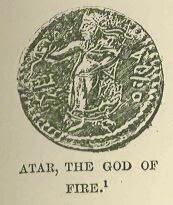
"Atari..... (Avestan ātar) is the Zoroastrian concept of holy fire, sometimes described in abstract terms as "burning and unburning fire" or "visible and invisible fire".....In the Avestan language, ātar is an attribute of sources of heat and light, of which the nominative singular form is ātarš, source of Persian āteš (fire). It was once thought to be etymologically related to the Avestan āθrauuan / aθaurun (Vedic atharvan), a type of priest, but that is now considered unlikely (Boyce, 2002:16). The ultimate etymology of ātar, previously unknown (Boyce, 2002:1), is now believed to be from the Indo-European *hxehxtr- 'fire'. This would make it related to the Latin ater (black) and either a loan source or cognate of the Serbian ватра / vatra (fire) (also of the Romanian vatră (hearth, home, fireplace), of possible Dacian or Paleo-Balkanic origin), which sets Serbian apart from other Slavonic languages, e.g. Russian (огонь = "fire"; Serbian also has огањ - "fire", but it is mostly poetic). The yazata Atar may not be of Indo-Iranian origin (Dhalla 1938:174).".....In later Zoroastrianism, ātar (in middle Persian: ādar or ādur) is iconographically conflated with fire itself, which in middle Persian is ātaxsh, one of the primary objects of Zoroastrian symbolism."

Atar, fire under its principal forms, divine fire, sacred fire, and earthly fire .....coin of King Kanishka

"Zariaspa, which is either an alternate name for Balkh or a term for part of the city, may derive from the important Zoroastrian fire temple Azar-i-Asp...... The period between 26th and 20th century BC was the most important period in the history of Balkh; it's in this relatively short period that a kingdom was established, then the population started to disperse and the kingdom started to shrink until the Median and Persian empires in 700 BC, around 1000 years later.".....The Greeks in Bactria and India. William Woodthorpe Tarn. 1938.

French Buddhist Alexandra David-Néel associated Shambhala with Balkh in present day Afghanistan, also offering the Persian Sham-i-Bala, "elevated candle" as an etymology of its name.... David-Néel, A. "Les Nouvelles Littéraires";1954, p.1

"....the Gurdjieffian J. G. Bennett published speculation that Shambalha was Shams-i-Balkh, a Bactrian sun temple......Bennett, J.G: "Gurdjieff: Making a New World"...Published April 1st 1976 by HarperCollins Publishers (first published 1973)

"The Bundahishn, a Zoroastrian view of creation finished in the 11th or 12th century AD, states that the Great Fires had existed since creation.....the Great Fires were also symbols of imperial sovereignty......these three "Royal Fires" are said to have mirrored social and feudal divisions: "The fire which is Farnbag has made its place among the priests; ... the fire which is Gūshnasp has made its place among the warriors; ... the fire which is Būrzīn-Mitrō has made its place among agriculturists" (Denkard, 6.293). These divisions, from an archaeological point of view, are most revealing, since from at least the 1st century BCE onwards, society was divided into four, not three, feudal estates....The Farnbag fire (translated as 'the fire Glory-Given' by Darmesteter) was considered the most venerated of the three because it was seen as the earthly representative of the Atar Spenishta, 'Holiest Fire' of Yasna 17.11 and described in a Zend commentary on that verse as "the one burning in Paradise in the presence of Ohrmazd....The location of the Mithra fire, i.e. that of Burzen-Mihr, Jackson "identified with reasonable certainty" at being near the village of Mihr half-way between Miandasht and Sabzevar on the Khorasan road to Nishapur (Jackson, 1921:82)."...http://en.wikipedia.org/wiki/Fire_temple

"The Arab geographers Yaqubi and Moqaddasi (9th and 10th centuries) depict Balkh as it was under Samanid rule, whe Bukhara was the center of power. A large and prosperous city of mud brick some three square miles in area, it held perhaps 200,000 persons. It was surrounded by mud-brick walls pierced by seven gates. A splendid Friday Mosque occupied the center, and many more mosques were scattered among the dwellings. The fire temple in the suburbs, which Xuanzang had admired when it was a Buddhist monastery, was still noteworthy."

"Iranians also refrained from contaminating the four elements. They would not bathe nor wash dirty objects in flowing water, and urinating or spitting into water was considered a great sin. Materials that were foul smelling or that generated smoke were never thrown into the fire, and the fire-holder was always kept clean. The earth and the soil were kept free from pollution and for this reason, the dead were placed on high ground and became food for birds and carnivores. Wild rue and frankincense were always burned inside houses and around the neighborhood so the air would smell good, and insects and bacteria would die. These customs are still practiced by Iranians and other nations, with some people also burning wild rue to repel envy and to cure the sick."

"The Vedic mode of worship (1500- 500 BC) was worship of the elements like fire and rivers, and the worship of heroic gods....Specific rituals and sacrifices of the Vedic religion include, among others:
The Soma rituals, which involved the extraction, utility and consumption of Soma....the Agnistoma or Soma sacrifice
Fire rituals involving oblations (hair): the Agnihotra or oblation to Agni, a sun charm.....the Agnicayana, the sophisticated ritual of piling the fire altar."

"Zoroastrian Ātashkada (fire-temple) Naubahār in Balkh, north Afghanistan......Ātashkada Naubahār is one of the oldest Zoroastrian Ātashkada in the world. It is located in Balkh, north Afghanistan. Balkh (Avestan: Bakhdi, Old Persian: Bakhtrish, Latin: Bactria) is believed to be the birthplace of Zoroastrianism, one of the world's earliest monotheistic religions."

http://www.youtube.com/watch?v=gafG7kcG1Lo

"Zoroastrian ceremonies are primarily of two types: ceremonies of the outer and inner circles. Ceremonies of the outer circle are ceremonies that can be performed outside a temple and in some cases by the laity. Ceremonies of the inner circle are ceremonies that are always performed within a temple and more specifically inside the pavi areas of the temple.....Ceremonies of the Outer Circle may be performed outside the pavi area (inner sanctum) of a fire temple.....The ceremonies performed in homes or public fires often require temporary fires as part of the ceremony. These fires are the Atash Dadgah - originally the court fire......Ceremonies of the outer circle such as the Afringan and jashan ceremonies employ the Atash Dadgah, a fire that is lit when required and maintained for the duration of the ceremony. The Atash Dadgah is consecrated with a recitation of the Atash Niyaesh as a prelude to the ceremony. .....Priests wear white as a symbol of cleanliness and light. They cover their mouths to prevent their breath from reaching the flame. They also sit on a white sheet spread on the floor...all Zoroastrian religious ceremonies are conducted on a white linen sheet, called a sofreh, spread on the floor. The sofreh represents the sacred space during the ceremony.."....http://www.heritageinstitute.com/zoroastrianism/ceremonies/liturgy.htm

"From Herodotus it is known that in the mid-5th century BCE the Zoroastrians worshipped to the open sky, ascending mounds to light their fires (The Histories, i.131). Strabo confirms this, noting that in the 6th century, the sanctuary at Zela in Cappadocia was an artificial mound, walled in, but open to the sky (Geographica XI.8.4.512).".....http://en.wikipedia.org/wiki/Fire_temple

"Of the Denkart, or Acts of the religion, only Books III-IX, containing about 169,000 words, were discovered at Bagdad in 1020.......One section informs us that the Farnbag fire is put in the position of priests, the Gushnasp fire in that of warriors, and the Burzinmihr fire in that of agriculturists. ....."....http://www.farvardyn.com/pahlavi2.php

"The Farnbag, Gushnasp, and Burzen-Mihr fires were connected, respectively, with the priests, the warriors, and the farmers. The Farnbag fire was at first in Khwārezm, until in the 6th century bc, according to tradition, Vishtāspa, Zoroaster’s protector, transported it to Kabulistan; then Khosrow in the 6th century ad transported it to the ancient sanctuary of Kariyan in Fars....".....http://www.britannica.com/EBchecked/topic/249753/Gushnasp-fire

"Following the Battle of al-Qādisiyyah (636 CE) and the Battle of Nihawānd (642 CE), both of which were instrumental to the collapse of the Sassanid Empire and state-sponsored Zoroastrianism, most fire temples in Greater Iran were either destroyed or converted into mosques. Many Zoroastrians fled, (according to one legend) taking a fire with them....According to Parsi legend, when (over a thousand years ago) one group of refugees from (greater) Khorasan landed in Western Gujarat, they had the ash of such a fire with them. This ash, it is said, served as the bed for the fire today at Udvada. (Boyce & Kotwal, 2006)".....http://en.wikipedia.org/wiki/Fire_temple

"The oldest remains of what has been identified as a fire-temple are those on Mount Khajeh, near Lake Hamun in Sistan. Only traces of the foundation and ground-plan survive and have been tentatively dated to the 3rd or 4th century BCE......

"Adur Gushnasp in Media Minor ....Although "in the eyes of [contemporary] Iranian Zoroastrian priests, the three fires were not 'really existing' temple fires and rather belonged to the mythological realm" (Stausberg, 2004:134), several attempts have been made to identify the locations of the Great Fires. In the early 20th century, A. V. Jackson identified the remains at Takht-i-Suleiman, midway between Urumieh and Hamadan, as the temple of Adur Gushnasp. The location of the Mithra fire, i.e. that of Burzen-Mihr, Jackson "identified with reasonable certainty" at being near the village of Mihr half-way between Miandasht and Sabzevar on the Khorasan road to Neyshabur (Jackson, 1921:82). The Indian (lesser) Bundahishn records the Farnbag fire having been "on the glory-having mountain which is in Khwarezm" but later moved "upon the shining mountain in the district of Kavul just as it there even now remains" (IBd 17.6). That the temple once stood in Khwarezm is also supported by the Greater (Iranian) Bundahishn and by the texts of Zadsparam (11.9). However, according to the Greater Bundahishn, it was moved "upon the shining mountain of Kavarvand in the Kar district" (the rest of the passage is identical to the Indian edition). Darmesteter identified this 'Kar' as Kariyan in Pars (Persia proper), "celebrated for its sacred fire which has been transported there from Khvarazm as reported by Masudi" (Jackson, 1921:89). If this identification is correct, the temple of the Farnbag fire then lay 10 miles southwest of Juwun, midway between Jahrom and Lar..".....http://en.wikipedia.org/wiki/Fire_temple

The Impact of Seleucid Decline on the Eastern Iranian Plateau......by Jeffrey D. Lerne

"A fire temple in Zoroastrianism is the place of worship for Zoroastrians, often called Dar-e Mehr (Persian) or Agiyari (Gujarati). In the Zoroastrian religion, fire (see Atar), together with clean water (see Aban), are agents of ritual purity. Clean, white "ash for the purification ceremonies [is] regarded as the basis of ritual life," which, "are essentially the rites proper to the tending of a domestic fire, for the temple [fire] is that of the hearth fire raised to a new solemnity" .....Today, there are 50 fire temples in Mumbai, 100 in the rest of India, and 27 in the rest of the world."....Boyce, Mary (1993), "Dar-e Mehr", Encyclopaedia Iranica

"Soma seems to have been used only as part of a fire-ritual. A golden liquid was expressed from the plant material with "soma-stones", filtered through wool and collected in a large bowl or "vat". In the course of this ritual a portion of the soma potion was used as a libation and was "sacrificed" to the flames. The remainder of the soma-liquid was apportioned among the celebrants who received it in individual bowls......Occasionally in the Vedas, and frequently in post-Vedic literature such as the story of the "churning of the ocean", the soma-liquid is known as amrita. This is especially so in the literature of Buddhism where the name soma is almost unknown. Soma is also the name of a god, considered by Hindus to be the divine personification both of the soma-drug and of the moon. The moon was thought to be the receptacle of soma from which it is consumed (presumably over a monthly period) by the gods and ancestors.......Compared to the Brahmanic rituals of later eras this fire-ritual was a very simple affair which has more in common with shamanic practices than the elaborate structures of organized religion. There are three main gods invoked in the Rigveda: Agni (god of fire), Soma (moon-god and personification of the soma drug), and Indra (sky-god and king of the gods). As the Rigveda states that (a) Indra enjoys the effects of soma and that (b) he who consumes the soma potion becomes god-like, perhaps it would not be straining the symbolism too far to say that in these three gods we have the three basic elements of the ritual, Agni (the sacrificial flames), Soma (the sacrificial offering) and Indra (the celebrant, rendered "divine" by the consumption of soma)......That the ritual is of Aryan origin rather than an indigenous Indian one is attested to by the existence of the similar haoma fire ritual in ancient Persia and in the Zoroastrian (Parsi) religion. The Indian fire-ritual was, in later times, taken up by Tantric Buddhists and, as a part of Vajrayana Buddhism, was carried into Tibet, Mongolia, China and even as far as Japan where it is known as goma."......http://www.erowid.org/plants/amanitas/amanitas_writings1.shtml

**************************

Email....okarresearch@gmail.com

John Hopkins.....Northern New Mexico….December 2012

**************************

Saturday, December 1, 2012

Tagzig Olmo Lung Ring & The Kingdom of Shambhala

**************************

Click Here to View the Main Index

Email....okarresearch@gmail.com

**************************

"Lopon Tenzin Namdak and other Bonpo Lamas I have spoken to have identified 'Ol-mo lung-ring with Shambhala. For a discussion of Shambhala in the Tibetan tradition in general, both Buddhist and Bonpo, see Bernbaum, The Way to Shambhala, op. cit.".....http://vajranatha.com/articles/traditions/dzogchen.html?start=5

..."Tonpa Shenrab was born at the palace Barpo Sogye of Tagzig Olmo Lung Ring."....http://gyalshen.org/history-of-bon-2/

'Ol-mo lung-ring Mandala
Source: http://kwling.org/bon/history/.....by Latri Khenpo Nyima Dakpa Rinpoche

".....the country of Olmo Lung-ring where Tonpa Shenrab descended from the celestial spheres and took up incarnation among human beings as an Iranian prince. The mysterious land of Olmo Lung-ring ('ol-mo lung-rings) or Olmoling ('ol-mo'i gling) is said to be part of a larger geographical region to the northwest of Tibet called Tazig (stag-gzig, var. rtag-gzigs), which scholars identify with Iran or, more properly, Central Asia where in ancient times Iranian languages such as Avestan and later Sogdian were spoken. According to the "gZer-mig" the traditional etymology of the name Olmo Lung-ring is as follows: '"ol" means "unborn", "mo" "undermined", "lung" "the prophetic words of Shenrab", and "rings" "everlasting compassion". According to the "gZi-brjid", Olmo Lung-ring was also known as Shambhala in Sanskrit and it continues to be known by this name among Tibetan Buddhists even today. Moreover, it is said that in ancient times it encompassed fully one-third of the known world a statement which could apply to the historical Persian empire."....OLMO LUNG-RING: THE IMPERISHABLE SACRED LAND....by Vajranatha

"......they put the birth of Tonpa Shenrab in distant Tazig, a fabulous land of legend, which recalled the Persian empire which the Tibetans much admired in the seventh century. ".........OLMO LUNG-RING: THE IMPERISHABLE SACRED LAND....by Vajranatha

Shenlha Odkar personifies one of the three main aspects of Tonpa Shenrab:......Deity (lha) is Shenlha Odkar......Priest (shen) is Tonpa Shenrab.....Creator (srid) is Sangpo Bumpti.....Shenlha Odkar is the deity of Supreme Compassion. Out of his compassion the Bön teachings and practices have grown to assist all sentient beings on the path to liberation. He is the master teacher of all teachers. So that teaching has become his primary activity. Wodkar means "white light" and his natural body is pearlescent, the body of perfection (dzo ku). Shenlha Odkar is always dressed in elaborate, ceremonial robes with his hands in the meditation mudra. He sits on a throne supported by two snow lions which represent Shenlha Odkar’s supremacy over all life forms....Shenlha Odkar Mantra:......"A OM HUNG AA A KAR SA LE OH A YANG OM DHU!".....http://bon-encyclopedia.wikispaces.com/Shenlha+Odkar

Shenlha Odkar.....Source: http://www.bonpo-arts.com/shenla_okar.html

"In all of the early Bonpo texts Olmo Lung-ring is clearly located to the west and the north of Tibet in Tazig or Central Asia. Moreover, there are two Tazigs, one of a heavenly nature and one quite physical, located in Central Asia. ".....http://bonpo.wordpress.com/who-is-buddha-tonpa/

Click on the map to enlarge....http://www.iranicaonline.org/articles/art-in-iran-vi-pre-islamic-eastern-iran-and-central-asia

"...according to the "gZi-brjid", Dimpling is the same as Shambhala...."........OLMO LUNG-RING: THE IMPERISHABLE SACRED LAND....by Vajranatha

"Olmo Lung-ring or Shambhala, this imperishable sacred land, which is the spiritual center of the world, existed on earth from the very beginning of the human race. It was the place where the celestial gods of the Clear Light ('od gsal lha) descended from heaven to earth in order to take up incarnation as human beings and ensoul the physical bodies which had been prepared for diem...."......http://bonchildren.tonkoblako-9.net/en/jewel2/03.tan

"The Bonpo account of the hidden land of Olmo Lungring is found in the “gZer-mig” and the “gZi-brjid”. There it is explained that Olmoling is physically part of our world and is not an imaginary holy land nor a celestial pure realm like the Sukhavati or Dewachan (bde-ba-can) of the Buddha Amitabha. Symbolically Olmo Lungring is the geographical, psychic, and spiritual center of our world of Jambudvipa (`dzam-bu`i gling) and at its center rises the holy mountain of nine levels, known as Yungdrung Gutseg (g.yung-drung dgu-brtsegs), which links heaven and earth. It is a kind of axis mundi connecting three planes of existence- the heaven worlds, the earth, and the nether regions. Therefore, Olmo Lungring possesses a different ontological status than ordinary geographical regions and countries. In terms of our own age, it is a hidden land or “beyul” (sbas-yul), inaccessible to all but realized beings or Siddhas. This land is said to be inhabited by Vidyadharas (rig-`dzin) or holders of esoteric knowledge. It exists on earth, but it is not an ordinary country or nation which could be observed from an orbiting satellite or sighted from a high flying airplane, for it possesses a special reality all its own. It is in this world, but not quite of it. It is part of our physical geographical world because it is located in Tazig, yet it partly exists in another spiritual dimension, and although material, it is in a certain sense imperishable and indestructible. When, at the end of the kalpa, the world will be destroyed and consumed by fire, Olmo Lungring will spontaneously rise up and ascend into the sky and there it will merge with its celestial archetype in the heavens which is called Sidpa Yesang (srid-pa ye-sangs). Olmo Lungring is truly the imperishable sacred land.".....Olmo Lungring: the imperishable sacred land.....BON CHILDREN

"Olmo Lungring or Shambhala, this imperishable sacred land, which is the spiritual center of the world, existed on earth from the very beginning of the human race."......bonchildren.tonkoblako-9.net/en/jewel2/03.tan

"...Tonpa Shenrab was bom a prince in Olmo Lung-ring and he emerged from there, crossing barriers of hot arid deserts and frigid glacial mountains, to visit briefly Zhang-zhung and Tibet. ...".....A Collection of Studies on Bon...... by wtemple

"Although the "gZi-brjid" specifically identifies Olmoling and Shambhala, neither in the "gZi-brjid" nor the "gZer-mig" is there any mention of Armaggedon or the climactic battle between the forces of the Mlecchas from the West and the forces of Shambhala led by the Kulika Rudrachakrin, as is found in the Buddhist recension of the "Kalachakra Tantra". The Bonpo canon also possesses a variant recension of this "Kalachakra Tantra", but it is said to be incomplete and it is classified as Kriya Tantra rather than Anuttara Tantra, as is the case in the Buddhist system.".....www.surajamrita.com/bon/Shambala.html

"This land is said to be inhabited by Vidyadharas (rig-'dzin) or holders of esoteric knowledge. It is in this world, but not quite of it. It is part of our physical geographical world because it is located in Tazig, yet it partly exists in another spiritual dimension, and although material, it is in a certain sense imperishable and indestructible."....http://bonpo.wordpress.com/who-is-buddha-tonpa/

"Tazig was said to have been inhabited by the "sTag-gzig hos rigs", the royal race (rgyal rigs) of the "Hos" or Persians (the Chinese "Hu"). But in an even earlier time the people belonged to the lineage of the "rGyal-bu 'thing-ge". And in the "Ma-rgyud" is found the story of the emperor Gyer-wer of Tazig who ruled most of the known world.".....http://www.freesangha.com/forums/the-tibetan-connection-(general)/re-pure-land-practices-why/30/?wap2

"The country is divided by rivers, chiefly nine in number, which flow into the four directions. From the foot of the sacred mountain flow four great rivers of special importance, originating from four springs that issue forth from four rocks having the shapes of symbolic animals. The river Nara arises from a spring in a lion-shaped rock (sen-ge kha 'babs) and flows to the east. The river Pakshu arises from a spring in a horse shaped rock (rta mchog kha 'babs) and flows to the north. The river Kyim-shang arises from a spring in a peacock-shaped rock (rma bya kha 'babs) and flows to the west. And the river Sindhu arises from a spring in an elephant-shaped rock (glang-chen kha 'babs) and flows to the south."....bonchildren.tonkoblako-9.net/en/jewel2/03.tan

from the simulacrum of a snowlion the river Narazara flows from the East;
from the simulacrum of a horse the river Pakshi flows from the North;
from the simulacrum of a peacock the river Gyim Shang flows from the West; and
from the simulacrum of an elephant the river Sindhu flows from the South.
...en.wikipedia.org/wiki/Tagzig_Olmo_Lung_Ring

"The land is filled with a complex pattern of shining cities, temples and palaces, parks and pleasure groves, lakes and bathing pools, like the descriptions of Shambhala found in the Buddhist tradition. It is truly an earthly paradise. Around the base of the sacred mountain in the center are literally hundreds of cities, palaces, and temples, but among them there are four, which are especially important. To the east of the mountain is the shining white temple of Shampo Lhatse (sham-po lha rtse). To the south is the great palace of Barpo Sogyad (bar-po so-brgyad) where Tonpa Shenrab's had lived and he was born. To the west is the palace of Trimon Gyalzhad (khri-smon rgyal-bzhad), where the chief queen of Tonpa Shenrab, Ho-za Gyalzhadma (Hos-bza* rGyal-bzhad-ma) had lived and where three of his children were born, namely, Tobu (gTo-bu), Chyadbu (dPyad-bu), and Ne'u-chen. And to the north is the palace of Khong-ma ne'u-cnung where another one of his queens, Po-za Thangmo (dPo-bza' thang-mo) lived and three more of his children were born, namely, Lungdren (Lung-'dren), Gyuddren (rGyud-'dren), and Ne'u-chung.".....The Founder of Bön and His Teachings.......by John Myrdhin Reynolds

"Within the territory of Olmo Lung-ring there are seven royal races (rgyal rigs) and chief among them is the clan of Mushen (dmu-gshen) from which Tonpa Shenrab descended. Thus the word "gshen" is also the name of a clan, as well as the term for a kind of practitioner. Besides the Mushen, there were six more royal races or clans (rgyal rigs) ruling in Olmo Lung-ring: "Hos", "Shag", "dPo", "rGya", "gTo", and "gNyan". There are also classes of ministers, merchants, artisans, commoners, and so on."....http://www.sacred-texts.com/bud/tib/orgibon1.htm

SACRED GEOGRAPHY..."Concerning the relationship between sacred geography and physical geography..."the contours of this sacral geography show remarkable similarities with the mythical 'Ol mo lung ring', surrounded by a wall of mountains." (Blondeau: 1996..pg 103)..

"The Bonpo account of the hidden land of Olmo Lungring is found in the “gZer-mig” and the “gZi-brjid”. There it is explained that Olmoling is physically part of our world and is not an imaginary holy land nor a celestial pure realm like the Sukhavati or Dewachan (bde-ba-can) of the Buddha Amitabha. Symbolically Olmo Lungring is the geographical, psychic, and spiritual center of our world of Jambudvipa (`dzam-bu`i gling) and at its center rises the holy mountain of nine levels, known as Yungdrung Gutseg (g.yung-drung dgu-brtsegs), which links heaven and earth. It is a kind of axis mundi connecting three planes of existence- the heaven worlds, the earth, and the nether regions. Therefore, Olmo Lungring possesses a different ontological status than ordinary geographical regions and countries. In terms of our own age, it is a hidden land or “beyul” (sbas-yul), inaccessible to all but realized beings or Siddhas. This land is said to be inhabited by Vidyadharas (rig-`dzin) or holders of esoteric knowledge. It exists on earth, but it is not an ordinary country or nation which could be observed from an orbiting satellite or sighted from a high flying airplane, for it possesses a special reality all its own. It is in this world, but not quite of it. It is part of our physical geographical world because it is located in Tazig, yet it partly exists in another spiritual dimension, and although material, it is in a certain sense imperishable and indestructible. When, at the end of the kalpa, the world will be destroyed and consumed by fire, Olmo Lungring will spontaneously rise up and ascend into the sky and there it will merge with its celestial archetype in the heavens which is called Sidpa Yesang (srid-pa ye-sangs). Olmo Lungring is truly the imperishable sacred land......Olmo Lungring or Shambhala, this imperishable sacred land, which is the spiritual center of the world, existed on earth from the very beginning of the human race.".....bonchildren.tonkoblako-9.net/en/jewel2/03.tan

"Tagzig Olmo Lung Ring is a non-dual spiritual realm (plane or dimension) of the Bon tradition which resides beyond dualism. It is understood to be a timeless perfected realm where peace and joy are the very fabric of being. This country-name rTa-gzig is believed to be a form of the name Tajik; while the Ol-mo-lung-ring is believed to be a form of the name of the city Olmaliq (now reckoned as being within Uzbekistan, but formerly included within Tajik-istan). The Beyul realm of Tagzig Olmo Lung Ring is fabled to be located to the west of Mount Kailash and shaped like an eight-petaled lotus and divided into four regions: inner, middle, outer and boundary area. The sky of this realm is likened to an eight-spoked wheel (refer Dharmachakra) and the land itself is fragrant and coloured by beautiful flora and landscaping, chorten and snow-capped mountains. Central to Tagzig Olmo Lung Ring is Yungdrung Gutsek, a pyramidal-shaped mountain serving as axis mundi with nine Yungdrungs[2] (refer sauwastika) ascending like a staircase evocative of the Nine Ways (or stages) of Bon. The four faces of the pyramidal mountain, face the four cardinal directions. At the corner-joints of Yungdrung Gutsek (cross-quarter directions) four rivers flow from simulacra of archetypal thoughtforms:
from the simulacrum of a snowlion the river Narazara flows from the East;
from the simulacrum of a horse the river Pakshi flows from the North;
from the simulacrum of a peacock the river Gyim Shang flows from the West; and
from the simulacrum of an elephant the river Sindhu flows from the South.
......http://en.wikipedia.org/wiki/Tagzig_Olmo_Lung_Ring

Okar Research Map.....Click on the map to enlarge.

**************************

Email....okarresearch@gmail.com

John Hopkins.....Northern New Mexico….December 2012

**************************